
Linear Velocity and Acceleration
Key facts
Velocity is the rate of change of position with respect to time:
Acceleration is the rate of change of velocity with respect to time:
If is the initial velocity,
the final velocity, and
the distance traveled in a time
, then:
and
An introduction to linear velocity and acceleration, also taking into account the particular case of constant acceleration
You're viewing an older version of this page (#3688). View the current version.
Introduction
In order to define linear velocity, consider a particle moving in a straight line from a fixed point , as diagramed in Figure 1.
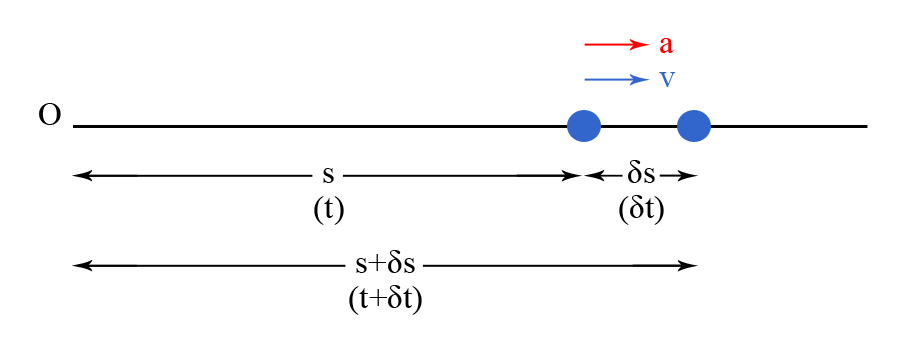
At a time let the distance from
be
, and at a time
let the distance increase to
. So over a time of
the particle traveled the distance
, from which it can be seen that the average rate of displacement from
, or average velocity, is
. The velocity at time
is defined as the limiting value of this quantity as
:
Thus, velocity can be defined as the rate of change of position with respect to time.
Similarly, it can be shown that acceleration, which is the rate of change of velocity with respect to time, is , or, expressed in a different form,
. Acceleration can also be written in a third form which is independent of time. For example, by expressing the acceleration as:
and taking into account (#1), we get:
Hence, acceleration may be expressed in any of the following three forms:
It is usual in Mechanics to denote differential coefficients with respect to time by dots placed above the dependent variables, so that notations as for example ,
,
, and
can also be denoted by
,
,
, and
respectively.
Constant Acceleration
Let be the initial velocity,
the final velocity,
the acceleration, which in this case is a constant,
the distance traveled in a time
, and
the time.
We previously saw that the acceleration can be written as . As in this case
is constant, by integrating
with respect to
, we get:
In this equation at ,
becomes
, and so the constant equals
. Thus, (#2) becomes:
Integrating again with respect to , and considering that
, we get:
In this equation at ,
becomes
, and thus the constant equals
. Hence, (#3) becomes:
Integrating this equation with respect to , and considering that
, we get:
As at ,
becomes
, the constant becomes
. Thus (#4) becomes:
\calc{(v^2-u^2)/2s} "Instant calculator eq(10)"
Example 1 [imperial]
The driver of an express train traveling at 60 mph sees, on the same track, 600 ft in front of him, a slow train traveling in the same direction at 20 mph.
What is the least retardation that must be applied to the express to avoid a collision?
For the express train, , and
. Taking into account that
, we get:
In a time the slow train will have traveled a distance of
. The express train will have gone further and will have traveled
:
Moreover, considering that , we get:
Combining (#1) and (#2), we thus obtain:
from which:
Example 2 [metric]
The driver of an express train traveling at 100 kph sees, on the same track, 200 m in front of him, a slow train traveling in the same direction at 30 kph.
What is the least retardation that must be applied to the express to avoid a collision?
For the express train, , and
. Taking into account that
, we get:
In a time the slow train will have traveled a distance of
. The express train will have gone further and will have traveled
:
Moreover, considering that , we get:
Combining (#1) and (#2), we thus obtain:
from which:
Further examples of constant acceleration can be seen in Frictionless Projectiles .