
Examples showing how various functions can be integrated

View versions (4)

Introduction

The following methods of Integration cover all the Normal Requirements of A.P.; A. level; The International Baccalaureate as well as Engineering Degree Courses.

It does not cover approximate methods such as The Trapezoidal Rule or Simpson's Rule.

Simple Algebraic equations

\int x^n\:dx = \frac{1}{n+1}\:x^{n+1} + C

Except when n = -1 Then \int \frac{dx}{x} = \ln\,x + C

Rational Algebraic Functions whose Denominator Factorizes

Here is a worked example

\int \frac{x}{(x\:-\:1)(x-2)}\:dx= \int \left( \frac{-\,1}{x\:-\:1}\:+\:\frac{2}{x\:-\:2} \right)\:dx

=-\ln(x\:-\:1)\:+\:2\,\ln(x-2) + C

= \ln\left[K\frac{(x\:-\:2)^2}{(x-1)} \right] + C

Rational Algebraic Functions whose Denominators do not Factorize

\int\frac{f^{'}(x)}{f(x)} = \ln\:f(x) + C Here are some examples

\int \frac{2\,x+3}{x^2+3\,x+7}\;dx = \ln(x^2\:+\:3x\:+\:7) + C \int \frac{a}{x^2+a^2}\:dx = tan^{-1}\left (\frac{x}{a}\right ) + C

Example 1
Problem

\int \frac{1}{x^2\:+\:8x\:+\:25}\,dx

Workings

= \frac{1}{3}\int \frac{3}{(x+4)^2+3^2}\:dx

Solution

= \frac{1}{3}\:tan^{-1}\left (\frac{x\:+\:4}{3}\right ) + C

Irrational Algebraic Fraction of the following kind

\frac{ax\:+\:b}{\sqrt{px^2+qx+s}}\;\:\:\;where\;p\:\neq\:0

Example 1
Problem

\int \frac{1}{\sqrt{x^2+2x-3}}\; dx

Workings

= \int \frac{1}{\sqrt[]{(x+1)^2-4}} =cosh^{-1}(\frac{x+1}{2}) + C

Solution

Other forms \int \frac{b}{(x + a)^2-d^2}\:dx = b \cosh^{-1} \frac{x + a}{d} \int \frac{b}{\sqrt[]{(x+a)^2+d^2}} = b \sinh^{-1} \frac{x + a}{d} \int \frac{b}{\sqrt[]{d^2-(x+a)^2}} = b \sin^{-1} \frac{x + c}{d}

An Irrational Function

\int \frac{\ln\:x}{x}\;dx

\text{let}\;\;\;U = \ln\:x \therefore\;\:\;\frac{dU}{dx} = \frac{1}{x} and dU = x\:dU thus the original equation can now be rewritten as :- \int \frac{\ln\:x}{x}\:dx = \int \frac{U}{x}\:.\:x\:dU

\text{And}\;\;\;\int U\:dU = \frac{1}{2}U^2 + C \therefore\:\;\;\int \frac{\ln\:x}{x}\:dx = \frac{1}{2}(\ln\;x)^2 + C

Example 1
Problem

Find the integral of \frac{\sqrt[]{x^3\:+\:a^2}}{x}\:dx

Workings

let U = \sqrt[]{x^3\:+\:a^2} \therefore\:\:\;U^2\:=\:x^3\:+\:a^2\;\;\;and\:\;\;2U\:\frac{dU}{dx}\:=\:3x^2 \therefore\;\;\;\frac{2}{3}\,U\:dU = x^2\:dx

The integral can now be written as :- \int \frac{U}{U^2\:-\:a^2}\:dU = \frac{2}{3}\int\frac{U^2}{U^2\:-\:a^2}\;dU = \frac{2}{3}\int \left(1\:+\:\frac{a^2}{(U\:-\:a)(U\:+\:a)} \right)dU = \frac{2}{3}\int \left(1\:+\:\frac{\frac{1}{2}a}{U\:-\:a}\:-\:\frac{\frac{1}{2}a}{U\:+\:a} \right)\:dU = \frac{2}{3}\left[U\:+\:\frac{1}{2}\: a\:Ln\:\frac{U\:-\:a}{U\:+\:a}\right]\;+\:C

Solution

=\:\frac{2}{3}\left[\sqrt[]{x^3\:+\:a^2}\:+\:\frac{1}{2}\:a\:Ln\:\frac{\sqrt[]{x^3\,+\:a^2}\:-\:a}{\sqrt[]{x^3\:+\:a^2}\:+\:a} \right]

An Irrational Function Containing

\sqrt[n]{ax\:+\:b}

substitute U = \sqrt[n]{ax\:+\:b}\;\;\;i.e.\;\;\;U^n\:=\:ax\:+\:b \therefore\;\;\;\frac{n}{a}\:\;U^{(n\:-\:1)}\:dU = dx So the integral is now rational in U\:dU

Example 1
Problem

Find the integral of \int \frac{1}{x+\sqrt{2x - 1}}\;dx

Workings

Substitute U=\sqrt{2x - 1} i.e. x=\frac{U^2+1}{2}

Therefore U\:dU = dx \todo Review the following workings

thus the integral can be written as:- \int \frac{1}{\frac{U^2+1}{2}+U}\:dU= 2\,\int \frac{U}{(U^2+1)}dU = 2\int\left(\frac{1}{U+1}-\frac{1}{(U+1)^2} \right) = 2\ln (U+1)+\frac{2}{U+1}+C

Solution

Therefore \int \frac{1}{x+\sqrt{2x-1}}\:dx = 2 \ln \left\{  \sqrt{2x-1} +1 \right\}  +\frac{2}{\sqrt{2x-1} + 1}+ C

Simple Trigonometrical Functions

\int \cos\:x\:dx = sin\:x\:+\:C \int \sin\:x\:dx\:= -\:\cos\:x + C \int \tan\:x\:dx = \ln\:\sec\:x + C \int \sec^2\:x\,dx\:= \tan\:x + C \int \sin^4\:\cos\:x\:dx = \frac{1}{5}\:\sin^5\,x + C

Using Trigonometrical formula

Example 1
Problem

To find the integral of (\cos \:5x\:\cos\:2x)\;dx

Workings

But \cos\:A\:+\:B = 2\:\cos\frac{A\:+\:B}{2}\:\cos\frac{A\,-\:B}{2} from which it can be shown that \int\cos\,5x\:\cos\,2x\:dx = \frac{1}{2}\int (\cos\,7x\:+\:\cos\,3x)\:dx

Solution

=\:\frac{1}{14}\,\sin\,7x\:+\:\frac{1}{6}\sin\,3x + C

Any Trigonometrical formula

To integrate any trigonometrical function such as (\sin\times  \cos x) dx
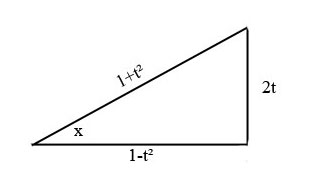
put\;\:\;\;t = tan\:\frac{x}{2} but\:\;\:\;tan\:x\:=\:\frac{2\:tan\,\frac{x}{2}}{(1\:+\:tan^2\:\frac{x}{2})} = \frac{2t}{1\:-\:t^2}

22109/integ.jpg
Example 1
Problem

\int \cosec\:x\:dx = \int \frac{1}{sin\,x}\:dx

Workings

= \int \frac{1}{\frac{2t}{1\:+\:t^2}}\;X\;\frac{2}{1\:+\:t^2}\;dt = \int \frac{1}{t}\:dt = \ln\:t + C

Solution

Therefore \int \cosec\:x\:dx = \ln\,\tan\frac{x}{2} + C

Any Hyperbolic Function

Simple equations

\int \sech^2\:\theta\;d\theta = \tanh\:\theta + C

\int \cosh^2\:\theta\:d\theta=\:\frac{1}{2}\theta\:+\:\frac{1}{4}\:\sinh\:2\,\theta + C

Any hyperbolic equation

\int (\sinh\,\theta\:\cos\,\theta)\:d \theta put\;\:\;\;\;\;U = e^\phi Then \sinh\:\theta = \frac{U\:-\:\frac{1}{U}}{2}\:=\:\frac{U^2\:-\:1}{2U} \cosh\:\phi\:=\:\frac{U\:+\:\frac{1}{U}}{2}\:=\:\frac{u^2\:+\:1}{2U}

Example 1
Problem

\int \sech\:\phi\:d\phi=\int\frac{2U}{1+U^2}\:.\:\frac{1}{U}\:dU

Workings

=\:2\:\tan{_1}\:U+C = 2\:\tan^{-1}\,e^\phi+C

Solution

=\:2\:\tan{_1}\:U\:+\:C\;\; = \;\;2\:\tan^{-1}\,e^\phi\:+\:C

Integration of Irrational Equations of the Following Type using Trigonometrical Substitution

\sqrt{ax^2 + bx + C}

Example 1
Problem

\int \frac{1}{x^2\:\sqrt[]{1\:-\:x^2}}\:dx

Workings

put\;\;\;\;x\:=\:\sin\:\theta\;\;\:and\;\therefore\;\;\;dx\:=\:\cos\:\theta\:d\theta thus\;\;\;integral\:=\:\int \frac{1}{sin^2\theta\:\cos\,\theta}\:\cos\theta\:d\theta =\:\int cosec^2\:\theta\:d\theta

Solution

=\:\cot\:\theta\:+\:C\;\;=\:-\:\frac{\sqrt[]{1\:-\:x^2}}{x}\:+\:C

Integration by Parts

\frac{d\,(uv)}{dx} = u \frac{dv}{dx} + v \frac{du}{dx}

\therefore\;\;\;uv = \int u\:\frac{dv}{dx}\:dx\:+\:\int 
v\:\frac{du}{dx}\:dx
(3)

\int u\:\frac{dv}{dx}\:dx\:=\:uv\:-\:\int v\:\frac{du}{dx}\:dx this can also be written as:- \int \:u (v)^{'}\:dx = u\,v\:-\:\int v\:(u)'\:dx

Example 1
Problem

\int x \cdot cos x\:dx

Workings

=\int x \cdot (\sin x)'\:dx = x \sin x-\int \sin x\:dx

Solution

=x \sin x + \cos x + C

The Integration by Parts twice to regain the Original Integral

This worked example is only visible to registered users. Sign in to see it.