
Principles of Similarity
An analysis of Specific speed, Multi-staging and performance of Centrifugal Pumps under various conditions
You're viewing an older version of this page (#3779). View the current version.
Specific Speed
The Specific Speed of a Centrifugal Pump is the seed in r.p.m.at which a similar model of the Pump would need to run when of such a size as to deliver unit quantity against Unit Head. Each type of Pump ( Radial Flow; Mixed Flow; Axial Flow; etc.) has it's own characteristic value of . Similar includes both dynamic and Geometric similarity. i.e. Similar Velocity triangles; All relevant velocities proportional to each other etc.
But
And
Since
But and
are by definition unity.
Therefore the Specific Speed,
Notes
a) is based on the values of N; Q; and H at the design point. i.e. at maximum efficiency.
b) is not dimensionless and will have different values in the different measuring systems. ( In the foot/slug/second system N is in r.p.m.; H is in feet and Q is in gallons/second)
The Dimensions of are:
Thus could be made dimensionless by dividing by
and it would still be a Constant.
For example, Addison's Shape Number is
c) Comparison of and
(Imperial Units)
Thus for a particular machine
d) Specific Speeds for Differing pump types (Imperial Units)
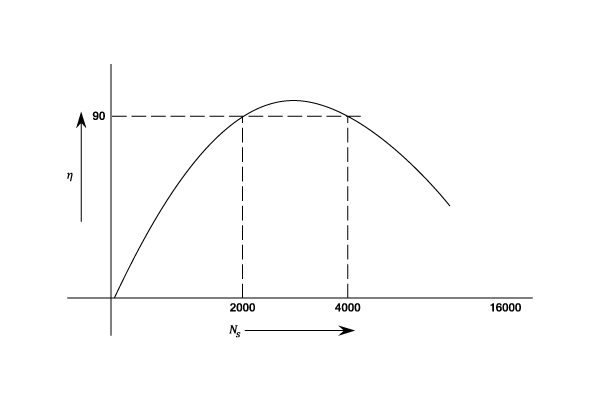
Centrifugal Pumps Type Specific Speed
- Radial Flow 800 - 2000
- Mixed Flow 2000 - 4000
- Axial Flow 4000 - 8000 and Screw Pump
- Propeller Pump 8000 - 16,000 (High Q and Low H)
e) Variation of efficiency with Specific Speed.
f) Multi-Staging.
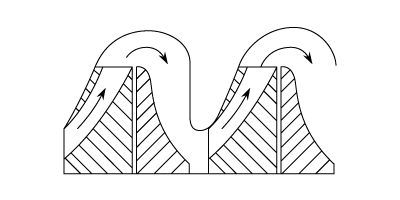
When the head to be developed is too great ( From an efficiency point of view) for a single impeller (about 150 ft.), several impellers in series are mounted on the same shaft. These are usually of the radial flow type. The flow through each stage is the same and the total head developed is divided equally between the stages.
Example 1
It is required to pump 900 gallons per min. through a height of 300 ft. If is 1500 how many stages are required if the motor speed is to be 1200 r.p.m.
and
Therefore Head/Stage is
Thus, the number of stage is:
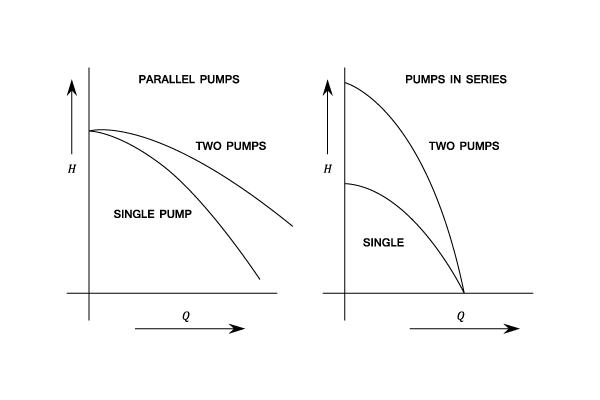
g) Pumps in Parallel When the quantity to be pumped is high and would require a very large pump, several pumps in parallel may be preferred, possibly running on the same shaft. Each must develop the required head and will deliver an equal share of the required discharge.
h) Double Entry (double suction) Impeller
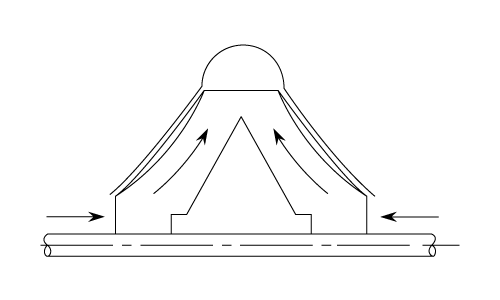
In a single stage pump, double entry impellers are frequently used to overcome the problem of end thrust. For Multistage pumps the single acting impellers can be arranged back to back.
For comparison of specific speeds between single and double acting impellers, the double type is regarded as two single acting impellers back to back. i.e. in the Specific Speed equation the value of Q would be half of the actual value.
Performance of a given Pump under Different Conditions.
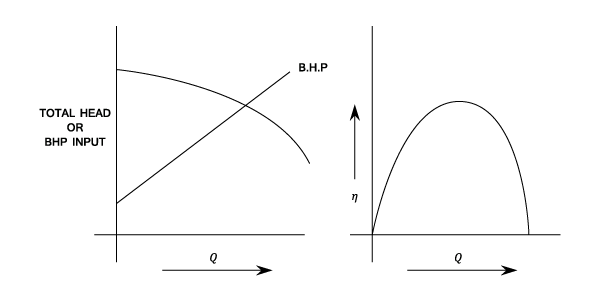
a) The characteristic curves for a Centrifugal Pump are plotted fro a constant speed or on a capacity basis. There is no meas of altering the Guide Vane angles as in a Turbine and the only control is the Delivery Valve. If only one motor speed is possible then there will be only one performance curve.
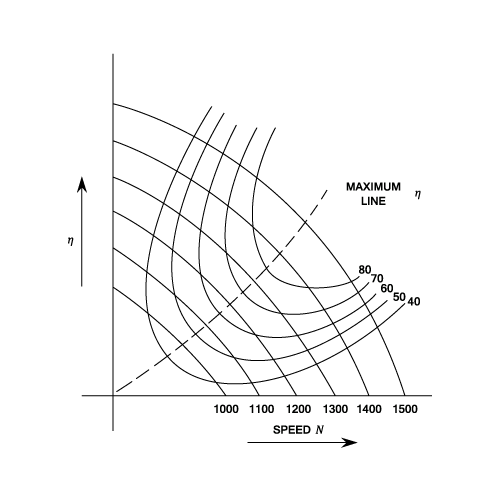
b) Iso-efficiency Curves. If the driving speed of the motor can be vared then tests of the performance at several speeds can be carried out and a chart drawn to show performance at all possible operating conditions.
c) Estimating the performance at different speeds (Unit Conditions)
If the performance curves for a particular pump are known at a particular speed, the corresponding curves can be found at any speed by using similarity conditions.
For dynamically similar conditions:
But
and
And
or
Equations (18)(21) (27) enable the characteristics at any speed to be calculated from test results at a single speed.
Fundamental Similarity Conditions and Model Testing.
Thus
And
and Power input
From equations (29) and (32)
Also from equations (29) and (36) same as above
From Equations ( ) and ( )
And from the same equations.
Example 2
A Pump delivers 400 g.p.m against a head of 110 ft. when running at 1.400 r.p.m. A geometrically similar pump 1.5 times the linear size operates at 1200 r.p.m.
Determine the head and discharge of the larger pump assuming that both pumps are working at their points of maximum efficiency. <table> <tr><td></td><td>Pump1</td><td>Pump 2</td></tr> <tr><td>Discharge Q</td><td>400 g/min.</td><td>?</td></tr> <tr><td>Delivery Head H</td><td>110 ft</td><td>?</td></tr> <tr><td>Speed N</td><td>1400 r.p.m</td><td>1200 rpm</td></tr> <tr><td>( Size) D</td><td>X</td><td>1.5</td></tr> </table>
Assume that the pumps are working under dynamically similar conditions.
From equation (18)
i.e.
therefore
Also from equation (36)
therefore
Limitations of the Simple Impeller Theory
a) secondary Circulatory motion
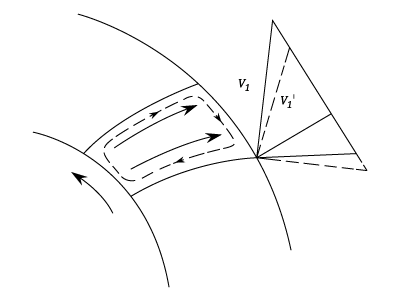
Due to the inertia of water. The water within the passages of the impeller rotate relative to the passage in the opposite direction to that of the impeller rotation. The effect of this is to decrease the effective outlet angle from to
and thus to decrease
to
(
and
remain unchanged)
b) Flow Breakaway
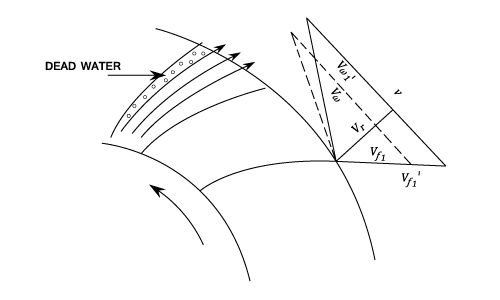
Flow concentrates in the trailing part of the passage, thus leaving an area of dead water behind the vanes. The effect is to increase the velocity of flow from to
and thus to decrease
to
(
and
remain unchanged)
Thus from both (a) and (b) it can be seen that the actual head transmitted by the vanes to the water
is less than that indicated by the Euler Equation which is based on ideal velocity triangles fro an infinite number of Vanes.
This does NOT imply a loss in the head produced or in the efficiency but simply means that both input and output power are less because less power has been transmitted by the vanes to the water.