
Cavitation
An analysis of Cavitation which can lead to loss of performance and physical damage to hydraulic machines.
You're viewing an older version of this page (#3767). View the current version.
The causes of Cavitation
If the pressure in a hydraulic circuit ( Pump; Turbine etc.)falls below the vapour pressure of the liquid at the prevailing temperature, then the liquid will the bubbles are carried down stream until the reach an area of higher pressure where they collapse or implode. This process has two serious consequences.
1) If the bubbles collapse against a solid boundary (Impeller Blades; Vanes; etc.) the inrush of water causes high local impact forces which may cause fracture by fatigue. Alternatively the surfaces may become eroded or pitted and this is particularly the case when Cavitation is combined with Chemical attack from dirty water.
2) The other consequence is that the flow patterns are disturbed by the presence of the bubbles. The area of line flow is reduced and eddies are formed giving rise to vibrations( If a Centrifugal Pump sounds as if it is pumping gravel, the pump is almost certainly cavitating).
Associated with this is a loss of performance and efficiency. In severe cases the pump may stop delivering.
Cavitation can be avoided by reducing the suction lift of a Pump or reducing the height of the Turbine above the Tail Race.
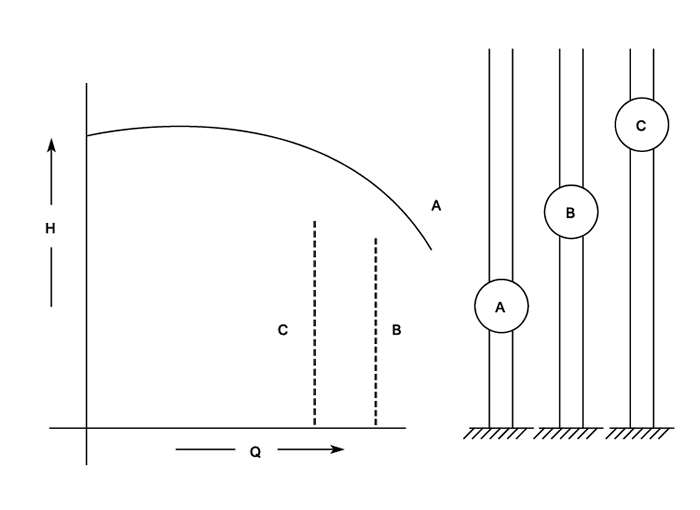
The Effects of Suction Lift on Pump Performance.
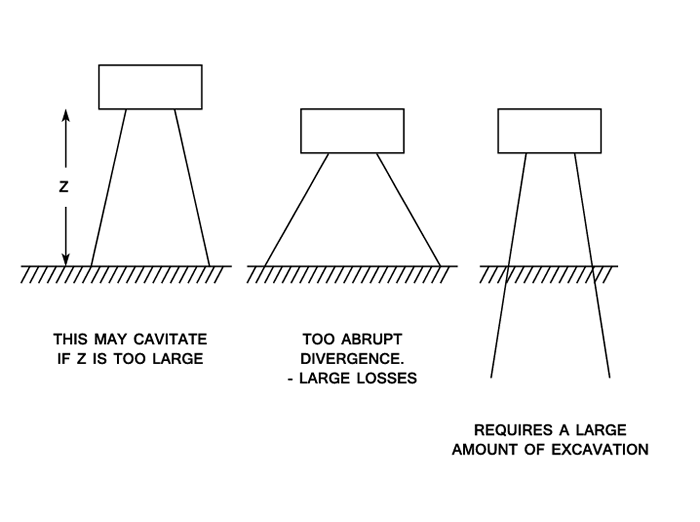
Draft Tube Design for a Turbine
Cavitation Theory for a Pump.
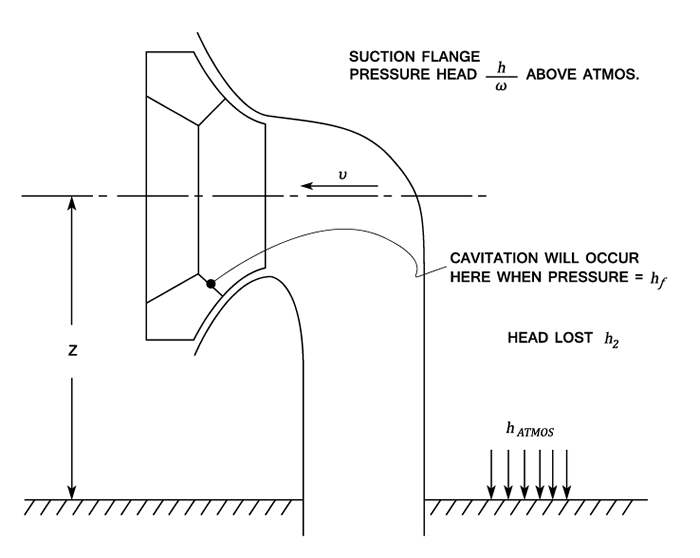
Apply Bernoulli's equation at the Suction flange and at the Water supply surface.
Therefore the Total head at the suction flange with the centre line as the datum is given by:-
The Nett Positive Suction Head ( NPSH )is defined as the Total head at the Suction flange minus the Vapour pressure of water at the prevailing Temperature . It is also known as the Dynamic Depression Head.
The NPSH is the Nett Head available at the Suction Flange to supply the increased velocity head and the losses at entry to the impeller.
Thoma's Cavitation Factor.
When the NPSH fslls to the point where Cavitation occurs then;_
For Suction conditions to be the same for model and Prototype the value of must be equal.
Cavitation Factor for a Turbine.
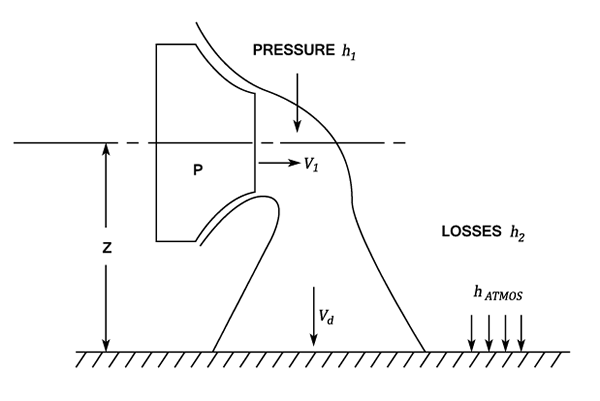
Let be the Water Velocity at entry to the Draft Tube. This equals the velocity at outlet from the runner ( Assuming that there is no whirl)
Applying Bernoulli at the entry to the Draft Tube and the Tail Race surface.
The Velocity Head is converted into Pressure head in the Draft Tube.
i.e. Pressure recovery in the draft tube is
The Draft Tube efficiency or recovery factor
NPSH or the Dynamic depression Head at the entry to the Draft Tube minus the Vapour Pressure of water at the prevailing temperature i.e. The amount by which pressure at the point of lowest pressure (P) may be below and still avoid Cavitation.
The Thoma Cavitation Factor
will be the same for similar machines running under dynamically similar conditions