
Newtons Second Law
Sir Isaac Newton (4 January 1643-31 March 1727 ) was an English physicist, mathematician, astronomer, natural philosopher, alchemist and theologian. His accomplishments in different fields have revolutionized the world.
The newton is the SI unit for force. It is equal to the amount of net force required to accelerate a mass of one kilogram at a rate of one meter per second squared i.e.
A force is any influence that causes a free body to undergo a change in speed, a change in direction, or a change in shape. Force can also be described by intuitive concepts such as a push or pull that can cause an object with mass to change its velocity or which can cause a flexible object to deform.
The relationship between force, mass and acceleration of an object
You're viewing an older version of this page (#3689). View the current version.
Introduction
Newton's second law defines the relationship between force, mass, acceleration:
A body of mass subject to a net force
undergoes an acceleration
that has the same direction as the force and a magnitude that is directly proportional to the force and inversely proportional to the mass, i.e.
.
Example 1 [metric]
A car of mass 800kg is pulling a trailer of mass 200kg along a straight road. The car is connected to the trailer by a tow bar which can be modelled by a light inextensible rod.
The driving force of the car is 2.6kN and the total resistance to motion of the car and trailer is 600N.
Determine the acceleration of the system.
The total mass is .
Using Newton's Second Law we have :
Thus Acceleration
Example 2 [metric]
A car of mass 800kg is pulling a trailer of mass 200kg along a straight road. The car is connected to the trailer by a tow bar which can be modelled by a light inextensible rod.
The driving force of the car is 2.6kN and the total resistance to motion of the car and trailer is 600N.
Given that the reistances of the car and trailer are proportional to their masses.
Determine the tension in the tow bar
As the resistance to motion of the car and trailer are proportional to the masses, then
The Resistance of the car is
The Resistance of the traier is
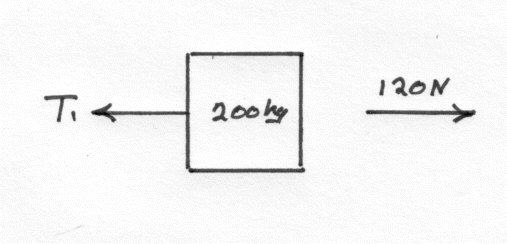
By Newton's Second Law
Therefore the tension in the towbar is
Instead of considering the Trailer we could have applied Newton's Second Law to the Car. In which case:
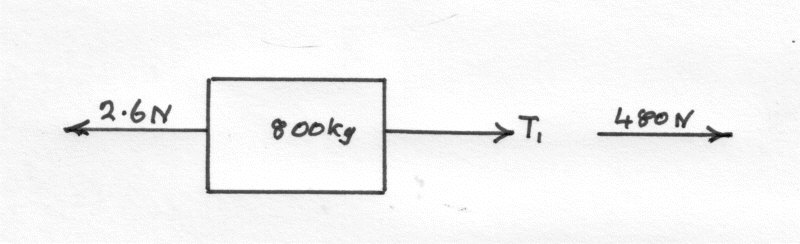
i.e. Exactly the same as before.
Tension in tow bar is .