An analysis of Theoretical Internal Combustion Engines Cycles

You're viewing an older version of this page (#3380). View the current version.

View versions (3)

Internal Combustion Cycles

  • The Working Substance is treated as pure air.
  • Expansions and Compressions are Reversible and Adiabatic.
  • Heat can be added instantaneously if desired.

Air Standard Cycles :-

  • Constant Volume or Otto Cycle - Spark Ignition.
  • Constant Pressure or Joule Cycle - Gas Turbines.
  • Diesel Cycle - Slow Speed Compression Ignition.

THE CONSTANT VOLUME CYCLE
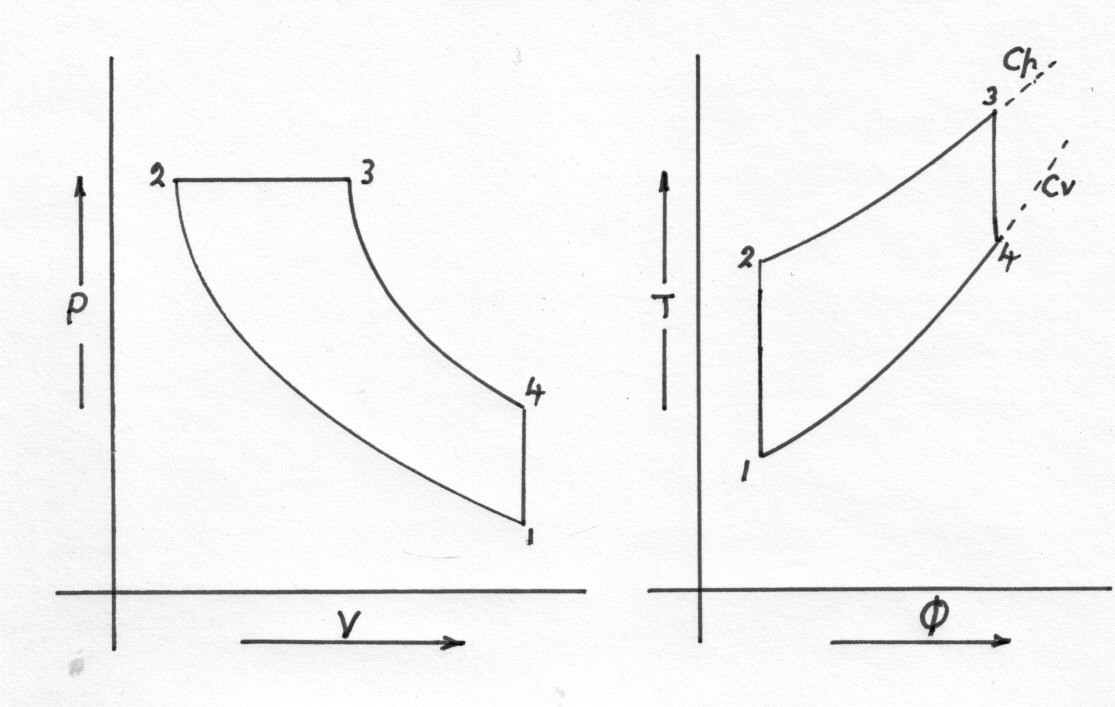
13108/img_therm30.jpg
Blank

The four Stages of this Cycle are:-

  • Adiabatic Compression 1 - 2
  • Heating at Constant Volume 2 - 3
  • Adiabatic Expansion 3 - 4
  • Cooling the WS to it's Original Condition 4 - 1
Thermal\; Efficiency\;=\;\frac{Work\;out put}{Heat\;Supplied}
(1)
=\;\frac{Q_S\;-\;Q_R}{Q_S}
(2)
Heat\;Supplied\;=\;w\;C_V(T_3\;-\;T_2)
(3)
Heat\;Rejected\;=\;w\;C_V(T_4\;-\;T_1)
(4)
\therefore\;\;\;\;\;Thermal\;\eta \;=\;1\;-\;\frac{(T_4\;-\;T_1)}{(T_3\;-\;T_2)}
(5)
But\;\;\;\;\;T_1V_1^{\gamma \;-\;1}\;=\;T_2V_2^{\gamma \;-\;1}
(6)
\therefore\;\;\;\;\;T_2\;=\;T_1\left(\frac{V_1}{V_2} \right)^{\gamma \;-\;1}\;=\;T_1\;r^{\gamma \;-\;1}\;\;\;\;where\;\;\;\frac{V_1}{V_2}\;=\;r
(7)
Similarly\;\;\;\;\;T_3\;=\;T_4\;r^{\gamma \;-\;1}
(8)

From equations (7) and (8)

T_3\;-\;T_2\;=\;r^{\gamma \;-\;1}\;(T_4\;-\;T_1)
(9)
\therefore\;\;\;\;\;\frac{(T_4\;-\;T_1)}{(T_3\;-\;T_2)}\;=\;\frac{1}{r^{\gamma \;-\;1}}
(10)
\therefore\;\;\;\;\;Thermal\;\eta \;=\;1\;-\;\frac{1}{r^{\gamma \;-\;1}}
(11)

NOTE "r" is called the Compression Ratio . For Carburettor Engines it's value is about 7. whilst for Fuel Injector Engines this figure is increased to around 10. Using these figures and a value for \gamma of 1.25, the Thermal efficiency of a petrol/Gasoline engine is between 39% and 44%.

THE CONSTANT PRESSURE CYCLE
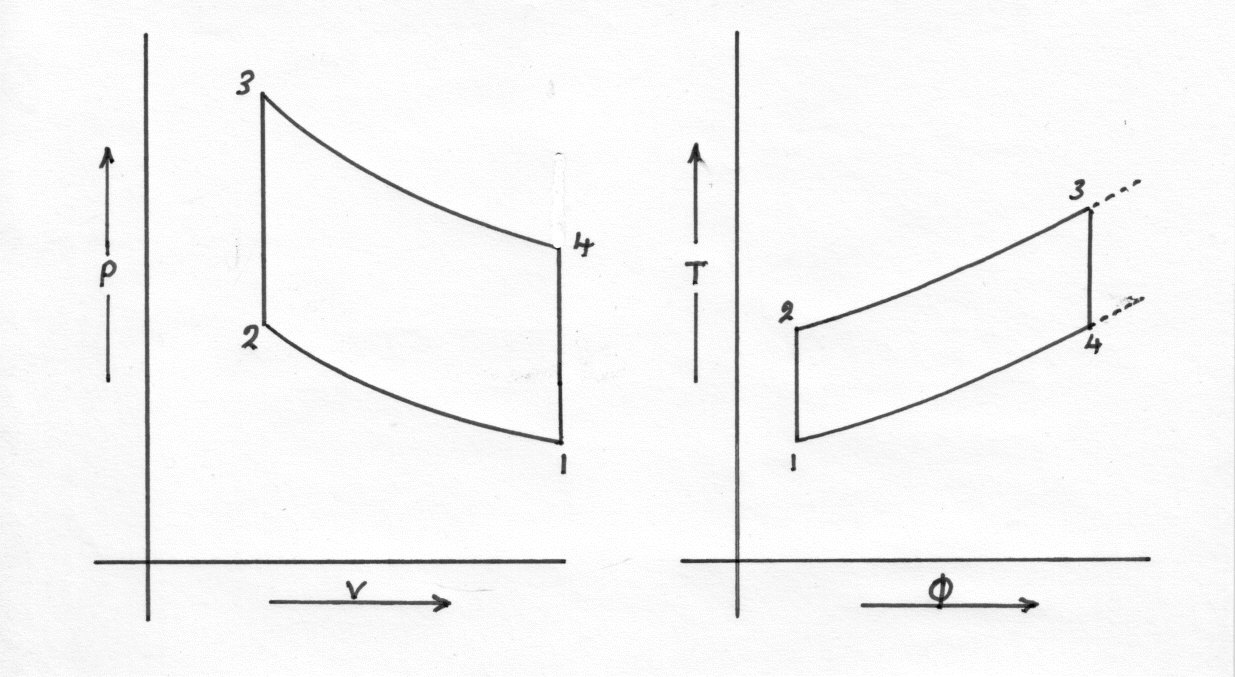
13108/img_therm31.jpg
Blank

The four stages of this Cycle are:-

  • Adiabatic reversible Compression 1 - 2
  • Heating at Constant Pressure 2 - 3
  • Adiabatic reversible Expansion 3 - 4
  • Cooling at Constant Pressure 4 - 1
Thermal \;\eta \;=\;1\;-\;\frac{Q_R}{Q_S}
(12)
=\;1\;-\;\frac{wC_P(T_4\;-\;T_1)}{wC_P(T_3\;-\;T_2)}\;=\;1\;-\;\frac{(T_4\;-\;T_1)}{(T_3\;-\;T_2)}
(13)
Blank

For the Adiabatic Compression 1 - 2

\frac{P_1}{T_1^{\frac{\gamma }{\gamma \;-\;1}}}\;=\;\frac{P_2}{T_2^{\frac{\gamma }{\gamma \;-\;1}}}
(14)
\therefore\;\;\;\;\;T_2\;=\;T_1\;J^{\frac{\gamma \;-\;1}{\gamma }}\;\;\;\;\;where\;J\;is\;the\;Pressure\;Ratio
(15)

Likewise for the Adiabatic expansion 3 - 4

\therefore\;\;\;\;\;T_3\;=\;T_4\;J^{\frac{\gamma \;-\;1}{\gamma }}
(16)
Subtracting\;\;\;\;\;\;\;(T_3\;-\;T_2)\;=\;J^{\frac{\gamma \;-\;1}{\gamma }}(T_4\;-\;T_1)
(17)
\therefore\;\;\;\;\;Thermal\;\eta \;=\;1\;-\;\frac{1}{J^{\frac{\gamma \;-\;1}{\gamma }}}
(18)

THE DIESEL CYCLE

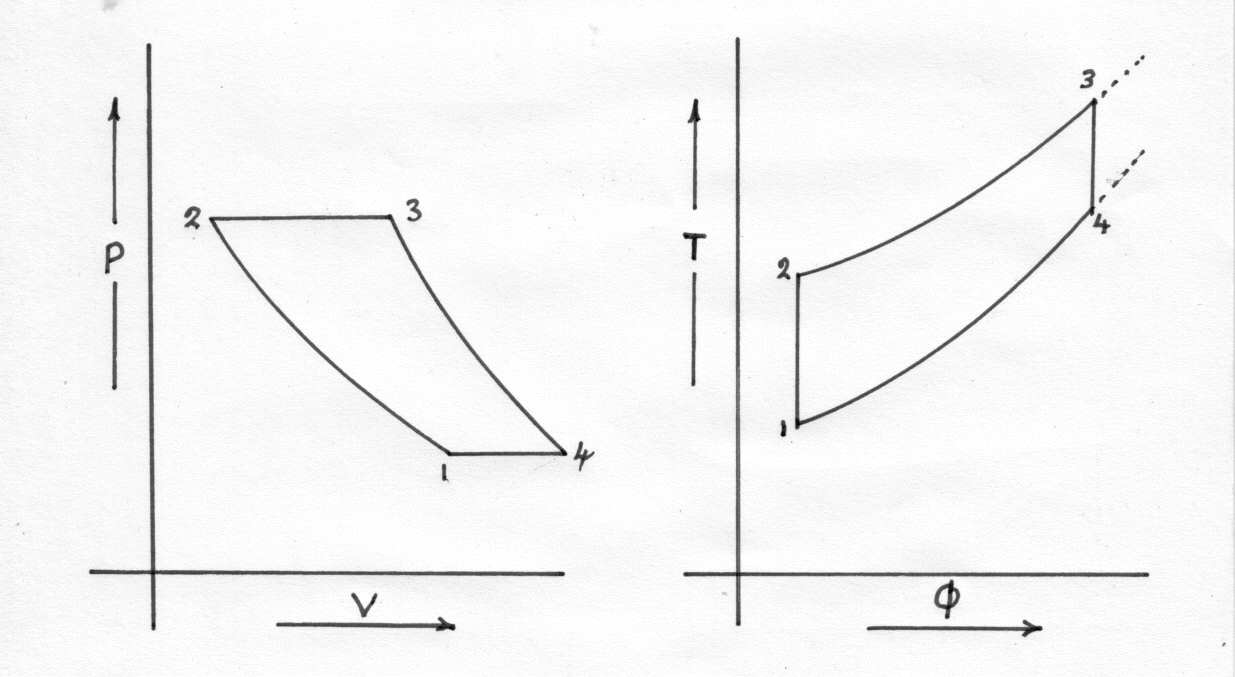
13108/img_therm32.jpg
Blank

The four stages of this cycle are :-

  • An Adiabatic reversible Compression. 1 - 2
  • Constant Pressure Heating. 2 - 3
  • Adiabatic reversible expansion. 3 - 4
  • Constant Volume cooling 4 - 1
Thermal\;\eta \;=\;1\;-\;\frac{Heat\;rejected}{Heat\;Supplied}
(19)
Heat\;rejected\;=\;wC_V(T_4\;-\;T_1)
(20)
Heat\;Supplied\;=\;wC_P(T_3\;-\;T_2)
(21)
\therefore\;\;\;\;\;Thermal\;\eta \;=\;1\;-\;\frac{1}{\gamma }\times \frac{(T_4\;-\;T_1)}{(T_3\;-\;T_2)}
(22)

For Stage 1 - 3

T_1V_1^{\gamma \;-\;1}\;=\;T_2V_2^{\gamma \;-\;1}
(23)
\therefore\;\;\;\;\;T_2\;=\;T_1\left(\frac{V_1}{V_2} \right)^{\gamma \;-\;1}\;\;\;\;\;where\;r\;is\;the\;compression\;ratio\;\frac{V_1}{V_2}
(24)

For Stage 2 - 3

\frac{V_2}{T_2}\;=\;\frac{V_3}{T_3}
(25)
\therefore\;\;\;\;\;T_3\;=\;T_2\frac{V_3}{V_2}
(26)
=\;T_2\;\beta \;\;\;\;\;\;Where\;\beta \;is\;the\;expansion\;ratio\;during\;heating
(27)
=\;T_1\;r^{\alpha \;-\;1}\;\beta
(28)

For Stage 3 - 4

T_3V_3^{\gamma \;-\;1}\;=\;T_4\;V_4^{\gamma \:-\:1}
(29)
\therefore\;\;\;\;\;T_4\;=\;T_3\;\left(\frac{V_3}{V_4} \right)^{\gamma \;-\;1}
(30)
\therefore\;\;\;\;\;T_4\;=\;T_1\;r^{\gamma \;-\;1}\;\beta \;\left(\frac{V_3}{V_4} \right)^{\gamma \;-\;1}
(31)
=\;T_1\;r^{\gamma \;-\;1}\;\beta \;\left(\frac{V_3}{V_2} \frac{V_2}{V_4}\right)^{\gamma \;-\;1}
(32)
=\;T_1\;r^{\gamma \;-\;1}\;\beta \;\left(\beta  \right)^{\gamma \;-\;1}\;\left(\frac{1}{r} \right)^{\gamma \;-\;1}
(33)
Thus\;\;\;\;\;T_4\;=\;T_1\;\beta ^\gamma
(34)
\therefore\;\;\;\;\;Thermal\;\eta \;=\;1\;-\;\frac{1}{\gamma }\;\left(\frac{\beta ^\gamma \;-\;1}{\beta \;-\;1} \right)\times \frac{T_1}{T_1\;r^{\gamma \;-\;1}}
(35)
=\;1\;-\;\frac{1}{\gamma }\left(\frac{\beta ^\gamma \;-\;1}{\beta \;-\;1} \right)\times \frac{1}{r^{\gamma \;-\;1}}
(36)

THE AIR STANDARD EFFICIENCY

Unless otherwise stated it can be assumed that the Air Standard efficiency will be that of the Constant Volume Cycle.

Example 1

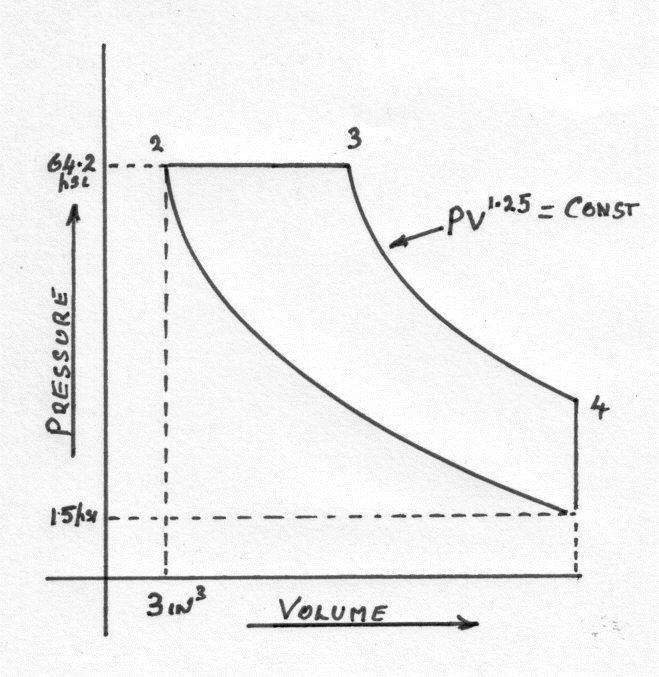
An engine operates under a diesel cycle with a top pressure of 642 psi, The compression ratio is 18 : 1 and the air at the start of compression is at 15 psi and 100 degrees F. 3 BTU are added during combustion and expansion in accordance to the lawP\;V^{1,25}\;-\;Constant. If the clearance volume is 3\;in.^3and the specific heat at Constant pressure during combustion is 0.027 BTU/cu.ft. Find ignoring the fuel mass.

1) Pressure; Volume;and Temperature at each change point of the cycle.

2)The work output of the cycle

3 The Thermal efficiency of the cycle.
Blank
13108/img_therm33.jpg
Blank

For convenience the following chart has been produced showing number given in the question in Roman numbers and calculate values in italics.
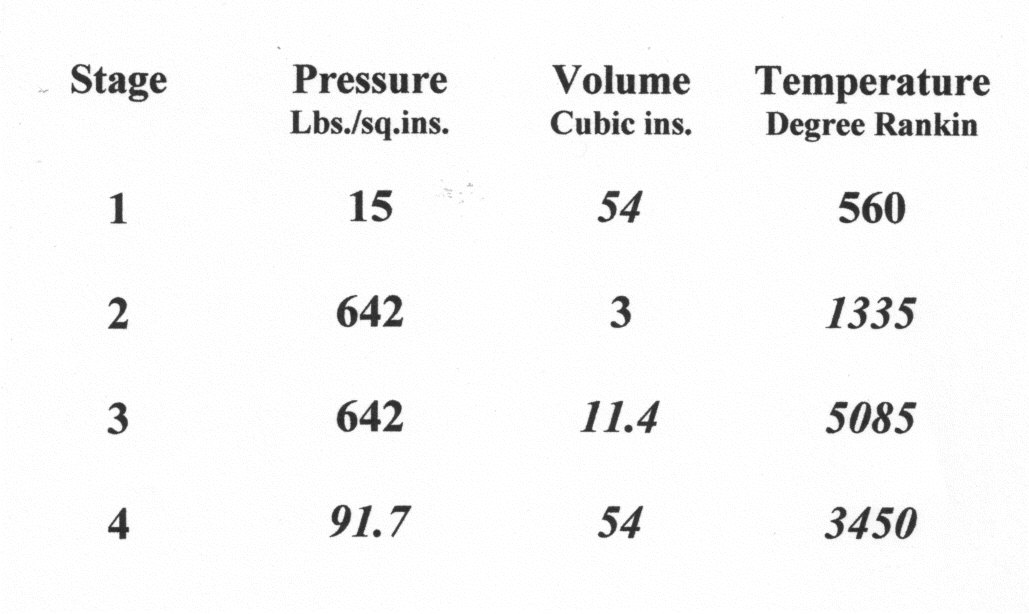
Blank
13108/img_therm_34.jpg
Blank

Between 1 - 2

\frac{P_1V_1}{T_1}\;=\;\frac{P_2V_2}{T_2}
(37)
\therefore\;\;\;\;\;T_2\;=\;\frac{P_2V_2}{P_1V_1}\;T_1
(38)
=\;\frac{642}{15}\times \frac{3}{54}\times 560\;=\;1335^0R
(39)
Blank

Between 2 - 3

Normally the heat supplied is shown as w\;C_P\;dt but in this case;_

Heat\;Supplied\;=\;V\;C_P\;\Delta T
(40)

Where V_S is the quantity of Gas present at 14.7 psi and 560^0R

C_P is the Specific heat at Constant Pressure.

V_S\;=\;54\times \frac{15}{14.7}\times \frac{(60\;+\;460)}{(100\;+\;460)}
(41)
=\;51.1\; in^3\;at\; 14,7 \;psi\;\;\;\; and \;\;\;\;60^0F.
(42)
\therefore\;\;\;\;\;3\;=\;\frac{51.1}{144\times 12}\times 0.025\left(T_3\;-\;T_2 \right)
(43)
\therefore\;\;\;\;\;(T_3\;-\;T_2)\;=\;\frac{3\times 1728}{51.1\times 0.027}\;=\;3750^0F.
(44)
\therefore\;\;\;\;\;T_3\;=\;3750\;+\;1335\;=\;5085^0R.
(45)
Blank

Also between 2 - 3

\frac{V_2}{T_2}\;=\;\frac{V_3}{T_3}
(46)
\therefore\;\;\;\;\;V_3\;=\;V_2\times \frac{T_3}{T_2}\;=\;11.4\;ft^3.
(47)
Blank

For the expansion 3 - 4

PV^{1.25}\;=\;Constant
(48)
TV^{0.25}\;=\;Constant
(49)
P_4\;=\;P_3\times \left(\frac{V_3}{V_2} \right)^{1.25}\;=\;642\times \left(\frac{11.4}{5.4} \right)^{1.25}\;=\;91.7 psi.
(50)
T_4\;=\;T_3\;\left(\frac{11.4}{54} \right)^{0.25}\;=\;\frac{5085}{(4.73)^{0.25}}\;\;3450^0R.
(51)
Blank

To Find the Work output of the Cycle.

Work\;out put=(P_3V_3-P_2V_2)+\left(\frac{P_3V_3-P_4V_4}{n_1-1} \right)-\left(\frac{P_2V_2-P_1V_1}{n_2\:-\;1} \right)
(52)

To find n_2

P_1V_1^{n_2}=P_2V_2^{n_2}
(53)
\therefore\;\;\;\;\;n_2\;=\;\frac{Ln\frac{P_2}{P_1}}{Ln\frac{V_1}{V_2}}
(54)
\therefore\;\;\;\;\;n_2\;=\;\frac{Ln\frac{642}{15}}{Ln18}\;=\;1.3
(55)
Work\;Done\;Cycle\;=\; \left[(642\times 11.4)-(642\times 3) \right]+\left[\frac{(642\times 11.4)-(91.7\times 54)}{0.25} \right]-\left[\frac{(642\times 3)-(15\times 54)}{0.3} \right]
(56)
=\;11070\times \frac{144}{1728}\;ft.lbs.\;=\;922.5\.ft.lbs.
(57)
Blank

The Thermal efficiency of the Cycle.

Thermal\;\eta \;=\;\frac{Work\;out put}{Heat\;Supplied}
(58)
=\;\frac{9225}{3\times 778}\;=\;0.395\;\;\;\;\;i.e. 39.5\%
(59)