
Circle
An Analysis of a Circle and it's relationship with tangents and straight lines
You're viewing an older version of this page (#3644). View the current version.
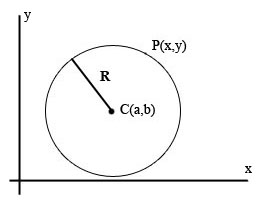
Suppose that the radius of a Circle is R and it's centre is the point c (a,b). The circle is the locus of a point P which moves so that it's distance from C is always equal to R. Hence if the coordinates of P are (x,y).
If then the equation becomes that of a circle radius R centred on the origin. This is an equation in the second degree in which the coefficients of
are equal and the xy term is missing.</p>
The General Equation of a Circle.
The equation of the circle is
This can be rearranged as:
From which it can be seen that the centre is (-g,-f) and the radius is
To find the equation of the Circle whose Diameter is the join of the points A and B
Let the coordinates of A and B be and
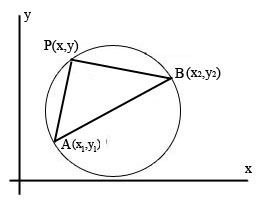
From the diagram it can be seen that since AB is a right angle the angle APD is a right angle. The slopes of AP and PB are respectively given by:
and
or
This relationship is satisfied by the coordinates (x,y) of any point P on the Circle and is therefore the required equation to the circle whose diameter joins the points A and B
The Equation of a Circle through three given Points.
Suppose that the three given points are
Substituting these values for x and y in the General Equation of a Circle:-
Then
and
These three equations are sufficient to enable the constants f,g,C and hence the equation of the Circle to be determined.
To Find the Equation to the Tangent of Gradient m to the Circle with centre the Origin.
The equation of the circle is
Suppose the equation of the tangent is . The length of the perpendicular from the tangent to the centre of the circle must be 'a'
The tangent of gradient m if therefore given by:-
The Equation to a Tangent of a Circle at a given Point
Suppose that we require the equation of the tangent at the point to the circle.
Differentiating with respect to x
Therefore the gradient at the point is given by:
The equation of tangent through the point on the circle with slope equal to the gradient of the curve is:
This can be written as:
But since the point lies on the circle we can make the following substitution:
by
Hence the required equation can be written as:
The length of the Tangent from a given external Point to a Circle.
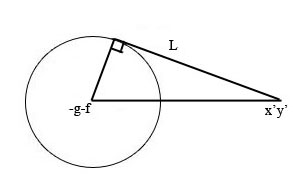
T is the given point with coordinates (a,b) and TQ is one of the tangents to the circle. If C is the centre of the circle:
Now T is the point (a,b) and C is the point
Also CQ, the radius of the circle is given by:
Hence
Thus the square of the length of the tangent drawn to the circle from the point (a,b) is obtained by writing a for x and b for y in the left hand side of the equation of a Circle.
Orthogonal Circles.
Two circles are said to be Orthogonal when the tangents at their points of intersection are at right angles.
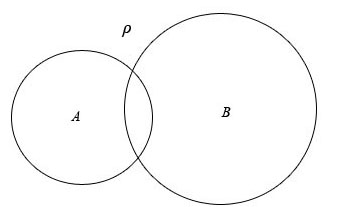
Let the Circles be:
and
If the circles cut at P then the angle APD must be a Right Angle.
or the square of AB equals the sum of the squares of the radii of the two circles.
or
The Points of Intersection of a Straight Line and a Circle.
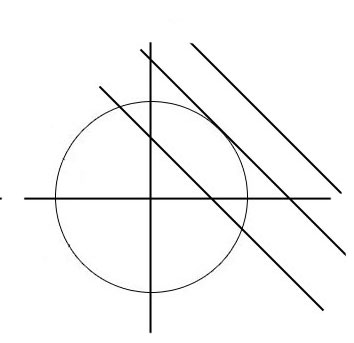
<p>Consider the points of intersection of the straight line y = mx + c = 0 and the circle . The coordinates of the points of intersection will satisfy the simultaneous equations</p>
Solving these equations for x
or
This equation has real; equal; or imaginary roots according to whether:-</p>
<p>Is positive, zero or negative. The three possibilities are shown as lines a, b, or c on the diagram. The line c does not meet the circle at any real points. The line b corresponds to a value of meets the circle at two coincident points T. Hence the equation of he line be can be written as:-</p>
This equation represents two lines. One is the line (b) on the diagram and the other is the tangent to the circle whose point of contact is diametrically opposite to the point T.
The length of the cord AB shown on the diagram can be found as follows. The x coordinates of the end points of the chord are given by the roots of equation ( 31) If the roots are denoted by and
If are the ordinates of the end points we have, since the points lie on the line y = mx + c
The Square of the length of the chord