
Parabola
An analysis of the Parabola, its proprties, Chords and Tangents
You're viewing an older version of this page (#3388). View the current version.
A Parabola is one of the Conics. These are defined by their focus-directrix property, i.e. as the locus of a point which moves so that its distance from a fixed point is in a constant ratio to its distance from a fixed line. The fixed point is called the FOCUS, the fixed line the the DIRECTERIX and the constant ratio the ECCENTRICITY.
- For the Parabola the eccentricity is 1.
- For the ellipse the eccentricity is less than 1.
- For the Hyperbola the eccentricity is greater than 1.
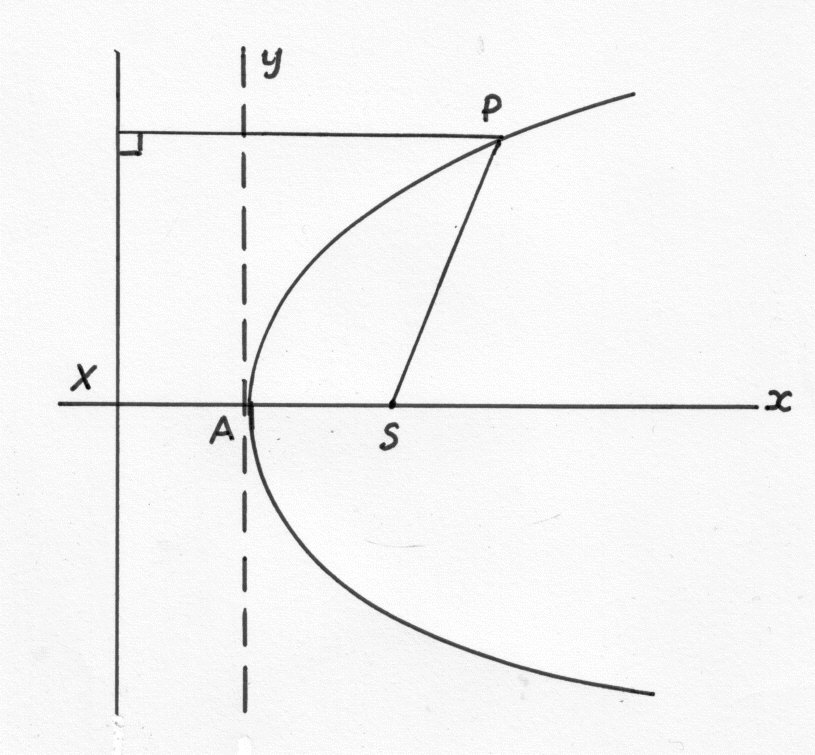
If S is the fixed point and X the foot of the perpendicular from S to the fixed line, the Parabola will obviously be symmetrical about SX and there will be one point only on SX on the locus. i.e. the mid point on SX,A.
Let SA = a and take AS to be the x-axis and A the origin. If P (x.y) is any point on the locus, and therefore:
or
This is the equation of a PARABOLA
To find the Tangent of Gradient m
Let the equation of the tangent be :-
This will meet the Parabola where:-
i.e. where
For a tangent , the roots of this equation must be coincident and therefore:-
The Tangent of Gradient m is
Example 1
Find the equations of the tangents and normals to the parabola at the points(16,16) and (1,-4). The tangents intersect at at the point T and the normals intersect at R. Prove that the line TR is parallel to the axis of the Parabola.
Example 2
Find the ordinates of the points in which the line meets the Parabola
and find the value of c when this line is a tangent to the parabola.
The Parametric equation of a Parabola.
It is now possible to rewrite equation (5) using the value of c:-
or
and by substitution
So the point is a parametric expression for a point on the Parabola for all values of m and the gradient of the tangent at that point is m. By writing 1/m for m, it can be seen that the point
also lies on the equation and the following table can be constructed.
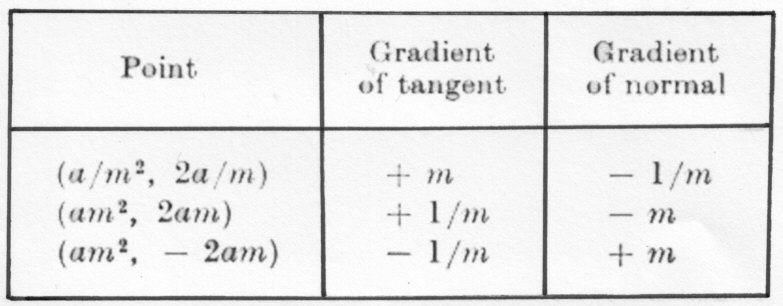
NOTE. It is usual to identify a point on a Parabola by using the parametric form
. However if the gradient of a tangent is required, then it is better to use
. Whilst it is easier to find the gradient of the normal by expressing the point as
.
Example 3
A chord PQ of a parabola passes through the focus. n Show that the tangents at P and Q meet on the Directerix.
The Normal
The Normal at may be written down from the knowledge that its gradient is - m. The equation of the normal will be in the form
.
Substituting values for x and y and the gradient
Thus the equation of the Normal is given by:
The Equation of the Line joining two points on a Parabola.
Let the two points be
The equation is given by:
or
The Parametric Equation of the Tangent
As the point t moves ever closer to m on the parabola., the chord joining the points becomes closer to the tangent. The parametric equation of the tangent at point m is found by putting t equal to m and is given by:
or
To find the Equation of the Tangent to the Parabola at a given point.
Let the point be and the equation of the Parabola be
Differentiating w.r.t x
It is therefore possible to write down the equation of the tangent that goes through (x',y') as:
And since
then
The Locus of the Foot of the Perpendicular from the Focus to a Tangent.
The equation of any tangent is given by:
If the Perpendicular to this tangent passes through (a,0), its equation is given by:-
We can find the locus by eliminating m from the two equations i e.
From which it can be seen that x = 0 is the tangent at the Vertex
The Locus of the Intersection of perpendicular Tangents
The equation of a tangent of gradient m is:
And the equation of the tangent who's gradient is 1/m is:
The locus is found by eliminating m from the above equations:-
This is the equation of the Directerix.
The Polar of (x',y')
Suppose that the point of contact of the tangents are and
. Then the tangent at
passes through
But this is equally the condition that the line should pass through
. But since there is a unique line joining two points,
must be the polar of
The feet of the Normals from a point to the Parabola
Suppose that the Normal at passes through the given point (h,k). Then (h,k) satisfies the following equation:-
This is a cubic in m giving three values for m. i.e. there are in general three Normals passing through a given point. Moreover since a cubic has either three or one real root, there must be three or one real Normal.
As the term in m squared is missing, the sum of the roots is zero. Therefore the sum of the ordinates of the feet is zero and so the centre of gravity of the triangle formed by the feet of the normals from any point lies on the axis.
The Circle through the feet of the Normals
Consider the intersection of the Parabola with the general circle,
If they meet at the point
This is a quartic in m and since the term in is missing the sum of the roots is zero. Therefore the sum of the ordinates of the points of intersection of the parabola
with any circle is zero.
Since the sum of the ordinates of the feet of the Normals is already zero, the circle through the three feet of the Normals from any point to the parabola must pass through the origin.
An Important property of the Parabola
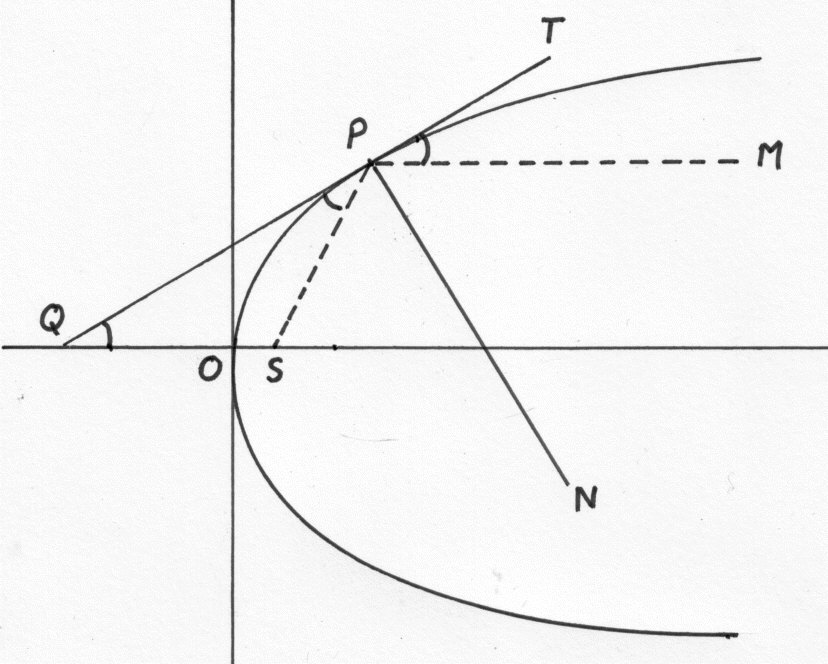
In the diagram P is th point "t2 on the Parabola whose Focus is S. PT is the tangent at P meeting the x axis at Q. Since the coordinates of P and S are respectively
and
The equation of the tangent PT is given by:
This meets the x-axis where:
and since then
Hence QS = PS and the triangle QSP is isosceles and the angle PQS = angle SPQ
If PM is drawn through P parallel to the x axis, it follows that:
So that the lines PS and PM are equally inclined to the tangent at P. If PN is the Normal at P, it follows that the lines PS and PM are equally inclined to the normal at P.
This is an important property of the parabola. It means that if a ray of light starting from the focus S strikes a parabolic mirror at P, the reflected ray, which makes an equal angle with the normal, will be parallel to the axis of the mirror. Since P is any point on the parabola it follows that all incident rays from a source at the focus will be reflected as rays which are parallel to the mirrors axis. Conversely all parallel rays from a distant source striking a parabolic mirror will be reflected so as to pass through the focus.