
Ellipse
Analysis of the Ellipse; Its Tangents and the Auxiliary Circle Chords
You're viewing an older version of this page (#3389). View the current version.
If X is the foot of the perpendicular from S to the Directrix, the curve is symmetrical about the line XS. This line is taken to be the x axis. The ratio SP:PK (e) is less than 1 and so there are two points on the line SX which also lie on the curve. One A' will lie between between S and X and nearer S and the other X will lie on XS produced. Let the distance AA' be 2a and let the mid point of AA' be the point C. C is called the Centre of the Ellipse and is taken to be the origin.
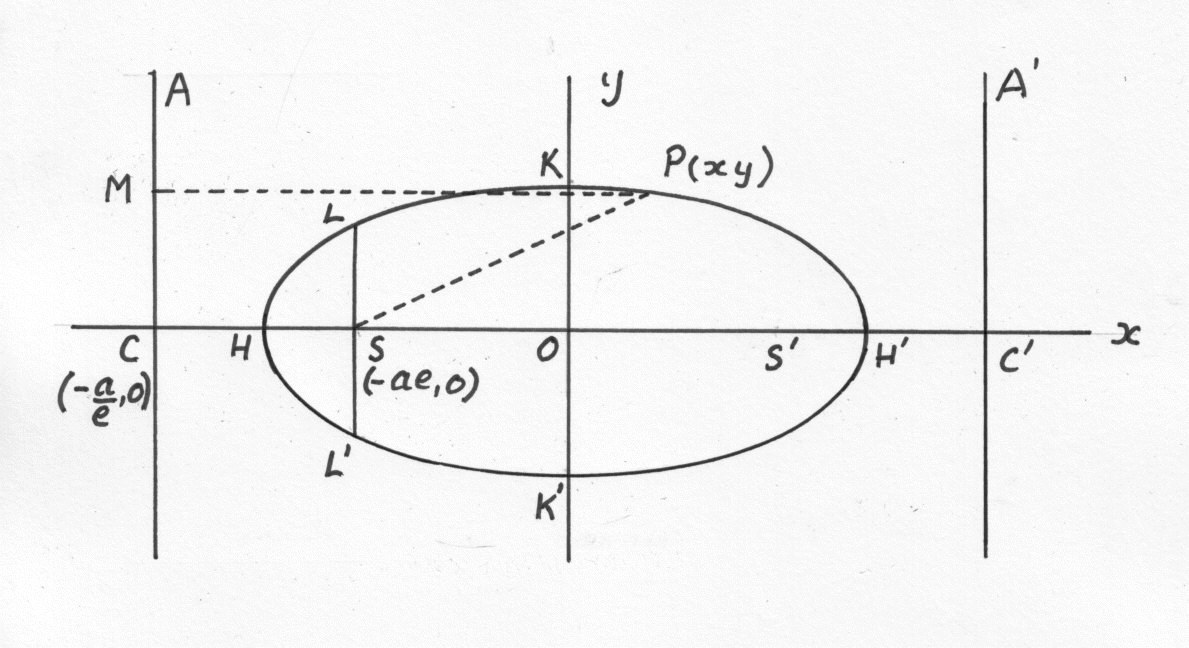
Since A' lies on the curve. SA = e(A X)
Since A' lies on the curve. SA' = e(A'X)
We now the lengths of both CX and CS and can proceed to find the equation of the curve.
from equation (4) we know that CS = ae
Let and the equation of the Ellipse becomes:-
The length a is called the semi-major axis. When x = 0 y is plus or minus b which is called the semi-minor axis.
NOTES.
1) The equation of an ellipse if the axis of length 2a is taken up the y axis is given by:-
The major axis is still 2a i.e.The major axis is always the larger of the two.
2)The equation of an Ellipse referred to a parallel axes through the point (h,k)is given by the equation:-
Example 1
Sow that the sum of the focal distances of any point on an is Ellipse is equal to the length of the major axis. Deduce a simple mechanical method for constructing the curve
The Tangent to an Ellipse at a given point.
Differentiating the equation for an ellipse with respect to x
The equation of the tangent at is therefore given by:-
This can be written as:-
Dividing through by and using the equation for an ellipse,which is the condition that the point
shall lie on the ellipse, the equation of the tangent at the point
can be written as:-
The Normal to the tangent at (x',y')
The Normal at the point is the line perpendicular to the tangent and therefore its slope is
and its equation is:-
Example 2
Find the equation of the Tangent and Normal to the Ellipse at the point in the first quadrant whose ordinate is 2.
The Points of Intersection of a Straight Line and an Ellipse.
The coordinates of the points of intersection of the straight line y = mx + c and the ellipse are the values of x and y which simultaneously satisfy both equations.Writing y = mx + c in the equating of the ellipse:-
This quadratic has real, equal or imaginary roots depending upon whether is positive,zero or negative. When
, the line intersects the ellipse in two real roots. When
, the line intersects the ellipse only in imaginary points and when
the line is a tangent to the ellipse.
Writing in the equation of the line:-
we get a line which always touches the ellipse. Also since the radical sign on the right hand side of the equation may be either positive or negative, there are two tangents parallel to each other.
Example 3
Find the locus of the points of intersection of tangents to an ellipse which are at right angles to each other.
Using the standard equation for a Ellipse:-
And the equation for a tangent from above:-
The equation of a perpendicular tangent at a gradient of -1/m is :-
These two equations for perpendicular tangents to the ellipise can be written as:-
The coordinates of the point of intersection of the tangents simultaneously satisfy these two equations. If m is eliminated from the two equations the locus of the pint of intersection will be found.
Squaring and adding:-
The locus is therefore a circle with centre coincident with the centre of the ellipse and with a radius of . This circle is called THE DIRECTOR CIRCLE.\b
The Parametric Equation of an Ellipse.
It is often convenient to express the coordinates of any point on the ellipse in terms of one variable.
Draw a circle on the major angle of an ellipse with a centre coinciding with the centre of the ellipse. This circle is called The Auxiliary Circle
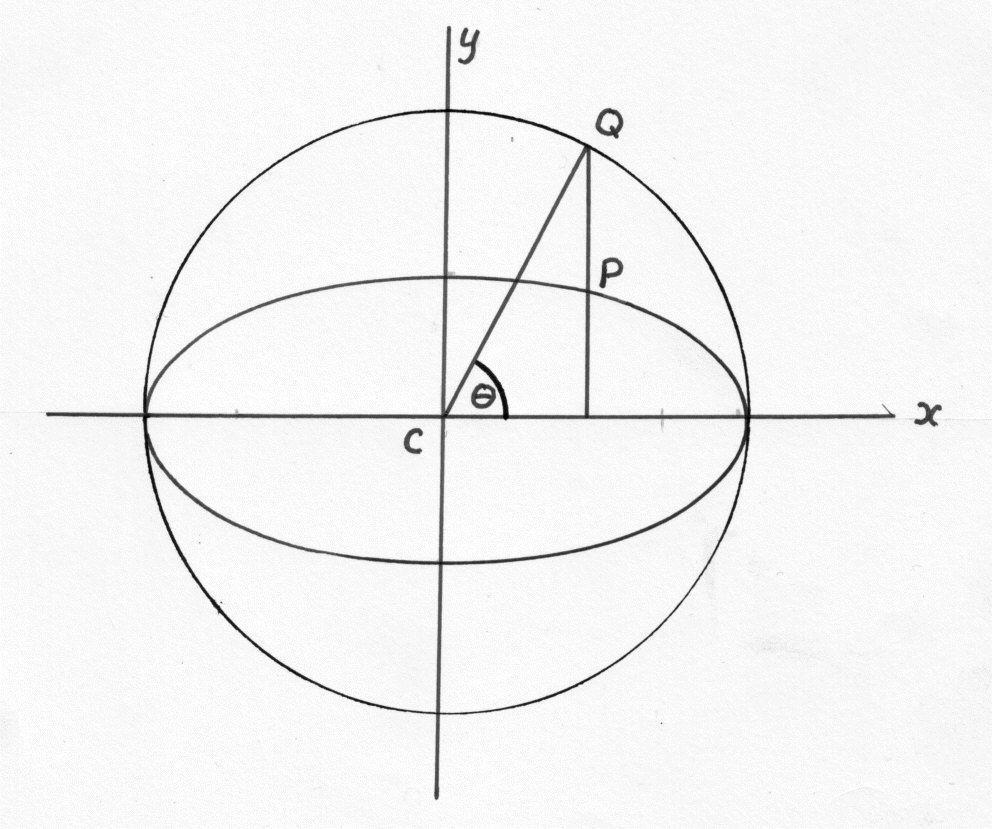
Draw a radius CQ of this circle making an angle with the major axis. Then CQ = a and the coordinates of Q are
.Draw the perpendicular from Q to the major axis to meet the ellipse at P. The x-coordinate of P is also
and since �he point P lies on the ellipse:-
Therefore the Parametric equation of an ellipse is :-
The Parametric Equation of a Chord.
The gradient of the chord joining the points and
is given by:-
The Equation of the Chord is therefore
The Equation of a tangent.
If the above equation for a Chord becomes the equation of a Tangent at the point
. The equation is:-
The Meet of Two Tangents at Points with Differing Eccentric Angles.
Let the two points have eccentric angles of . Therefore the equations of the tangents are:-
Eliminating y from these equations:-
Eliminating x from the equations:-
But since the point of intersection of the Tangents is:-
Example 4
The Chord PQ of an Ellipse passes through he focus (ae,0) . Show that the meet of the tangents at P and Q lies on the Directrix .
The equation of PQ is :-
This passes through the point (ae,0) and so:-
The meet of the tangents at P and Q is :-
The x coordinate is :-
Example 5
Q is the point on the Auxiliary Circle of the Ellipse
. P is the point on the Ellipse with coordinates
. If S is a Focus of the Ellipse, show that the length of the perpendicular from S on to the Tangent at Q is equal to SP.
The equation of the Auxiliary Circle is given by :-
And the equation of the tangent at the point Q is:-
If S is the focus (ae,0), where e is the eccentricity of the Ellipse, the length of the perpendicular from S onto the tangent is:-
The distance SP between the points is given by:-
This shows tat the SP is equal to the length of the perpendicular from S on to the tangent at Q to the circle. A similar proof holds if S is taken as the second Focus (- ae, 0)