The sine and cos formula; areas of triangles and an analysis of the varios circles associated with Triangles

You're viewing an older version of this page (#3393). View the current version.

View versions (2)

The Trigonometrical Formula Associated with Triangles.

There are a number of equations associated with triangles. Of these, the best known are the Sine and Cos formulae.

The Sine Formula.

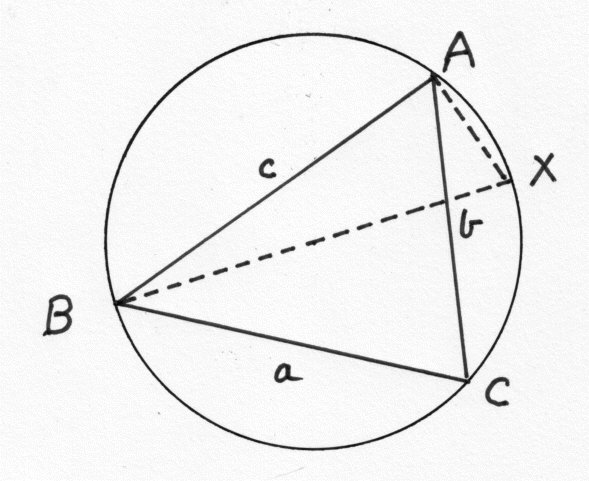
Consider the Triangle ABC with its Circumcircle. Draw the diameter BX through B
Blank
13108/img_trig_42.jpg
Blank

Angle BAX = 90 degrees and angle AXB = angle ACB

From the diagram it can be seen that c = 2R sin C

\therefore\;\;\;\;\;\frac{c}{sin\,C}\;=\;2R
(1)

Therefore by symmetry:-

\mathbf{\frac{a}{sin\,A}\;=\;\frac{b}{sin\,B}\;=\;\frac{c}{sin\,C}\;=\;2R}
(2)

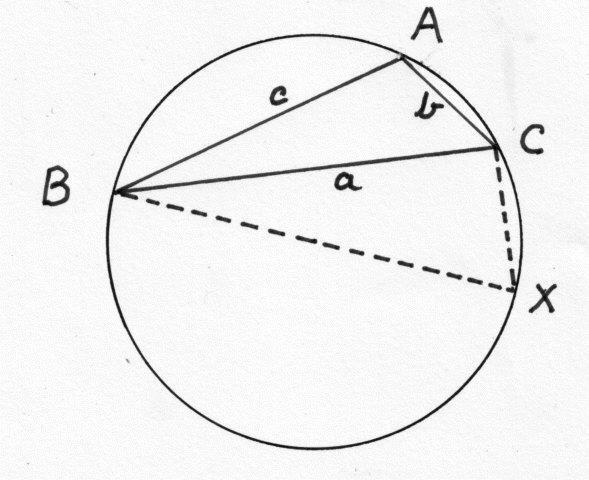
Obtuse Case

If A is obtuse, angle BXC = 180 - A
13108/img_trig_43.jpg
a\;=\;2R\,sin\,(180^0\;-\;A)\;=\;2R\,sin\,A
(3)
\mathbf{\frac{a}{sin\,A}\;=\;\frac{b}{sin\,B}\;=\;\frac{c}{sin\,C}\;=\;2R}
(4)

The Cosine Formula

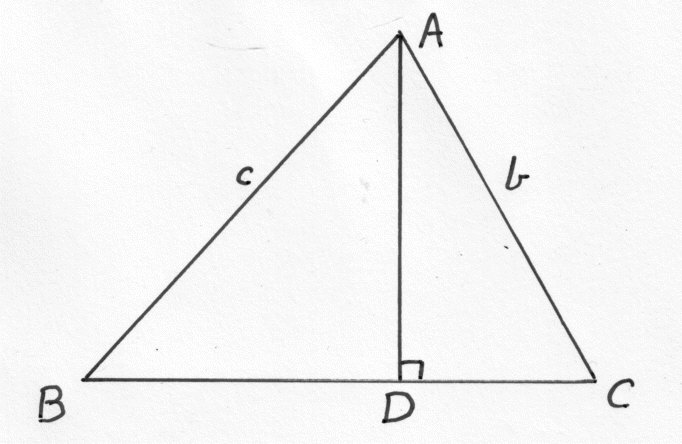
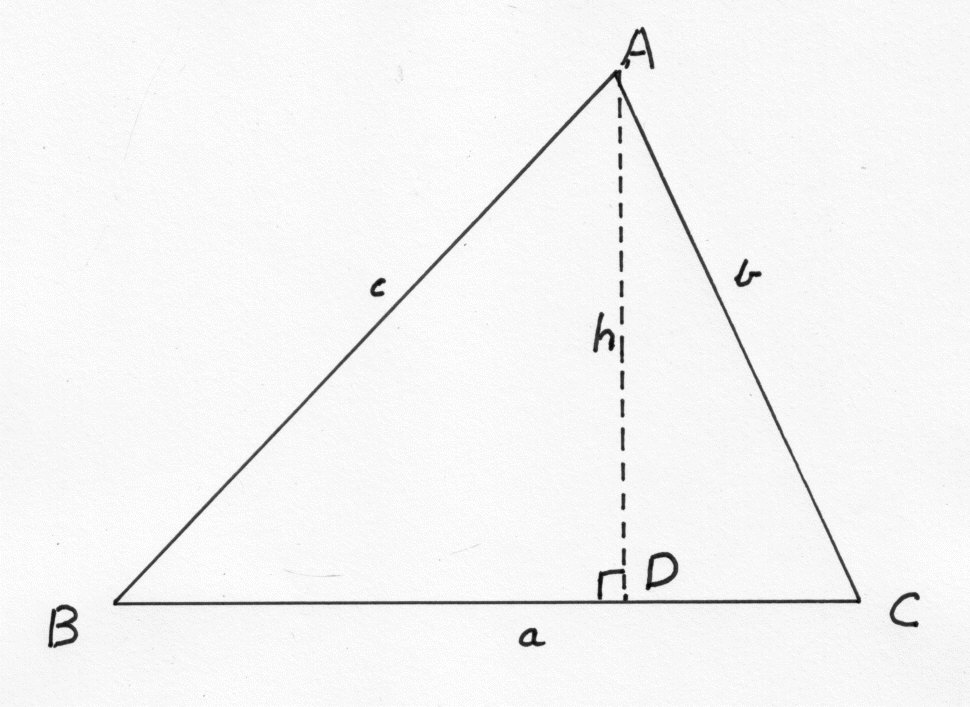
ABC is an acute-angled triangle of height h
13108/img_trig_40.jpg
Then\;\;\;\;\;\;\;\;CD\;=\;b\;cos\,C
(5)
\therefore\;\;\;\;\;\;BD\;=\;a\;-\;b\;cos\,C
(6)

Using Pythagoras:-

h^2\;=\;b^2\;-\;(b\;cos\,C)^2
(7)
and\;\;\;\;\;\;h^2\;=\;c^2\;-\;(a\;-\;b\;cos\,C)^2
(8)
\therefore\;\;\;\;\;b^2\;-\;b^2\,cos^2\,C\;=\;c^2\;-\;a^2\;-\;b^2\;cos^2\,C\;+\;2ab\;cos\,C
(9)
or\;\;\;\;\;\;\;\mathbf{c^2\;=\;a^2\;+\;b^2\;-\;2ab\;cos\,C}
(10)

NOTE This equation can be re-written in terms of either angle A or B

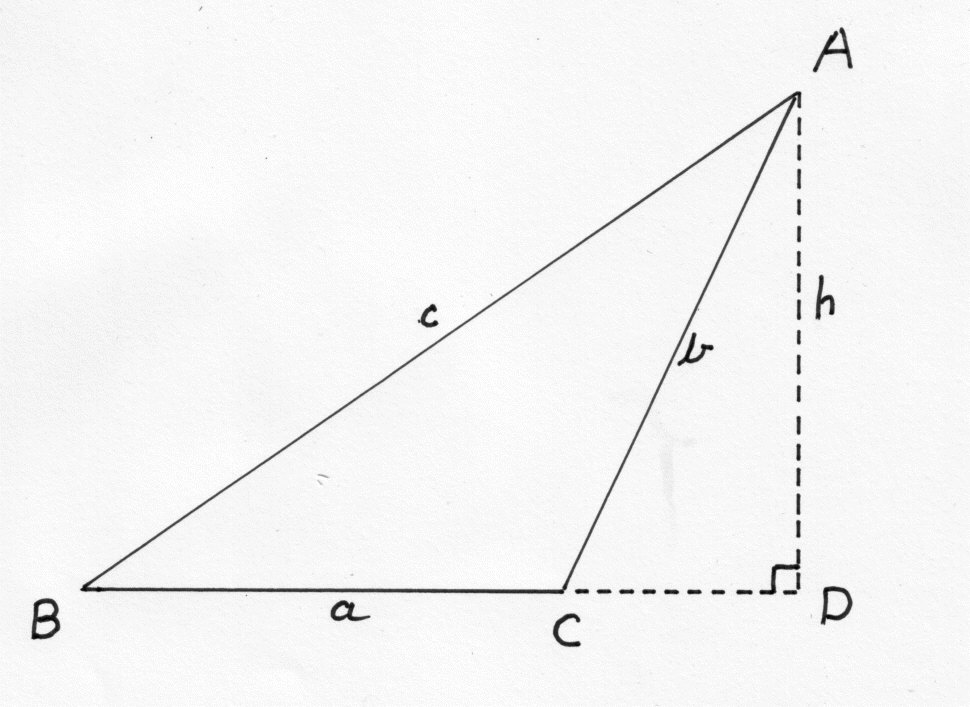
If C is obtuse
13108/img_trig_41.jpg
CD\;=\;b\;cos\,(180^0\;-\;C)
(11)
BD\;=\;a\;+\;b\;cos\,(180^0\;-\;C)
(12)
\therefore\;\;\;\;\;h^2\;=\;b^2\;-\;b^2\;cos^2\,(180^0\;-\;C)
(13)
and\;\;\;\;\;h^2\;=\;c^2\;-\;\left(a\;+\;b\;cos\,[180^0\;-\;C] \right)^2
(14)
\therefore\;\;\;\;b^2\;-\;b^2\;cos^2(180^0\;-\;C)\;=
c^2\;-\;a^2\;-\;b^2\;cos^2\,(180^0\;-\;C)\;-\;2ab\;cos\,(180^0\;-\;C)
(15)
or\;\;\;\;\;c^2\;=\;a^2\;+\;b^2\;+\;2ab\;cos\,(180^0\;-\;C)
(16)
Thus\;\;\;\;\;\mathbf{c^2\;=\;a^2\;+\;b^2\;-\;2ab\;cos\,C}
(17)

It should be noted that the same equation can be applied in both cases.

Two Additional Formulae for the Solution of Triangles

The cos and sine formula together are sufficient to solve any triangle but the cos formula can be unwieldy in use and is sometimes replaced by the following:-

Formula 1

Using the sine formula

\frac{a\;-\;b}{a\;+\;b}\;=\;\frac{2R\;sin\,A\;-\;2R\;sin\,B}{2R\;sin\,A\;+\;2R\;sin\,B}
(18)
=\;\frac{2\;cos\,\frac{1}{2}(A\;+\;B)\times sin\;\frac{1}{2}(A\;-\;B)}{2\;sin\,\frac{1}{2}(A\;+\;B)\times cos\,\frac{1}{2}\,(A\;-\;B)}
(19)
=\;\frac{tan\,\frac{1}{2}(A\;-\;B)}{tan\,\frac{1}{2}(A\;+\;B)}
(20)
=\;\frac{tan\,\frac{1}{2}(A\;-\;B)}{cot\,\frac{1}{2}C}
(21)

as C and (A + B) are complements

\therefore\;\;\;\;\;\mathbf{\frac{a\;-\;b}{a\;+\;b}\times cot\,\frac{C}{2}\;=\;tan\,\frac{A\;-\;B}{2}}
(22)

This is the quickest way of solving a triangle given two sides and the included angle.

Example

If a = 18.4; b = 12.2 and C is 42 degrees, find the other side and the other angles.

tan\frac{A\;-\;B}{2}\;=\;\frac{18.4\;-\;12.2}{18.4\;+\;12.2}\;cot\frac{42}{2}\;=\;\frac{6.2}{30.6}\;cot\,21
(23)
\therefore\;\;\;\;\;\frac{A\;-\;B}{2}\;=\;27^0\,50'
(24)
Thus\;\;\;\;\;A\;-\;B\;=\;55^0\;\;40'
(25)
But\;\;\;\;\;A\;+\;B\;=\;135^0
(26)
From\;which\;\;\;\;\;A\;=\;96^0\;\;50'\;\;\;and\;\;\;B\;=\;41^0\;\;10'
(27)

From the sine formula

\frac{c}{Sin\,C}\;=\;\frac{b}{sin\,B}
(28)
\therefore\;\;\;\;\;\;c\;=\;12.2\times \frac{sin\;42^0}{sin\;41^0\;\;10'}\;=\;12.4
(29)
Blank

Formula 2

13108/imgtrig_90.jpg
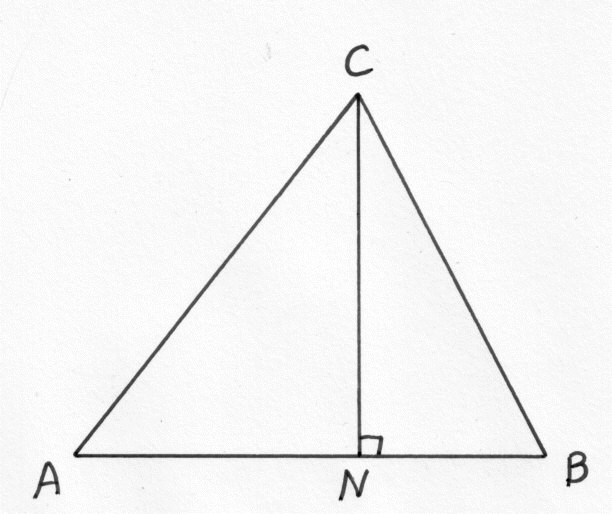
c\;=\;AN\;+\;NB
(30)
\therefore\;\;\;\;\;\mathbf{c\;=\;a\;cos\,B\;+\;b\;cos\,A}
(31)

Half Angle Formula

The cos formula can be used to find the ratios of the half angles in terms of the sides of the triangle and these are often used for the solution of triangles, being easier to handle than the cos formula when all three sides are given.

cos\: C\; = \frac{a^2\;+\:b^2\;-\;c^2}{2ab}
(32)
but\;\;\;\;\;cos\;2\theta\;=\;cos^2\,\theta\;-\;sin^2\;\theta
(33)
=\;2\;cos^2\;\theta\;-\;1
(34)
Let\;\;\;\;\;\;C\;=\;\frac{\theta }{2}
(35)
\therefore\;\;\;\;\;\;2\;cos^2\,\frac{C}{2}\;-\;1\;=\;\frac{a^2\;+\;b^2\;-c^2}{2ab}
(36)
or\;\;\;\;\;\;2\;cos^2\,\frac{C}{2}\;=\;\frac{a^2\;+\;b^2\;-c^2}{2ab}\;+1
(37)
=\;\frac{(a^2\;+\;2ab\;+\;b^2)\;-\;c^2}{2ab}
(38)
=\;\frac{2s\times 2(s\;-\;c)}{2ab}\;\;\;\;\;where \;s\;is\;the\;semi\;perimeter\;of\lthe\;triangle
(39)
\therefore\;\;\;\;\;\;\mathbf{cos\;\frac{C}{2}\;=\;\sqrt{\frac{s(s\;-\;c)}{ab}}}
(40)

Similarly

1\;-\;2\;sin^2\,\frac{C}{2}\;=\;\frac{a^2\;+\;b^2\;-\;c^2}{2ab}
(41)
\therefore\;\;\;\;\;2\;sin^2\,\frac{C}{2}\;=\;1\;-\;\frac{a^2\;+\;b^2\;-\;c^2}{2ab}
(42)
=\;\frac{c^2\;-(a^2\;-\;2ab\;+\;b^2)}{2ab}
(43)
=\;\frac{(c\;+\;a\;-\;b)(c\;-\;a\;+\;b)}{2ab}
(44)
=\;\frac{2(s\;-\;b)(\times 2(s\;-\;a)}{2ab}
(45)
\therefore\;\;\;\;\;\;\mathbf{sin\,\frac{C}{2}\;=\;\sqrt{\frac{(s\;-\;a)(s\;-\;b)}{ab}}}
(46)
By \;division\;\;\;\;\;\;\mathbf{tan\,\frac{C}{2}\;=\;\sqrt{\frac{(s\;-\;a)(s\;-\;b)}{s(s\;-\;c)}}}
(47)

Area of a Triangle

13108/img_trig_91.jpg

The area of a Triangle is a half base times height.

i.e.\;\;\;\;\;\;Area\;=\;\frac{1}{2}\;BC\times AD
(48)
But\;\;\;\;\;AD\;=\;b\;sin\;C
(49)
\therefore\;\;\;\;\;\;\;\mathbf{Area\;=\;\frac{1}{2}\,ab\,sinC\;=\;\frac{1}{2}\,bc\,sinA\;=\;\frac{1}{2}\,ac\,sin\,B}
(50)

Heron's Formula for the Area of a Triangle

Since\;the\;Area\;=\;\frac{1}{2}\;ab\;sin\,C
(51)

The area of the triangle can be written as :-

Area\;=\;\frac{1}{2}\;ab\times 2\;sin\,\frac{1}{2}C\times cos\,\frac{1}{2}\,C
(52)
ab\;\sqrt{\frac{(s\;-\;a)(s\;-\;b)}{ab}}\sqrt{\frac{s(s\;-\;c)}{ab}}
(53)
\therefore\;\;\;\;\;\mathbf{Area\;=\;\sqrt{s(s\;-\;a)(s\;-\;b)(s\;-\;c)}}
(54)

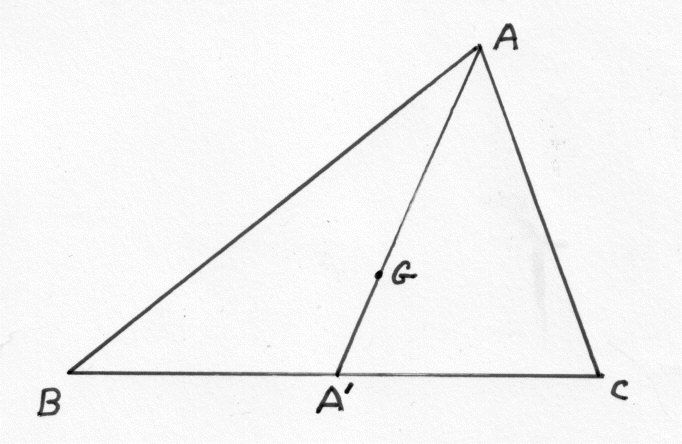
The Median and Centre of Gravity ( By Apollonius )
13108/img_trig_92.jpg
AB^2\;+\;AC^2\;=\;2AA'^2\;+\;2BA'^2
(55)
\therefore\;\;\;\;\;\;b^2\;+\;c^2\;=\;2AA'^2\;+\;2\left(\frac{1}{2}\;a^2 \right)
(56)
\therefore\;\;\;\;\;4AA'^2\;=\;2b^2\;+\;2c^2\;-a^2
(57)
\therefore\;\;\;\;\;\mathbf{AA'\;=\;\frac{1}{2}\sqrt{2b^2\;+\;2c^2\;-a^2}}
(58)
Blank
Also\;\;\;\;\;\mathbf{AG\;=\;\frac{2}{3}AA'\;=\;\frac{\sqrt{2b^2\;+\;2c^2\;-a^2}}{3}}
(59)

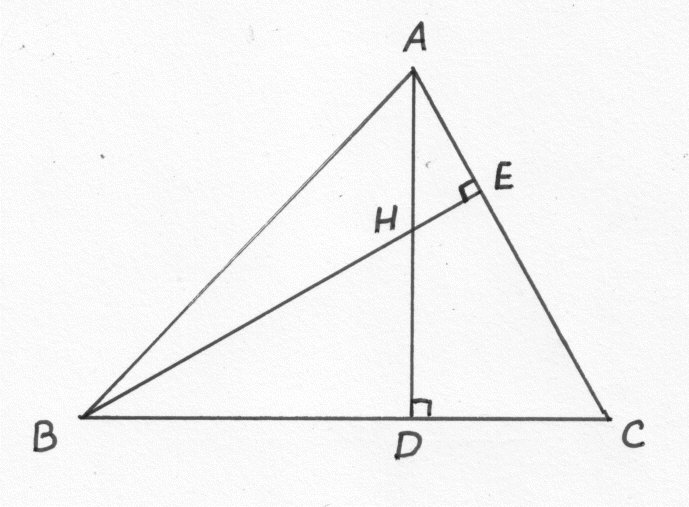
The Orthocentre.

Using the sine formula for the triangle AHB
13108/img_trig_94.jpg
Blank
\frac{AH}{sin\;ABH}\;=\;\frac{c}{Sin\;AHB}
(60)
But\;\;\;\;\;angle\;ABH\;=\;(90^0\;-\;A)\;\;\;and\;\;\;angle\;AHB\;=\;(180^0\;-\;C)
(61)
\therefore\;\;\;\;\;\frac{AH}{cos\,A}\;=\;\frac{c}{sin\,C}\;=\;2R
(62)
\therefore\;\;\;\;\;\mathbf{AH\;=\;2R\;cos\,A}
(63)
Similarly\;\;\;\;\;BH\;=\;2R\;cos\,B
(64)
But\;\;\;\;\;angle\;HBD\;=\;90^0\;-\;C
(65)
Blank
\therefore\;\;\;\;\;\mathbf{HD\;=\;2R\;cos\,B\;cos\,C}
(66)

The Angle Bisector

13108/img_trig_95.jpg

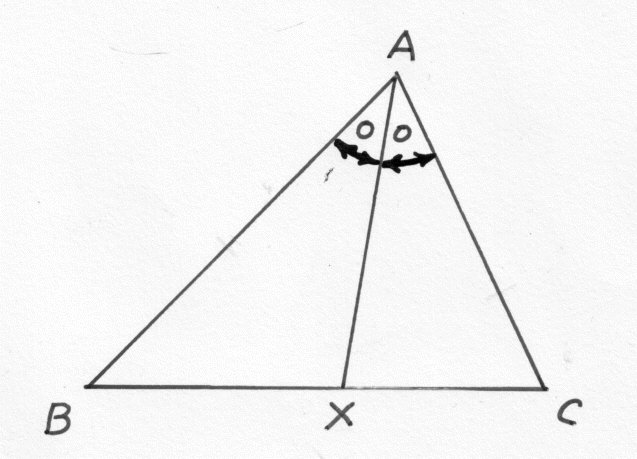
As AX bisects the angle BAC internally

But\;\;\;\;\;\;\;Sin\,A\;=\;sin\,\frac{1}{2}\,A\;cos\,\frac{1}{2}\,A
(67)
\frac{BX}{XC}\;=\;\frac{c}{b}
(68)

And since BX + XC = a

BX\;=\;\frac{c\,a}{b\;+\;c}
(69)

Applying the sine formula to AXB

\frac{AX}{sin\,B}\;=\;\frac{BX}{sin\,\frac{1}{2}A}
(70)
=\;\frac{a\;c}{(b\;+\;c)\;sin\,\frac{1}{2}A}
(71)
\therefore\;\;\;\;\;AX\;=\;\frac{a\;c\;sin\,B}{(b\;+\;c)\;sin\,\frac{1}{2}A}
(72)
=\;\frac{c\;b\;sin\,A}{(b\;+\;c)\;sin\,\frac{1}{2}A}
(73)
\therefore\;\;\;\;\;\mathbf{The\;Angle\;bisector\;AX\;=\;\frac{2\;cb\,cos\,\frac{1}{2}A}{b\;+\;c}}
(74)

The Pedal Triangle

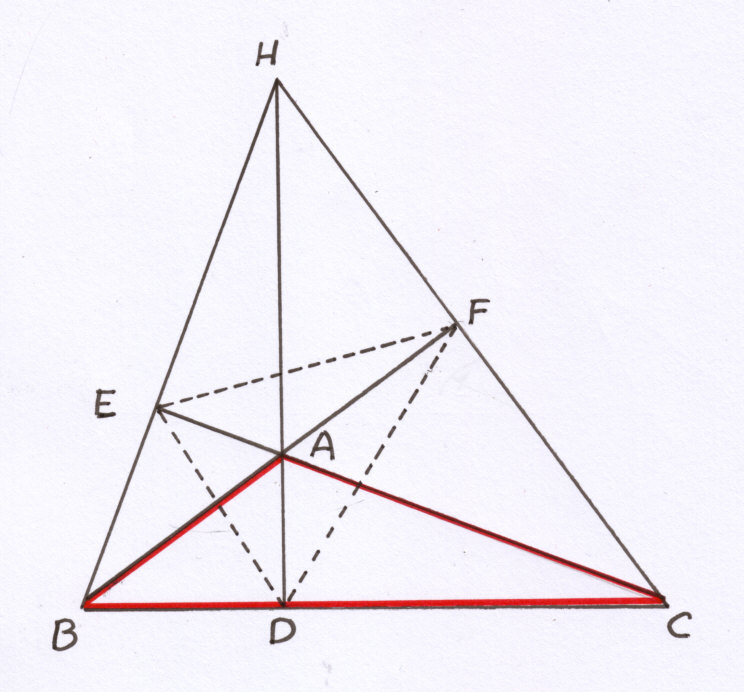
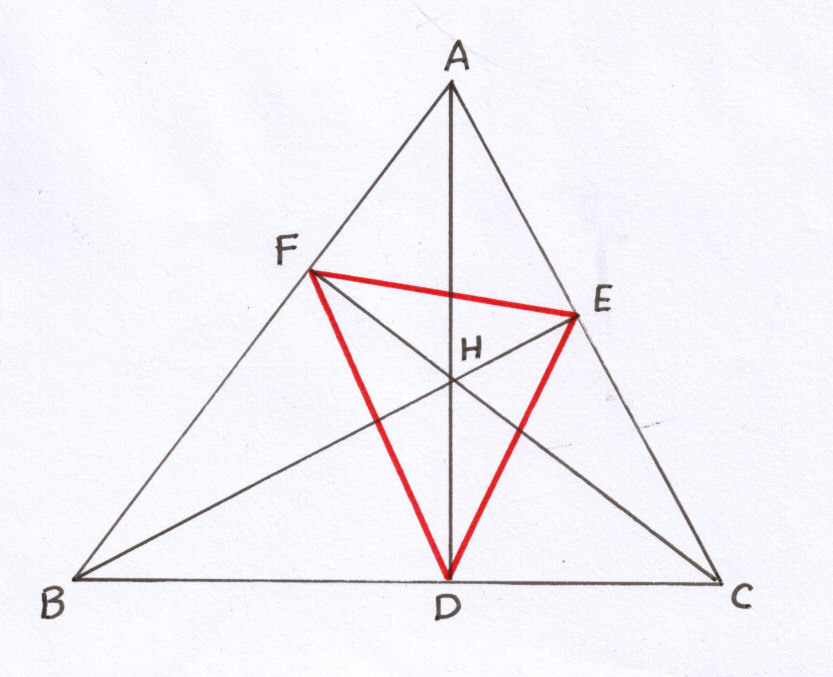
The Pedal Triangle of ABC is the triangle formed by joining the feet of the altitudes of the triangle ABC.

a) if all the angles are acute
13108/img_trig_95_0001.jpg

Since FHDB is cyclic

H\hat{D}F\;=\;H\hat{B}F\;=\;90^0\;-\;A
(75)

And Since DHEC is cyclic

F\hat{D}E\;=\;H\hat{C}E\;=\;90^0\;-\;A
(76)

By addition

F\hat{D}E\;=\;180^0\;-\;2A
(77)

H is the incentre of the Pedal Triangle and the angles are given by:-

\mathbf{(180^0\;-\;2A);(180^0\;-\;2B);(180^0\;-\;2C)}
(78)

The sides of the Pedal Triangle are a cos A ; b cos B ; and c cos C

Blank

b) If A is obtuse

Blank
13108/img_trig_96.jpg
Blank

Since DBEA is cyclic, angle AED = angle ABD = B

Since BEFC is cyclic, angle FEA = angle FBC = B

And therefore angle DEF = 2B

Similarly angle EFD = 2C

By\; Subtraction\;\;\;\;E\hat{D}F\;=\;180^0\;-\;2B\;-\;2C
(79)
=\;180^0\;-\;2(180^0\;-\;A)\;=\;2A\;-\;180^0
(80)

A is the Incentre of the Triangle HBC and the angles of the Pedal Triangle are:-

(2A\;-\;180^0)\,;\,(2B)\,;(2C)
(81)
Blank

Using the sine formula for triangle

AFE:-

\frac{EF}{sin\,EAF}\;=\;\frac{AF}{sin\,AEF}
(82)
Hence\;\;\;\;\;\;\frac{EF}{sin\,EAF}\;=\;\frac{b\,cos\;(180\;-\;A)}{sin\,HBC}
(83)
Thus\;\;\;\;\;\;EF\;=\;-\;2R\;cos\,A\;sin\,A
(84)
=\;-\;a\;cos\,A\;\;\;\;or\;\;\;\;-\;R\;sin\,2A
(85)

The sides of the Pedal Triangle are - a cos A ; b cos B ; c cos C

Blank

It is worth noting that in the case of either an acute or an obtuse angle triangle, the four points A,B,C,and H are the three ex=-centre and incentre of the Pedal Triangle.

The Circumcircle

The radius of the circum-circle can be obtained from:-

\frac{a}{sin\,A}\;=\;\frac{b}{sin\,B}\;=\;\frac{c}{sin\,C}\;=\;2R
(86)

from which it is possible to write:-

\frac{abc}{bc\;sin\,A}\;=\;2R
(87)
\frac{abc}{2\times area\;of\;triangle}\;=\;2R
(88)
\mathbf{R\;=\;\frac{a\,b\,c}{4\times area\;of\;triangle\;ABC}}
(89)
Blank

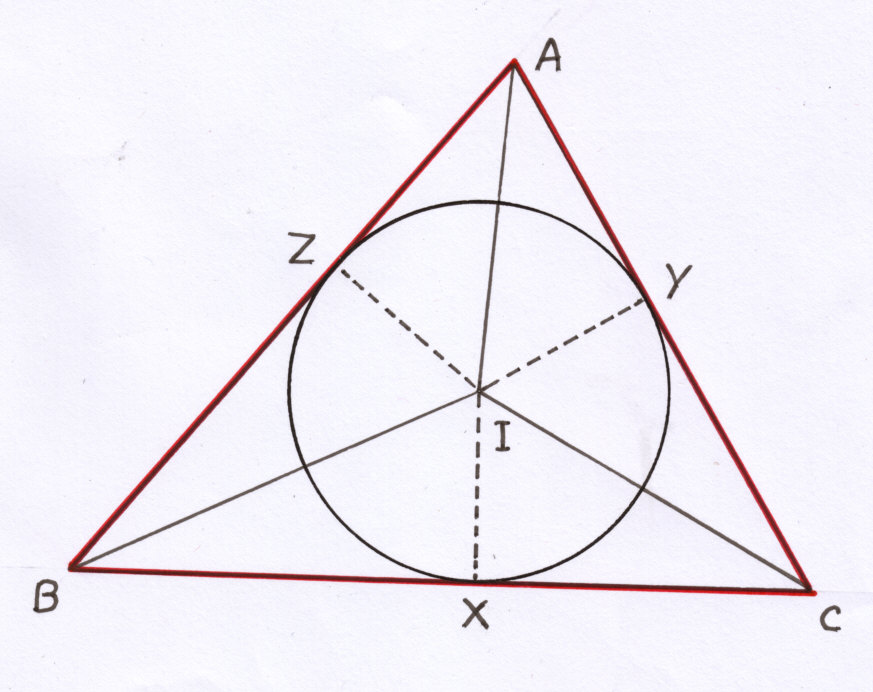
The Incircle

13108/img_trig_97.jpg

The Area of the triangle ABC is the sum of the areas of te triangles AIB; AIC; BIC.

Area\;of\;AIB\;=\;\frac{1}{2}\times AB\times Radius\;=\;\frac{1}{2}\;c\;r
(90)

Similar equations can be written for triangles AIC and BIC

Therefore the area of triangle ABC is given by:-

=\;r\times \frac{1}{2}(a\;+\;b\;+\;c)\;=\;r\times s\;\;\;\;\;\;\;where\;s\;=\;the\;semi\;perimeter
(91)

If X , Y , Z are the points of contact between the triangle and circle, then

BX = BZ ; CX = CY ; AY = AZ and the semi circumference of the triangle( s ) is given by:-

BX\;+\;XC\;+\;AY\;=\;s\;=\;AY\;+\;BC\;\;\;\;\;but\;\;\;\; BC\;=\;a
(92)
\therefore\;\;\;\;\;\;\mathbf{AY\;=\;s\;-\;a}
(93)

A similar relationship exists for AZ; BZ etc.

Blank

For the triangle AZI

r\;=\;AI\,sin,\frac{1}{2}A
(94)

Applying the sine formula to triangle AIB

\frac{AI}{sin\;\frac{1}{2}B}\;=\;\frac{c}{sin\,AIB}\;=\;\frac{c}{sin\,\left(180^0\;-\;\frac{A\;+\;B}{2} \right)}
(95)
=\;\frac{c}{sin\,\frac{1}{2}\,(A\;+\;B)}\;=\;\frac{c}{sin\,\frac{1}{2}\,C}
(96)
=\;\frac{2R\;sin\,C}{cos\,\frac{1}{2}\,C}\;=\;4R\;sin\,\frac{1}{2}\,C
(97)
\therefore\;\;\;\;\;AI\;=\;4R\;sin\,\frac{1}{2}\,B\times sin\,\frac{1}{2}\,C
(98)
Thus\;\;\;\;\;\mathbf{r\;=\;4R\;sin\,\frac{1}{2}\,A\,\times sin\,\frac{1}{2}\, B\times sin\,\frac{1}{2}\,C}
(99)

The Ex-circles.

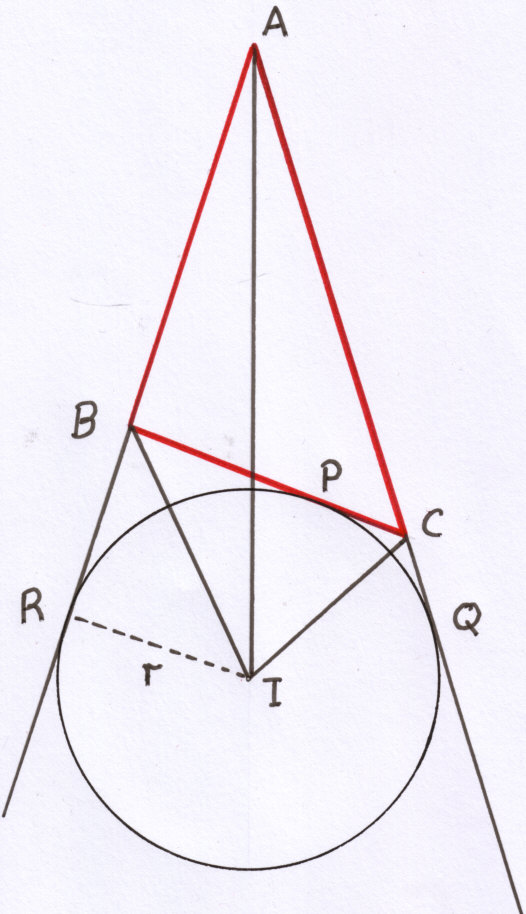
The diagram shows the ex-circle opposite to angle A. There are of course two more circles opposite B and C. There are similar equations for them .
Blank
13108/img_trig_98.jpg

Let P, Q, R, be the points of contact between the lines which make up the sides of the triangle ABC and the circle.

Equating the areas of triangles ABC, AIB, AIC, BIC. we get:-

\Delta ABC\;=\;\Delta AIB\;+\;\Delta AIC\;-\;\Delta BIC
(100)

This can be re-written in terms of r the radius of the ex-circle

\Delta ABC\;=\;\frac{1}{2}\,c\,r\;+\;\frac{1}{2}\,b\,r\;-\;\frac{1}{2}\;a\,r\;=\;\frac{1}{2}\,r\,(b\;+\;c\;-\;a)
(101)
but\;\;\;\;\;\;2\,s\;=\;a\;+\;b\;+\;c
(102)
\therefore\;\;\;\;\;\;\Delta ABC\;=\;r(s\;-\;a)
(103)

Thus the radius of the ex-circle, r is given by the equation:-

\mathbf{r\;=\;\frac{\Delta ABC}{(s\;-\;a)}}
(104)
Blank

By inspection AR = AQ ; BR = BP ; CQ = CP.

\therefore\;\;\;\;\;AB\;+\;BP\;=\;AC\;+\;CP\;=\;\frac{1}{2}\;perimeter\;=\;s
(105)
Thus\;\;\;\;\;\;BP\;=\;s\;-\;c\;\;\;and\;\;\;PC\;=\;s\;-\;b
(106)

From triangle AIR

r\;=\;AI\;sin\,\frac{1}{2}\,A
(107)

Using the sine formula in triangle ABI

\frac{AI}{sin\,ABI}\;=\;\frac{c}{sin\,AIB}
(108)
\therefore\;\;\;\;\;\frac{AI}{sin\;(90^0\;+\;\frac{1}{2}B)}\;=\;\frac{c}{sin\;(90^0\;-\;\frac{1}{2}B\;-\;\frac{1}{2}A)}
(109)
\therefore\;\;\;\;\;\frac{AI}{cos\,\frac{1}{2}B}\;=\;\frac{c}{sin\frac{1}{2}C}\;=\;\frac{2R\;sin\,C}{sin\frac{1}{2}C}
(110)
=\;4R\;cos\,\frac{1}{2}C
(111)
\therefore\;\;\;\;\;AI\;=\;4R\,cos\,\frac{1}{2}\,B\;cos\,\frac{1}{2}\,C
(112)
Thus\;\;\;\;\;\;\;\mathbf{r\;=\;4R\;sin\,\frac{1}{2}\;A\times cos\,\frac{1}{2}\,B\times cos\,\frac{1}{2}\,cos\,C }
(113)

The Triangle Formed by the Three Ex-centres

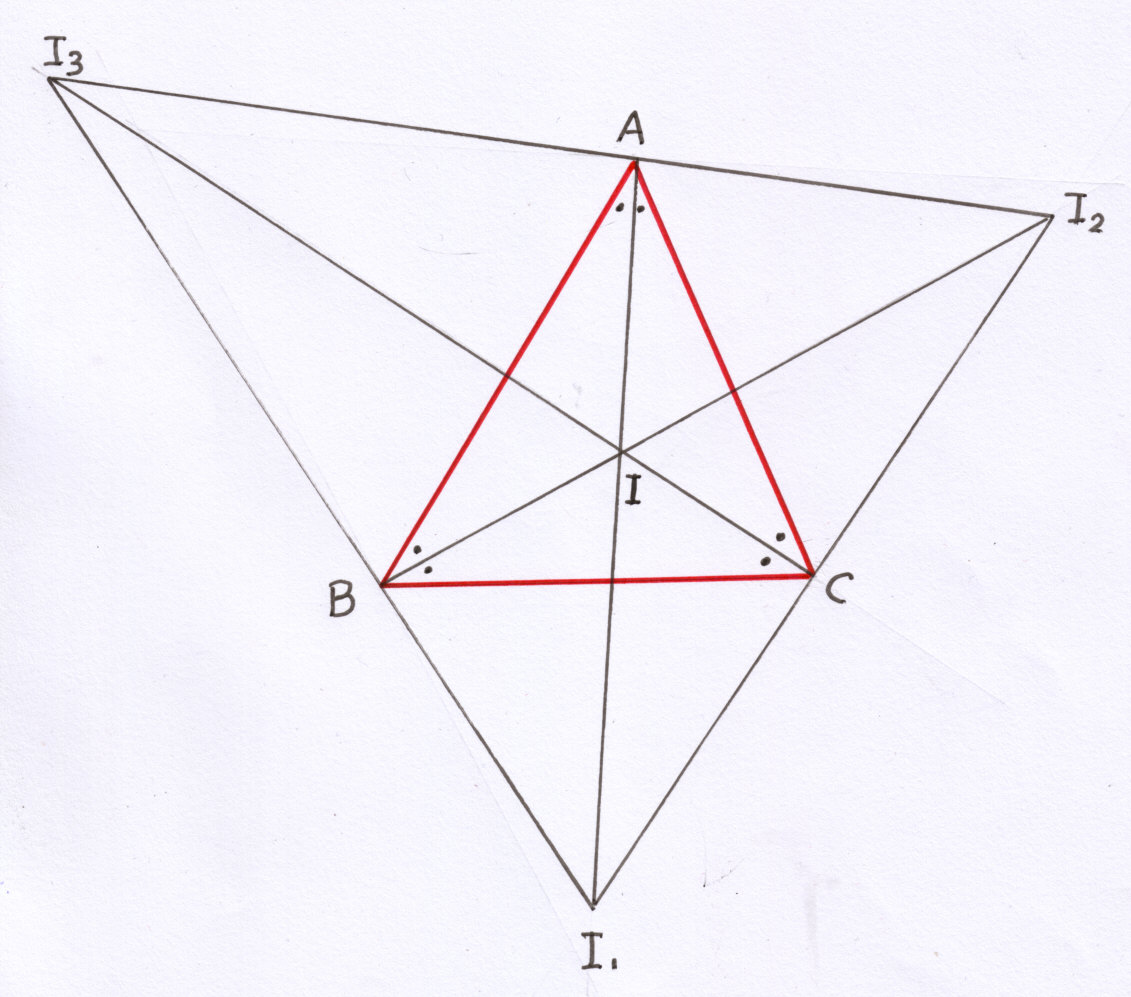
It is clearly possible to draw a triangle based upon the three ex-centres.
13108/img_trig_99.jpg
Blank

Since AI_2\,,\,AI_3 are the external bisectors of the angle A , the line I_2 A |_3 is a straight line as is also the line A\,I\,I_1( the Internal bisector)

As the external and internal bisectors of an angle are perpendicular, AI_1 is perpendicular to I_2\,I_3

Therefore the triangle ABC is the Pedal Triangle of I_1,I_2,I_3 and I is the orthocentre.

Since\;\;\;\;\;I_1\,BC\;=\;90^0\;-\;\frac{1}{2}\,B\;\;\;\;and\;\;\;\;I_1CB\;=\;90^0\;-\;\frac{1}{2}C
(114)
BI_1C\;=\;\frac{1}{2}(B\;+\;C)\;=\;90^0\;-\;\frac{1}{2}\,A
(115)
\therefore\;\;\;\;\;BC\;=\;I_2I_3\;cos(90^0\;-\;\frac{1}{2}A)
(116)
Thus\;\;\;\;\;\;I_2I_3\;=\;\frac{a}{sin\frac{1}{2}A}\;=\;2R\;\frac{sin\;A}{sin\frac{1}{2}A}
(117)

Therefore the Length of the side of the Triangle through A is :-

\mathbf{I_2I_3\;=\;4R\;cos\;\frac{1}{2}A}
(118)

The nine point circle of I_1I_2I_3 will pass through the feet of its altitudes ABC. The radius of the its nine point circle is therefor R. But since the radius of a nine point circle is half that of the circum-circle, the radius of the circum-cirle of I_1I_2I_3 is 2R

\therefore\;\;\;\;\;\;II_1\;\;=\;2(2R)\;cos\,(90^0\;-\;\frac{1}{2}A)
(119)
\mathbf{Thus\;\;\;\;\;II_1\;=\;4R\;sin \,\frac{1}{2}A}
(120)