
This section contains worked examples of the type of differential equation which can be solved by integration

You're viewing an older version of this page (#3401). View the current version.

View versions (2)

Introduction.

This section contains worked examples of the type of differential equation which can be solved by direct Integration. The questions are graded from fairly basic to some which were set as part of a London University Engineering degree. We have "hidden" the solutions so it will be necessary to log into Codecogs before you can see them. If you are not already a member then please register. Membership is free and the registering process simple!

Should you find any mistakes in the calculations, please contact us through the Forum

Example 1

1

\mathbf{\frac{dy}{dx}\;=\;\frac{1}{cos^2\,\frac{1}{2}x}}
(2)

More...

Thus\;\;\;\;\;\;y\;=\;2\,tan\,\frac{1}{2}\,x\;+\;C
(3)

Example 2

2

\mathbf{\frac{d^2y}{dx^2}\;=\;2\;+\;\frac{1}{x}}
(5)

More...

\therefore\;\;\;\;\;\;y\;=\;x^2\;+\;x\,ln\,x\;+\;Cx\;+\;K
(6)

Example 3

3

\mathbf{\frac{dx}{dy}\;=\;1\;-\;y}
(8)
x\;=\;a\;(tan\,(ax\;+\;c))
(9)

More...

\therefore\;\;\;\;\;\;x\;=\;y\;-\;\frac{y^2}{2}\;+\;C
(10)

Example 4

4

\mathbf{\frac{dy}{dx}\;=\;a^2\;+\;y^2}
(12)

More...

x\;=\;a\;(tan\,(ax\;+\;c))
(13)

Example 5

5

\mathbf{\frac{dy}{dx}\;=\;\frac{x^2\;-\;1}{y}}
(15)

More...

\therefore\;\;\;\;\;\frac{y^2}{2}\;=\;\frac{x^3}{3}\;-\;x\;+\;C
(16)

Example 6

6

\mathbf{\frac{dy}{dx}\;=\;\frac{y}{x^2\;-\;1}}
(19)

More...

\therefore\;\;\;\;\;y\;=\;C\;\sqrt{-\;\left(\frac{1\;+\;x}{1\;-\;x} \right)}
(20)

Example 7

7

\mathbf{\sqrt{x\;-\;1}\;\;dy\;+\;\sqrt{y\;-\;1}\;\;dx\;=\;0}
(24)

More...

\therefore\;\;\;\;\; (y\;-\;1)\;=\;2\,(x\;-\;1)\;+\;K\,(x\;-\;1)^{\frac{1}{2}};+\;K^2\;\;\;\;\;where\;K\;=\;\frac{C}{2}
(25)

Example 8

8

\mathbf{\frac{1}{r}\;\frac{dr}{d\theta }\;=\;cot\,\theta }
(28)

More...

r\;=\;C\;sin\;\theta
(29)

Example 9

9

\mathbf{\frac{d}{dr}\left(r\,\frac{dp}{dr} \right)\;=\;0}}
(32)

More...

Blank
\therefore\;\;\;\;\;p\;=\;C\,\ln\,r\;+\;K
(33)

Example 10

10

\mathbf{x\,y\;dx\;-\;(1\;+\;x^2)\;dy\;=\;0}
(34)
Blank

More...

thus\;\;\;\;\;\;\;y\;=\;K\;\sqrt{(1\;+\;x^2)}
(38)

Example 11

11

\mathbf{tan\,x\;cot\,y\;\frac{dy}{dx}\;=\;2}
(41)
cot\,y\;dy\;=\;2\;cot\,x\;dx
(39)
\ln \,sin\,y\;=\;2\;\ln\,sin\,x
(40)
\therefore\;\;\;\;\;\;\;sin\,y\;=\;A\;sin^2\,x
(42)

Example 12

13

\mathbf{x\,dy\;+\;\sqrt{y^2\;+\;4}\;\;dx\;=\;0}
(50)
\frac{dy}{\sqrt{y^2\;+\;4}}\;=\;-\;\frac{1}{x}\,dx
(43)
\therefore\;\;\;\;\;\ln\left(y\;+\;\sqrt{y^2\;+\;4} \right)\;=\;-\;\ln\,x\;+\;C
(44)
\therefore\;\;\;\;\;\frac{C}{x}\;=\;y\;+\;\sqrt{y^2\;+\;4}
(45)
Thus\;\;\;\;\;\;\left(\frac{C}{x}\;-\;y \right)^2\;=\;y^2\;+\;4
(46)
Rearranging\;\;\;\;\;\;\;\frac{C^2}{x^2}\;-\;\frac{2Cy}{x}\;=\;4
(47)
\therefore\;\;\;\;\;\;\frac{2\,Cy}{x}\;=\;\frac{C^2}{x^2}\;-\;4
(48)
\therefore\;\;\;\;\;\;y\;=\;\frac{C}{2\,x}\;-\;\frac{2\,x}{C}
(49)

Put K\;=\;-\;\frac{2}{K}

Then \;\;\;\;\;\;\;\;y\;=\;K\,x\;-\;\frac{1}{K\,x}
(51)

Example 13

14

\mathbf{\frac{dy}{dx}\;=\;\frac{(1\;+\;x)\;y^2}{x^3}}
(55)
\frac{dy}{y^2}\;=\;\frac{(1\;+\;x)}{x^3}\;dx
(52)
\therefore\;\;\;\;\;\;-\;\frac{1}{y}\;=\;-\;\frac{1}{2x^2}\;+\;\frac{1}{x}\;+\;C
(53)
thus\;\;\;\;\;\;+\;\frac{1}{y}\;=\;\frac{2x\;+\;1\;-\;2Cx^2}{2x^2}
(54)
y\;=\;\frac{2x^2}{2x\;+\;1\;-\;2Cx^2}
(56)

Example 14

15

Find y if \frac{d^4}{dx^4}\;=\;\frac{w}{EI} where w;E;and I are constants and y\;=\;0\;and\;\frac{d^2y}{dx^2} \;=\;0 at both x = 0 and x = l

\frac{d^4y}{dx^4}\;=\;\frac{w}{EI}
(57)
\frac{d^3y}{dx^3}\;=\;\frac{w}{EI}x\;+\;A
(58)
\frac{d^2y}{dx^2}\;=\;\frac{w}{2EI}x^2\;+\;Ax\;+\;B
(59)

Which equals 0 at x = 0 and x = 1

Thus B = 0 and A\;=\;-\;\frac{w\,l}{2EI}

\therefore\;\;\;\;\;\;\frac{dy}{dx}\;=\;\frac{wx^3}{6EI}\;+\;\frac{Ax^2}{2}\;+\;C
(60)
\therefore\;\;\;\;\;\;y\;=\;\frac{wx^4}{24EI}\;+\;\frac{Ax^3}{6}\;+\;Cx\;+\;D
(61)

When x = 0 y = 0 and therefore D = 0

\therefore\;\;\;\;\;\;0\;=\;\frac{wl^4}{24EI}\;-\;\frac{wl^4}{12\,EI}\;+\;Cl
(62)
\therefore\;\;\;\;\;\;C\;=\;\frac{wl^3}{24EI}
(63)
Thus\;\;\;\;\;\;y\;=\;\frac{w}{EI}\left(\frac{x^4}{24}\;-\;\frac{x^3l}{12}\;+\;\frac{l^3x}{24} \right)}
(64)

Example 15

16

Find y if \frac{d^4y}{dx^4}\;=\;\frac{w}{EI} and y = 0 at x = 0 and x = l. \frac{dy}{dx}\;=\;0\;at\;x\;=\;0\;and\;\frac{d^2y}{dx^2}\;=\;0\;at\;x\;=\;l

\frac{d^4y}{dx^4x}\;=\;\frac{w}{EI}
(65)
\frac{d^3y}{dx^3}\;=\;\frac{w}{EI}x\;+\;A
(66)
\frac{d^2y}{dx^2}\;=\;\frac{w}{EI}x^2\;+\;Ax\;+\;B
(67)
\frac{dy}{dx}\;=\;\frac{w}{EI}x^3\;+\;Ax^2\;+\;Bx\;+\;C
(68)
y\;=\;\frac{w}{EI}x^4\;+\;Ax^3\;+\;Bx^2\;+\;Cx\;+\;D
(69)

From equation (67) when x = 0 \frac {d^2y}{dx^2}\;=\;0)

So\;\;\;\;\;\;0\;=\;\frac{wl^2}{2EI}\;+\;Al\;+\;B
(70)

From equations (68) and (69) when \frac{dy}{dx}\;=\;0\;and\;x\;=\;0 and y = 0 at x = 0

so both C and D = 0

However at y = 0 x can also equal l

So\;\;\;\;\;\;0\;=\;\frac{wl^4}{24EI}\;+\;A\frac{l^3}{6}\;+\;B\frac{l^2}{2}
(71)

Rearranging equation (70) gives:-

B\;=\;-\;\left(\frac{wl^2}{2EI}\;+\;Al \right)
(72)

And this value for B into equation (71)

0\;=\;\frac{wl^4}{24EI}\;+\;\frac{Al^3}{6}\;-\;\frac{l^2}{2}\left(\frac{wl^2}{2EI}\;+\;Al} \right)
(73)
0\;=\;\frac{wl^4}{24EI}\;+\;\frac{Al^3}{6}\;-\;\frac{wl^4}{4EI}\;-\;\frac{Al^3}{2}
(74)
=\;\frac{5wl^4}{24EI}\;+\;\frac{Al^3}{3}
(75)
\therefore\;\;\;\;\;\;\;A\;=\;-\;\frac{5wl}{8EI}
(76)
\therefore\;\;\;\;\;\;y\;=\;\frac{wx^4}{24EI}\;-\;\frac{5}{48}\;\frac{wlx^3}{EI}\;-\;\frac{wl^2x^2}{4EI}\;+\;\frac{5wl^2x^2}{16EI}
(77)
Hence\;\;\;\;\;\;y\;=\;\frac{wx^2}{48EI}\left(2x^2\;-\;5xl\;+\;3l^2 \right)
(78)

Example 16

17

Solve the following equation given that y = 0 at x = 0

\mathbf{\frac{dy}{dx}\;=\;sec\,y}
(81)
cos\;y\;dy\;=\;dx
(79)
\therefore\;\;\;\;\;\;\;sin\,y\;=\;x\;+\;A
(80)

But when x = 0 y = 0 and so A = 0

\therefore\;\;\;\;\;\;\;y\;=\;sin^{-1}x
(82)

Example 17

18

Solve the following equation given that x = 1 at y = 2

\mathbf{(1\;-\;x^2)\;y^2\;dx\;+\;dy\;=\;0}
(85)
(1\;-\;x^2)\;dx\;=\;-\;\frac{1}{y^2}\;dy
(83)
\therefore\;\;\;\;\;\;\;x\;-\;\frac{x^3}{3}\;=\;\frac{1}{y}\;+\;C
(84)

When x = 1 y = 2. Hence C = 1/6

\frac{1}{y}\;=\;x\;-\;\frac{x^3}{3}\;-\;\frac{1}{6}
(86)

Example 18

19

Solve the following equation :-

\mathbf{\frac{r\;tan\theta }{a^2\;-\;r^2}\frar }{d\theta}\;=\;1\;\;\;\;r\;=\;0\;\;\;at\;\;\;\theta \;=\;\frac{\pi }{4}}
(94)
{\frac{r}{a^2\;-\;r^2}\dr \;=\;\frac{1}{tan\,\theta }d\theta
(87)
\therefore\;\;\;\;\;\;-\;\frac{1}{2}\ln(a^2\;-\;r^2)\;=\;\ln\,sin\,\theta \;+\;\ln\;C
(88)
\therefore\;\;\;\;\;\;\frac{1}{\sqrt{a^2\;-\;r^2}}\;=\;C\;sin\,\theta
(89)
But\;\;\;\;\;r\;=\;0\;\;\;\;when\;\;\;\;\theta \;=\;\frac{\pi }{4}
(90)
\therefore\;\;\;\;\;\frac{1}{a}\;=\;\frac{C}{\sqrt{2}}
(91)
thus\;\;\;\;\;\;c\;=\;\frac{\sqrt{2}}{a}
(92)
\therefore\;\;\;\;\;\;\frac{1}{(a^2\;-\;r^2)}\;=\;\frac{2}{a^2}\;sin^2\theta
(93)
(a^2\;-\;r^2)\;=\;\frac{a^3}{2}\;cosec^2\theta
(95)

Example 19

20

Solve the following equation given that v = o when \phi \;=\;0

\mathbf{\frac{dv}{d\phi }\;=\;e^{-v}\;sin\,\phi }}
(99)
e^v\,dv\;=\;sin\,\phi \;d\phi
(96)
e^v\;=\;-\;cos\,\phi \;+C
(97)

But when v = 0 \phi = 0 and therefore C = 2

\therefore\;\;\;\;\;\;e^v\;=\;-\;cos\,\phi \;+\;2
(98)
v\;=\;\ln(2\;-\;cos\,\phi)
(100)

Example 20

21

Show that the general solution to the equation;-

\mathbf{(1\;+\;y^2)dx\;+\;(1\;+\;x^2)\,dy\;=\;0}
(107)

can be written in the form \displaystyle y\;=\;\frac{a\;-\;x}{1\;+\;ax} where a is an arbitrary constant. Find the particular solution which makes y = 2 when x = 1

(1\;+y^2)\,dx\;=\;-\;(1\;+x^2)\,dy
(101)
\frac{dx}{1+x^2}=\frac{dy}{1+y^2}
(102)
\therefore\;\;\;\;\;\;\;tan^{-1}y\;=\;tan^{-1}x\;+\;tan^{-1}a
(103)
\therefore\;\;\;\;\;\;\;tan^{-1}y\;=\;tan^{-1}\frac{x\;+\;a}{1\;-\;ax}
(104)
thus\;\;\;\;\;\;\;y\;=\;\frac{a+x}{1-ax}\;\;\;\;or\;\;\;\;\frac{a-x}{1+ax}
(105)

The choice of answer depends upon the value of "a"

When y = 2 x = 1

2\;=\;\frac{a-1}{1+a}
(106)

from which a = -3

y\;=\;\left(\frac{-3\;-\;x}{1-3x} \right)\;=\;\left(\frac{x+3}{3x-1} \right)
(108)

Example 21

22

\mathbf{If\;\;\;\;\;(x-xy^2)dx\;+\;(y+yx^2)dy\;=\;0\;\;\;Prove \;that\;y^2\;=\;1+C(1+x^2)}
(113)
x(1-y^2)dx\;=\;-\;y(1+x^2)dy
(109)
\therefore\;\;\;\;\;\;\frac{x}{1+x^2}dx\;=\;-\;\frac{y}{1-y^2}dy
(110)
\therefore\;\;\;\;\;\;\ln(1+x^2)\;=\;\ln-(1-y^2)\;-\ln C
(111)
Thus\;\;\;\;\;\;C(1+x^2)\;=\;-\,(1-y^2)
(112)
So\;\;\;\;\;\;\;y^2\;=\;1+C(1+x^2)
(114)

Example 22

23

If a and b are the radii of concentric spherical conductors at potentials of V_1 respectively, then V is the potential at a distance r from the centre. Find the value of V if;-

\mathbf{\frac{d}{dr}\left(r^2\;\frac{dV}{dr} \right)\;=\;0}
(115)
Blank

and V\;=\;V_1 at r = a and V = 0 at r = b

\frac{d}{dr}\left(r^2\frac{dV}{dr} \right)\;=\;0
(116)
\therefore\;\;\;\;\;\;r^2\frac{dV}{dr} \right)\;=\;A
(117)
\frac{dV}{A}\;=\;\frac{dr}{r^2}
(118)
\therefore\;\;\;\;\;\;\frac{V}{A}\;=\;-\;\frac{1}{r}\;+\;B
(119)

Substituting in the given values for V and r

\frac{V_1}{A}\;=\;-\;\frac{1}{a}\;+\;B
(120)
and\;\;\;\;\;\frac{0}{A}\;=\;-\;\frac{1}{b}\;+\;B
(121)
\therefore\;\;\;\;\;\;B\;=\;\frac{1}{b}
(122)
\therefore\;\;\;\;\;\;\frac{V_1}{A}\;=\;-\;\frac{1}{a}+\frac{1}{b}\;=\;-\;\frac{b-a}{ab}
(123)
Thus\;\;\;\;\;A\;=\;-\;\frac{abV_1}{b-a}
(124)
V\;=\;\left(\frac{1}{r}\;-\;\frac{1}{b} \right)\left(\frac{abV_1}{b-a} \right)
(125)

Example 23

24

For vertical motion of a particle under gravity, \frac{d^2y}{dx^2}\;=\;g where y is the distance of the particle below some fixed point. Find the general expression for y in terms of t and also find the particular solution which makes y = 50 and \frac{dy}{dt}\;=\;-\;20 at t = 0. Take g as 32 ft/sec.sq.

\frac{d^2y}{dx^2}\;=\;g
(126)
\therefore\;\;\;\;\;\frac{dy}{dt}\;=\;gt+A
(127)
\therefore\;\;\;\;\;y\;=\;\frac{1}{2}gt^2+At+B
(128)

At t = 0 \frac{dy}{dt}\;=\;-20

\therefore\;\;\;\;\;a\;=\;-\;20
(129)

And at t = 0 y = 50

So B = 50

Substituting in the equation for y

y\;=\;16t^2\;-\;20t\;+\;50
(130)

Example 24

25

A body which weighs 6 lbs, is acted upon by a force which diminishes uniformly with time from 1 lb weight to 1/2 lbs. wt. in 20 secs. If it starts from rest find its greatest velocity during the 20 secs. and how far it moves in this time.

The Force = 1 - Kt Where K is a constant

At t = 20 secs. Force = 1/5 lb.wt.

Using the above equation

And\;\;\;\;\;\frac{1}{5}\;=\;1-20K
(131)
\therefore\;\;\;\;\;\;Force\;=\;1-\frac{4}{100}t
(132)

Using Newton's second law

\frac{6}{32}\times \frac{d^2y}{dt^2}\;=\;\left(1-\frac{4}{100}t \right)
(133)
\frac{6}{32}\times \frac{dy}{dt}\;=\;t-\frac{2}{100}t^2 +A
(134)

But at t = 0 \frav{dy}{dt}\;=\;0 and therefore A = 0

\frac{6}{32}\times y\;=\;\frac{t^2}{2}-\frac{2}{300}t^3 +B
(135)

But at t = 0 y = 0 and therefore B = 0

At t = 0

\frac{dy}{dt}\;=\;\left(20 - \frac{2\times 20^2}{100} \right)\times \frac{32}{6}
(136)
=\;\frac{12\times 32}{6}\;=\;64\,ft/sec
(137)
y\;=\;\frac{32}{6}\left(\frac{20^2}{2}-\frac{2\times20^3}{300} \right)}\;=\;782\,\frac{2}{9}\;ft.
(138)

Example 25

26

A train of mass 300 tons travels along the level at a uniform speed of 80 ft/sec. against a resistance of 14 lb. wt/ton. It then climbs an incline of 1 in 100. Assuming that the horse power and the resistance remain constant, show that when the speed is v ft/sec.the retardation is (2v - 80)/5v ft/sec squared. Find the time taken for the speed to fall from 80 to 60 ft/sec. and how far the train has traveled in this time.(LU)

NOTE One ton is 2240 lbs.

One Horse power is 550 ft.lbs/sec

g = 32 ft/sec squared

The mass of the train is 300\times2240\times\frac{1}{32} slugs

Along the Level

The restance to motion is 300\times14\; lbs.

The output of the engine is 300\times\14 \times 80 ft.lbs.per second

=\frac{300\times14\times80}{550}\;=\;611 HP
(139)

Up the Incline

The total resistance \displaystyle =\;\left(\frac{300\times2240}{160}\;+\;300\times14 \right)\;\;lbs.wt.

Force up the incline due to the engine is:-

=\;\frac{300\times14\;\times80}{V}\;\;\;\;\;lbs.wt.
(140)

By Newton's second Law:-

\left( \frac{300\times2240}{160}\;+\;300\times14\;-\;\frac{300\times14\;\times80}{V} \right)g\;=\;300\times2240\times a
(141)
\therefore\;\;\;\;\;\;a\;=\;\frac{(2V-80)}{5V}
(142)
Thus\;\;\;\;\;\frac{1}{a}\;=\;\frac{dt}{dV}\;=\;\frac{5V}{2V-80}
(143)
or\;\;\;\;\;dt\;=\;\frac{5V}{2V-80}dV
(144)
\therefore\;\;\;\;\;dt\;=\;\left( \frac{5}{2}+\frac{200}{2V-80} \right)dV
(145)

Integrating

t\;=\;\left[\frac{5}{2}V+100 \ln\,(V-40) \right]^{80}_{60}
(146)
=\;50+100\ln2\;=\;119.3\,secs.
(147)

Example 26

27

The effective Horse Power of a ship of mass 10,000 tons is 6000 and its full speed is 20 mph. Assuming that the resistance to motion varies as the square of the speed and that the horse-power is constant, find the distance traveled from rest in attaining a speed of 16 mph (LU)

Note 60 mph is 88 ft/sec.

At 20 mph

Force output of the ship\;=\;\frac{�000\times 550}{V}

The resistance to motion is given by:-

Resistance\;=\;K\times \left(\frac{88}{60}\times20 \right)^2\;=\;600\times550\times\left(\frac{60}{88\times20} \right)
(148)
\therefore\;\;\;\;\;\;K\;=\;\frac{6ooo\times550\times27}{88^3}\;=\;131
(149)

It is easier to carry out the next stage of the solution in symbols

Hence Let the power of the engines be P

Let the Mass of the ship be M

Let the velocity be V

Applying Newton's Second Law:-

\frac{P}{V}\;-\;131V^2\;=\;M\;V\frac{dV}{dx}
(150)
or\;\;\;\;\;\;\frac{P\;-\;131V^3}{V}\;=\;M\;V\frac{dV}{dx}
(151)
\therefore\;\;\;\;\;\;\;\frac{dx}{M}\;=\;\left(\frac{V^2}{P-131V^3} \right)dV
(152)

Integrating

\frac{x}{M}\;=\;-\;\frac{1}{3\times 131}\left[\ln\;(P-131V^3) \right]^{\frac{88\times 16}{60}}_0
(153)

Substituting in numerical values:-

M = 10,000 X 2240 lbs and P = 6000 X 550 ft.lbs/sec.

\therefore\;\;\;\;\;\;x\;=\;\frac{10,000\times 2240}{393\times 32}\left[\ln\;\frac{3300000}{3300000\,-\,1692877} \right]
(154)
= 1781\times \ln 2.05\;\;=\;\;1279 ft.
(155)

Example 27

28

A body of weight W is shot upwards under gravity at a velocity of u and the air resistance is \frac{W}{g}KV^2 where K is a constant. Show that \displaystyle V^2\;=\;\left(u^2+\frac{g}{K} \right)e^{-2Kx}-\frac{g}{K} and the greatest height reached by the body is \displaystyle \frac{1}{2K}\ln\left(1+\frac{Ku^2}{g} \right) . If the terminal velocity of the body when dropping under gravity is 1000 ft/sec. find the maximum height approximately when u = 2,500 ft./sec.

Applying Newton's Second Law:-

W+KV^2\frac{W}{g}\;=\;-\;\frac{W}{g}\;V\frac{dV}{dx}
(156)
\therefore\;\;\;\;\;\;dx\;=\;-\;\frac{V\,dV}{g+KV^2}
(157)

Integrating

x\;=\;-\;\frac{1}{2K}\;\ln\left[g+KV^2 \right]^{V}_{u}
(158)
\therefore\;\;\;\;\;\;-\,2Kx\;=\;\ln\;\frac{g+KV^2}{g+Ku^2}
(159)
\therefore\;\;\;\;\;\;e^{-2Kx}\;=\;\frac{g+KV^2}{g+Ku^2}
(160)
Thus \;\;\;\;\;\;e^{-2Kx}\left(g+Ku^2 \right)-g\;=\;KV^2
(161)
\therefore\;\;\;\;\;V^2\;=\;\left(\frac{g}{K}+u^2 \right)e^{-2Kx}\;-\;\frac{g}{K}
(162)

At the greatest height V = 0

\therefore\;\;\;\;\;\frac{g}{K}\;=\;\left(\frac{g}{K}+u^2 \right)e^{-2Kx}
(163)
e^{-2Kx}\;=\;\frac{g}{K}\times \frac{K}{g+Ku^2}
(164)
-\,\ln\,\frac{g}{g+Ku^2}\;=\;2Kx\;=\;\ln\left(1+\frac{Ku^2}{g} \right)
(165)

Therefore the greatest height reached is given by:-

\frac{1}{2K}\;\ln\left(1+\frac{Ku^2}{g} \right)
(166)

If the terminal velocity of the body when dropping under gravoity is 1000 ft/sec.

At terminal velocity.

W\;=\;\frac{KV^2}{g}W
(167)
\therefore\;\;\;\;\;\;KV^2\;=\;g
(168)
\therefore\;\;\;\;\;\;K\;=\;\frac{g}{10^6}
(169)

The greatest height equals

\frac{10^6}{32\times 2}\;\ln\left(1+\frac{25^2\times 10^4}{10^6} \right)\;=\;31000\,ft.
(170)

Example 28

29

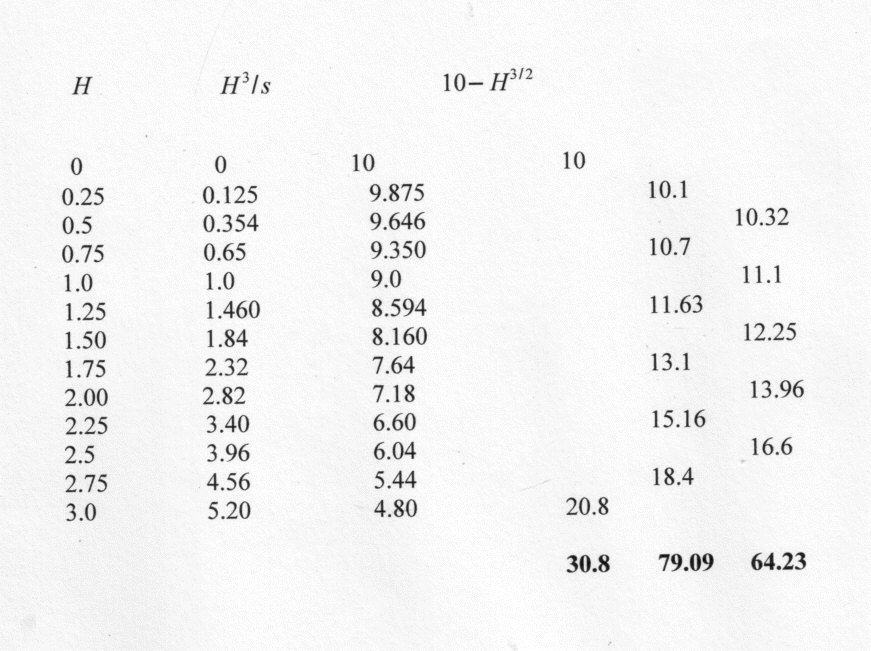
In a reservoir receiving flood water and discharging over a weir, if H ft. is the height of the water above the sill of weir at any time t mins it is known that \frac{dt}{dH}\;=\;\frac{100}{10\;-\;H^{\frac{3}{2}}}. By graphical integration or otherwise estimate the time required for the level to rise 3 ft. from the instant when overflow commences. (LU)

13108/img_diff_eqn_100_1.jpg
\frac{dt}{dH}\;=\;\frac{100}{10-H^{\frac{3}{2}}}
(171)
\therefore\;\;\;\;\;\;{dt}\;=\;\frac{100}{10-H^{\frac{3}{2}}}dH
(172)

For Graphical integration using Simpsons Rulelet h = 0.2
13108/img_diff_eqns_101.jpg

By Simpsons rule

T\;=\;\frac{1}{3}\;h\;\left((first + last)+4\times odd + 2\times remaing\;even \right)
(173)
\therefore\;\;\;\;\;\;T\;=\;\frac{1}{3}\;0.25\;\left(30.8+4\times 79.09 + 2\times 64.23\right)
(174)
Thus\;\;\;\;\;\;\;T\;=\;39.6 Mins
(175)

Example 29

30

A particle of mass m moves in a straight line in a medium whose resistance is \displaystyle mk\,(v^3+\lambda ^2v) where v is the speed and k,\lambda are positive constants, there being no other forces acting on the particle.If the particle moves through the origin with given velocity u, find its distance from the origin when its velocity is v and show that whatever the velocity u, the maximum distance from the origin is \frac{\pi}{2k\lambda} (LU)

Applying Newton's Second Law

mk\left(v^3+\lambda ^2v \right)\;=\;-mv\frac{dv}{dx}
(176)
\therefore\;\;\;\;\;\;k\,dx\;=\;-\frac{dv}{(v^2+\lambda ^2)}
(177)

Integrating

\therefore\;\;\;\;\;\;k\,x\;=\;-\;\frac{1}{\lambda }\;tan^{-1}\frac{v}{\lambda }\;+\;C
(178)

When x = 0 y = u

Hence\;\;\;\;\;\;\;C\;=\;\frac{1}{\lambda k}\;tan^{-1}\frac{u}{\lambda }
(179)
\therefore\;\;\;\;\;\;\;x\;=\;\frac{1}{\lambda k}\;\left(tan^{-1}\frac{u}{\lambda }\;-\;tan^{-1}\frac{v}{\lambda } \right)
(180)

However large u becomes

tan\;\frac{u}{\lambda }\leq \inf.
(181)
\therefore\;\;\;\;\;\;\;tan^{-1}\;\frac{u}{\lambda }\leq \frac{\pi }{2}
(182)

Thus the maximum distance is given by:-

\mathbf{\hat{x}\;=\;\frac{\pi }{2k\lambda }}
(183)
Blank