
Simple Harmonic Motion
An analysis of Simple Harmonic Motion
You're viewing an older version of this page (#3795). View the current version.
Simple Harmonic Motion.
If a particle moves in a straight line in such a way that its acceleration is always directed towards a fixed point on the line and is proportional to the distance from the point, the particle is said to be moving with Simple Harmonic Motion.
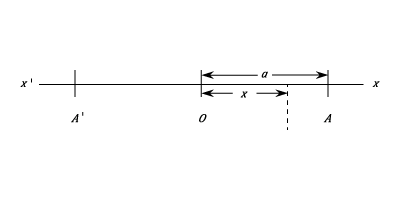
Let O be a fixed point on the line X'X and x the distance of the particle from O at any time t Also let the acceleration of the particle along OX as .is a positive constant. No matter whether x is positive or negative the acceleration will be directed towards O
If v is the velocity at time t the acceleration will be in the direction OX and will be given by the differential relationship :-
This can be expressed as:
or
In the initial stage of the motion v is negative as the particle is moving towards O
and
When t = 0 x = a and = 0 and hence K = 0
and
When cos nt = 0 and thus a particle starting from A moving towards O arrives in a time
with a velocity of
. It will continue along the straight line and its velocity will be zero when
and
. It will then return to O arriving when
with a velocity an and reach A in a time
with zero velocity. The motion is then repeated indefinitely unless destroyed by some force.
Note.
- The time
is called the Period of the oscillation and is the time for one complete cycle.
- If the frequency is f and the period
then
Also
- If the period of the motion are known the motion is completely determined.
- The Period maybe written down at once if the magnitude of the acceleration for some value of x is known.
- The amplitude is determined by the initial displacement.
Other Initial Conditions
If the the motion is started by giving the particle a velocity when its distance from O is
, the type of motion is unchanged and the time is measured from this instant instead of the instant when x = a. In this case the value of x at any instant is given by :-
where is a constant]
Now
Also when
Then
And
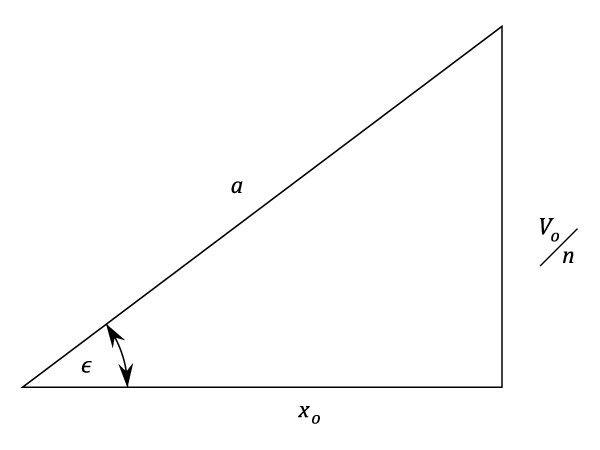
The Constant is called the Epoch of the motion. The Phase of the motion at time t is the time which has elapsed since the particle was at the positive end of its path, thus the phase is
less a multiple of the period.
Also
In particular if i.e.the particle starts from O
and the amplitude is
Since the acceleration at any instant is
This is characteristic of Simple Harmonic Motion and its solution is given by:-
may be written down if the amplitude and the epoch are known.
The Relation to Uniform Motion in a Circle.
If a particle is describing a circle of radius a with uniform angular velocity , its orthogonal projection on a diameter of the circle moves on the diameter in simple harmonic motion of amplitude a and period
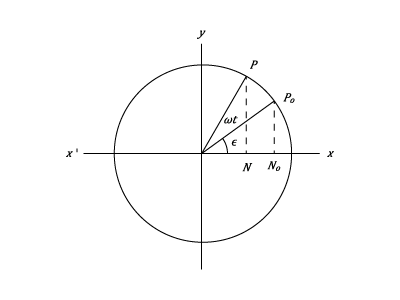
Let be the angle which the radius initially makes with the diameter X'OX . Then after a time t the angle made by the radius to the particle is
. Hence if P is the position of the particle at time t and N the foot of the perpendicular from P on OX, then:-
and the point moves with Simple Harmonic Motion of amplitude a and period
Example 1 [imperial]
A particle moves with Simple Harmonic Motion in a straight line. Find the time of a complete oscillation if the acceleration is 4 ft/sec\^2, when the distance from the centre of the oscillation is 2 ft. If the Velocity with which the particle passes through the centre of oscillations is 8 ft./sec. find the amplitude.
If the acceleration is at a distance x from the centre then:
Hence the period is:
If the phase is zero when
where a is the amplitude. Then
And the value of v at the centre of oscillation is
and
The period is
and amplitude
Example 2
In a brake test on an engine the coefficient of friction between the rope and the wheel is . The rope carries a load W at one end and is attached to a spring of stiffness s at the other. Find the period of oscillation of W, the general expression for the displacement of W in terms of t and the least and greatest values for the tension of the rope on the side of W when W is making oscillations of amplitude a.
When the spring is extended a distance x, its tension on the other side of the wheel is
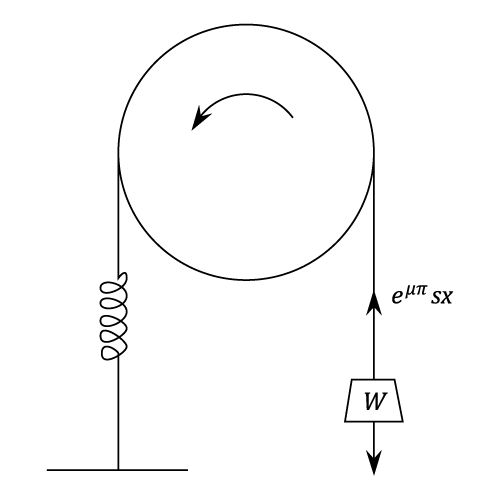
Applying Newton's Second Law
From which it can be shown that:
Hence the weight oscillates with a period which is given by :
about a centre at a distance
The general expression for x in terms of t is : where
The greatest and least tensions of the rope are the values of when W is in its lowest and highest positions. i.e. when
. The greatest and least value tensions are therefore
If the period of oscillation of W is 1/3 secs. and a = 1/4 in then and
.
Therefore the least and greatest tensions are 0.77 W and 1.23 W
The least and greatest tensions are 0.77 W and 1.23 W
Example 3 [imperial]
If the weight of a body is 16 lbs. and = 18lbs./ft. find the period of its oscillation. Also, if the body is given a velocity of 1/3 ft./sec. away from O find the displacement t secs. later and the amplitude of the oscillation.
Applying Newton's Second Law i.e
Hence the Period is
Now
But at t = 0
Substituting in equation (#1)
And in equation (#2)
#E3 where
Thus the amplitude of the oscillations is
The Period is
The displacement is
The amplitude of the oscillations is