
Damped and Forced Oscillations
The Equations for damped and forced and damped Oscillations
You're viewing an older version of this page (#3405). View the current version.
Damped Oscillations.
Consider the motion of a body in a viscous fluid in which the resistance to motion is proportional to the velocity. Suppose that the body has a weight W and that it is acted upon by a force acting towards x = 0 ; by a constant force F and by a resistance
Then applying Newtons Second Law the equation of motion is :-
Putting
The equation of motion can be re-written as :-
By putting
x = b is the position of statical equilibrium and y is the displacement from the equilibrium position.
The Auxiliary equation is :-
The solution of equation therefore takes three forms depending upon whether k '<'n; k = n or k > n.
- If k < n there is slight damping.
In this case the body oscillates with a period of . It can also be shown that successive amplitudes form a geometric progression and that the ratio of successive extreme positions on either sides of y = 0 is
. In other words the logarithmic decrement of the oscillation is
.
- If k = n the motion is critically damped and there will be no oscillations. Both roots of the auxiliary equation are equal to -k.
- If k>n the result is a high degree of damping.
This can be written as equal to
As are all positive
will tend to zero as t tends towards infinity. Thus in all three cases as t tends to infinity y tends towards zero and x tends towards b. As a result in case one the oscillations are damped out and the body will ultimately come to rest in its equilibrium position. In the second two cases there will be no oscillations and the body will come to rest in its equilibrium position. In some cases the body may pass through the equilibrium position before returning to it.
Example 1
A body which weighs 8 lbs. is acted upon by three forces
- 6.25x lb.wt acting towards x = 0.
- A constant force of 2.5 lbs.wt.
- A resistance of
.
If find x in terms of t when ;_
- r = 0.7
- r = 2.5
- r = 6.5
Sketch a rough graph of x against t for the three cases.
By Newton's Second Law the equation of motion is:-
Re-arranging
Let x = 0.4 + y (x = 0.4 is the equilibrium position)
In the first case r = 0.7 so the above equation becomes :-
The resulting auxiliary equation is :-
from which
The Period of the oscillations is:-
Had there been no damping the Period would have been :-
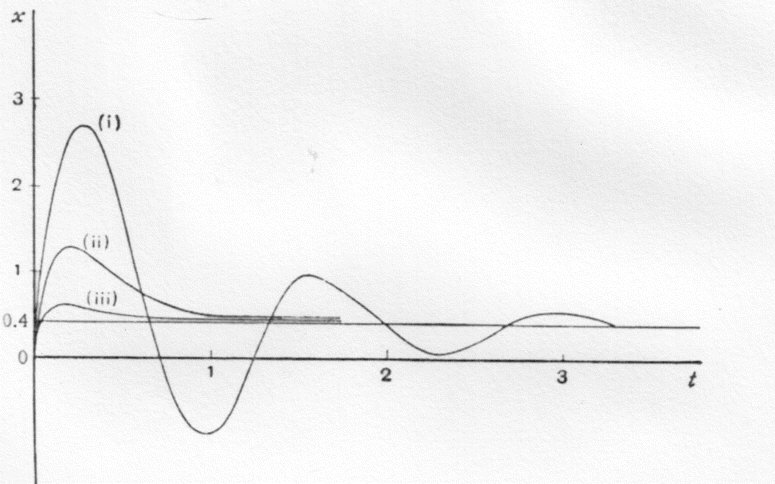
In the second case r = 2.5 and the equation of motion is :-
The auxiliary equation is which has equal roots of -5
This has one maximum value of approximately 1.3 at t = 0.23
The body will pass through the equilibrium position of x = 0.4 at t = 0.4/14 and then creep back to it again as t tend to infinity.
In the third case r = 6.5 and the equations become:-
which has roots m = -1 and m = -25
This has one maximum value . The body passes through its equilibrium position when
and then creeps back to it as t tends to infinity.
Had a smaller initial velocity been taken than 16 ft./sec. it would have been found that when r>2.5 the body would never reach its equilibrium position until t was infinite but that when r<2.5 it would oscillate just as before.
Forced Oscillations
If in addition to the force which causes Simple Harmonic Motion and the force
which causes damping, the body is acted upon by a force
the equation of Motion now becomes:-
This can be re-written as :-
have the same meaning as before.
To solve this equation let x = u be a solution of the above equation in which case:-
Now substitute x = u + z in equation (32)
Subtracting equation (S) from (T)
Thus z is the solution for free damped harmonic oscillations which we have already found in the previous paragraph. Therefore the solution of (32) is obtained by adding together u which is any particular solution and naturally depends upon f(t) and z which is the general solution for free oscillations. i.e. when there is no applied force f(t). We have already seen that the latter is damped out as t increases and hence the solution approaches x = u as t tends towards infinity. Foe this reason u is called the Steady State and the part z which dies away is called the transient.
In most cases the applied force is either a constant one or it s periodic of period . In which case f(t) is of the form
and the steady state can be found by assuming a trial solution
and finding A and B by making the resulting equation identically true, i.e. by making the coefficients of
the same on the left hand side of the equation as on the right. This method of finding A and B is shown in the following example.
Example 2
Find the general solution to the equation:-
Equating the coefficients of cos 2t and then sin 2t;_
Therefore the steady state is given by:-
To find the Transient substitute in equation (33)
The Auxiliary equation is therefore:-
From which it ca be shown that:-
And the general Solution is:-
Note that the steady state is an oscillation of the same period as the applied force but that it lags
behind the phase of the applied force.
If in the above example the body starts from rest at the origin then:-
Differentiating equation (48)
Hence by putting in the values at t = 0
Whence C = -1 and D = -7
Therefore the particular solution required is:-
It can be seen that the amplitude of the transient is less than 0.03% 0f the amplitude of the steady state after one period of the steady state, but of course, the transient can be made to die away as fast or as slowly as is required by choosing suitable values of r in the resisting force
Please Note that there will be more worked examples in the third section of " Differential Equations. Worked Examples. This is currently in preparation and should be available shortly.