
Strain Energy
A beam is a horizontal structural element that is capable of withstanding load primarily by resisting bending. The bending force induced into the material of the beam as a result of the external loads, own weight, span and external reactions to these loads is called a bending moment.
Deflection is a term that is used to describe the degree to which a structural element is displaced under a load.
Strain energy due to bending and deflection calculated using Calculus
You're viewing an older version of this page (#3749). View the current version.
Strain Energy due to Bending.
Consider a short length of beam under the action of a Bending Moment
. If
is the Bending Stress on an element of the cross section of area
at a distance
from the Neutral Axis, then the Strain energy of the length
is given by:
where
represents The Volume.
But
For the whole beam
The product is called the flexural Rigidity of the beam.
Example 1 [imperial]
A simply supported beam of length carries a concentrated load
at distances of
and
from the two ends.
Find expressions for the total strain energy of the beam and the deflection under load.
The integration for strain energy can only be applied over a length of beam for which a continuous expression for can be obtained. This usually implies a separate integration for each section between two concentrated loads or reactions.
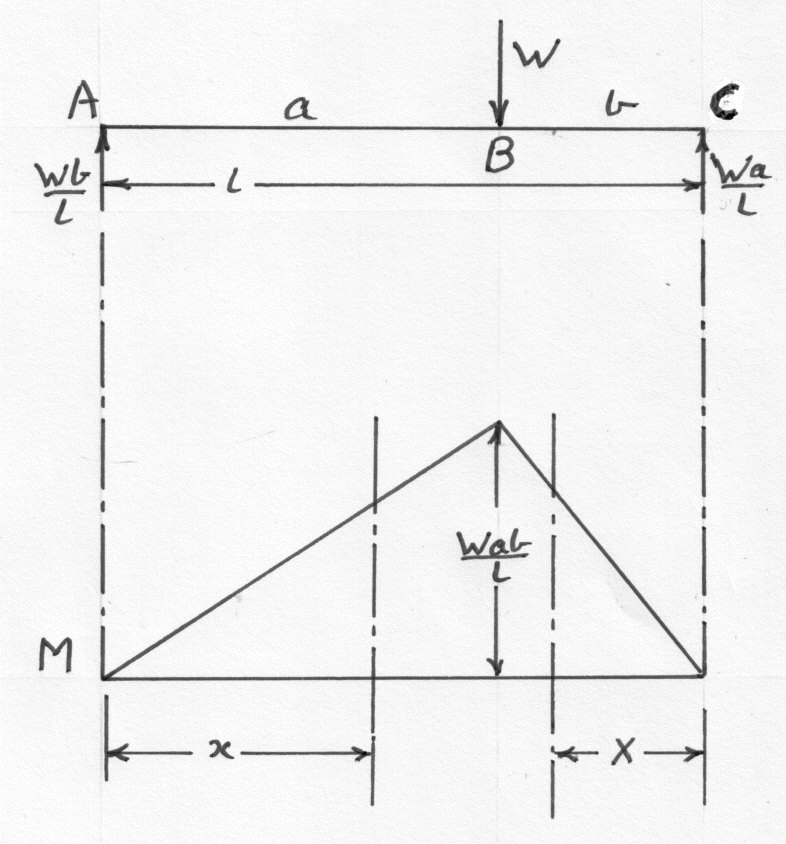
For the section .
Similarly by taking a variable measured from
Total:
But if is the deflection under the load, the strain energy must be equal to the work done by the load if it is gradually applied.
For a Central Load:
Hence:
It should be noted that this method of finding deflection is limited to cases where only one concentrated load is applied (i.e. doing work) and then only gives the deflection under the load . For a more general application of strain energy to deflection see Castigliano's Theorem. This can be found under Engineering Materials Curved Beams.
- The total strain energy is
- The deflection under load is
.
Example 2 [imperial]
Compare the strain energy of a beam, simply supported at its ends and loaded with a uniformly distributed load, with that of the same beam centrally loaded and having the same value of maximum bending moment.
If is the span and
the Flexural Rigidity, then for a uniformly distributed load
, the end reactions are
and at a distance
from one end:
Using Equation (1),
Using Equation (1)-from the Example 1 for a central load ,
The Maximum Bending Stress and for a given beam depends upon the maximum Bending Moment. ( See Engineering materials Shear Force and Bending Moments)
Equating maximum Bending Moments:
Using Equations (#1) and (#2), the ratio
Using Equation (#3),
Deflection by Calculus
In "Bending Stress" equation (3) it the general equation on bending was written. From this it can be seen that:
And that in terms of the co-ordinates and
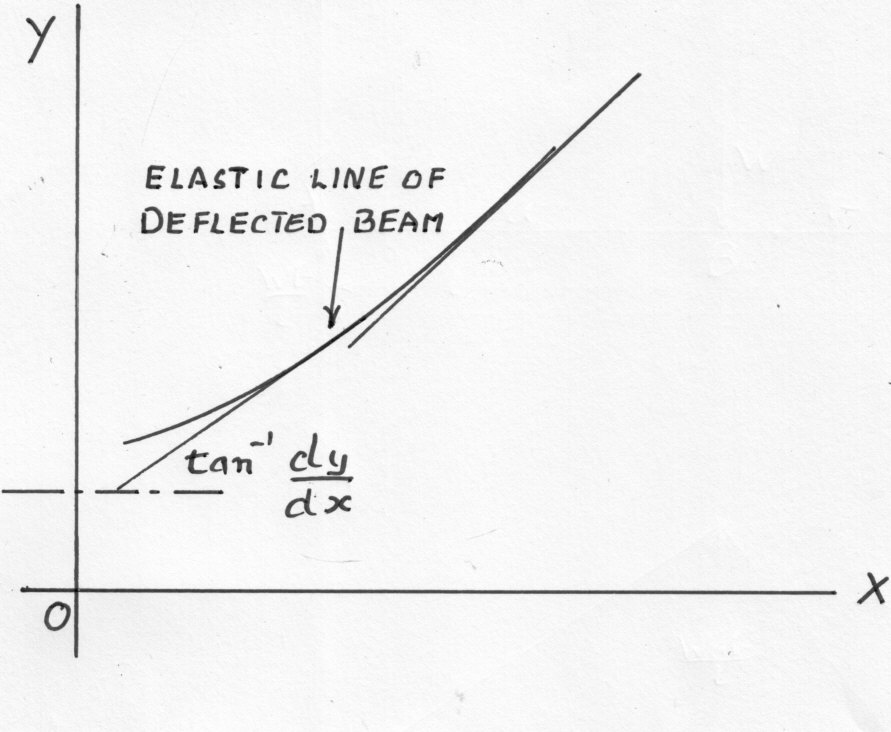
The sign depends upon the convention for axes. For beams met with in normal engineering practice the slope is everywhere very small and may be neglected in comparison to 1 in the denominator.
Taking as positive upwards, under the action of a positive Bending Moment, the curvature of the beam is shown in the diagram.
It can be seen that is increasing as
increases.
i.e. is positive and therefore,
Hence
Or
Thus provided that can be expressed as a function of
equation(#2) can be integrated to give the slope
and the deflection
can be found for any value of
. Two constants of integration will be involved and these can be found by substituting known values of slope or deflection at particular points. A mathematical expression is thus obtained for the form of the deflected beam. (Also known as The Elastic Line)
Notes on Application
- Take the
axis through the level of the supports.
- Take the origin at one end of the beam or at a point of zero slope.
- For built in or fixed end beams or when the deflection is a maximum. The slope
- For points on the
For those working in Imperial Units.
It is convenient to use the following units
in
( or
)
in
in
in
(or
)
in
After the integration, one side of the Equation has units
and the other side has units
. Hence in numerical questions, the right hand side has to be multiplied by 144. After the second integration
has units
and the corresponding right-hand side must be multiplied by 1728.
It is possible to differentiate equation (#2) and in which case:
(See the paragraph on the relationship between and
in Engineering Materials Shearing Force and Bending Moment.)
These forms are of use in some cases although generally the Bending Moment relationship is the most convenient.
Example 1 [imperial]
Obtain expressions for the maximum slope and deflection of a cantilever of length carrying:
- a) A concentrated load
at its free end.
- b) A uniformly distributed load
along its whole length.
- a) If the origin is taken through the free end and the
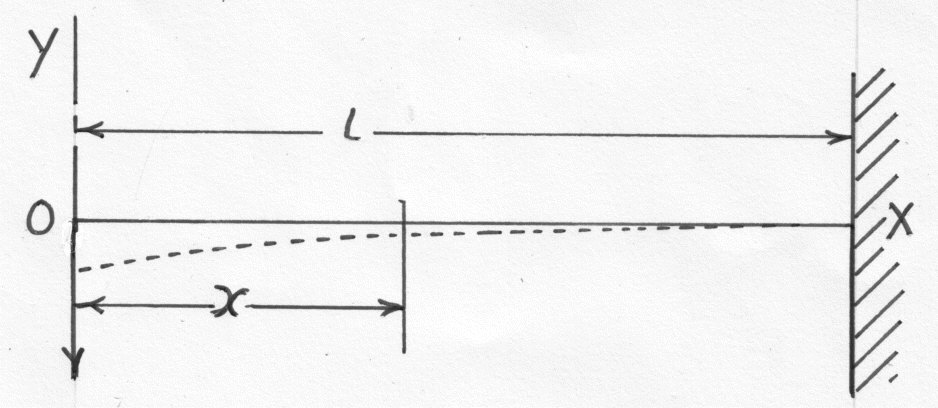
And using equation (2) from above
Integrating: But
at
Integrating again:
At
The slope and deflection at the free end ( Where they are at a maximum) are given by the values of and
when
i.e. The Slope
And the deflection (Note the negative sign indicating downwards)
- b)
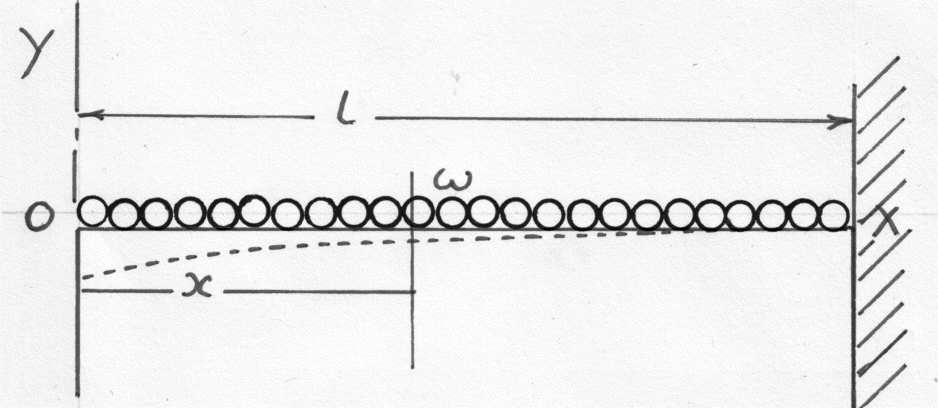
Integrating
When
Integrating again:
When
Putting
The Slope
The Maximum Deflection
- a) The Slope is
and the deflection is
.
- b) The Slope is
and the Maximum Deflection is
.