
Multiple Continuous Beams
A beam is a horizontal structural element that is capable of withstanding load primarily by resisting bending. The bending force induced into the material of the beam as a result of the external loads, own weight, span and external reactions to these loads is called a bending moment.
Span is the distance between two intermediate supports for a structure, e.g. a beam or a bridge.
The deflection of Continuous Beams with more than one span.
Continuous Beams
When a Beam is carried on three or more supports it is said to be Continuous. It is possible to use an extension of the Moment-Area method (See "Bending of Beams Part 3") to obtain a relationship between the Bending Moments at three points (usually supports.)
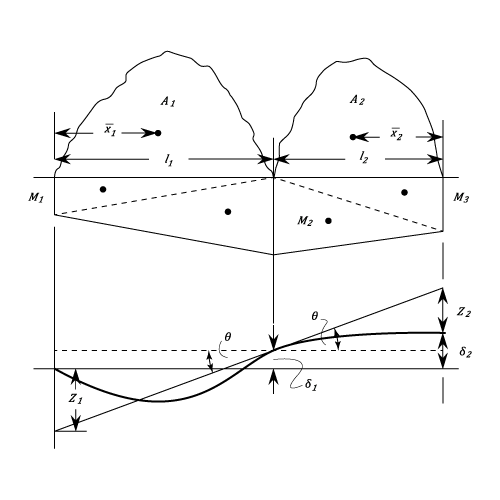
On the drawing, the areas and
are the Free Bending Moment areas obtained by treating the Beam as over two separate spans
and
. If the actual Bending Moments at these points are
,
and
, then a Fixing Moment diagram consisting of two trapezia can be introduced, and the actual Bending Moment will be the Algebraic sum of the two diagrams.
In the lower figure the Elastic Line of the deflected Beam is shown.
The deflections and
are measure relative to the left hand support and are positive upwards.
is the slope of the beam over the central support, and
and
are the intercepts for
and
.
\(\therefore\;\;\;\;\;\;θ = \frac{Z_1 + δ _1}{l_1} = \frac{Z_2\;+
If
If the supports are at the same level:
If the Ends are Simply Supported then
Clapeyron's Equation or The Equation of Three Moments
Equation (#1) is the most general form of The Equation of Three Moments. Equations (#2) , (#3) and (#4) are simplifications to meet particular needs. Off these Equation (#3) is the form most frequently required.
Example 1 [imperial]
A Beam Ad 60 ft. long rests on supports at ,
, and
which are at the same level.
and
The loading is 1 ton/ft. throughout and in addition a concentrated load of 5 tons acts at the mid-point of
and a load of 2 tons acts at
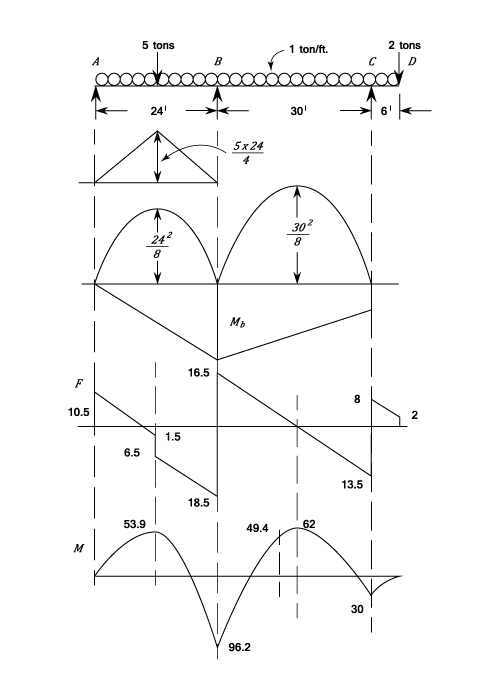
Draw the Shear Force and Bending Moment diagrams.
Applying Equation (3) to the span
The Bending Moment at mid-point of
The Bending Moment at the mid-point of
To find the reactions at the supports:
for
for
And
By difference,
From the Shear Force diagram it can be seen that the maximum Bending Moment occurs either at a distance of 13.5 ft. from where:
Or at a distance of 10.5 ft. from where:
The combined Bending Moment diagram is shown at the bottom of the sketch.
Example 2 [imperial]
A Beam of uniform cross section rests on elastic supports at
each support sinking by
inches per ton of load carried.
If is 20 ft and
16 ft. and the loading is
tons/ft. find the reactions at the supports and the maximum Bending Moment.
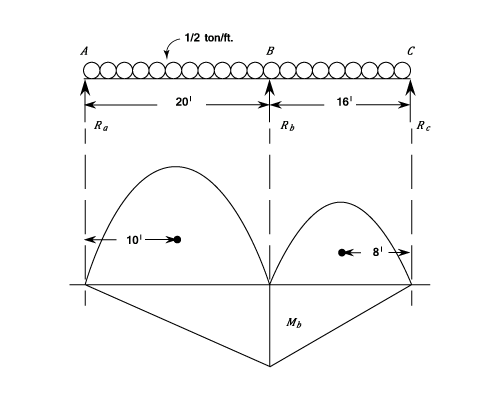
Applying the Theorem of Three Moments . See Equation (2)
Where
And upwards
i.e.
But is the hogging Bending Moment at
Thus,
Also,
Thus,
Substituting in Equation (1)
From Equation (2)
From Equation (3)
From Equation (4)
The Shear Force is Zero at from
and at
from
The Maximum Bending Moment between and
:
The Maximum Bending Moment between and
:
Thus the maximum Bending Moment is
,
and
- The maximum Bending Moment is
Beams with more than Two Spans.
Where a Beam extends over more than three Supports the Equation of Three Moments is applied to each group of three in turns. In general, if there are Supports, there will be
unknown Bending Moments ( excluding the Ends) and
equations to solve simultaneously.