
Elastic Constants
Describes the realtionship betyween the Elastic Constants and introduces Bulk Modulus and Young's Modulus
You're viewing an older version of this page (#3532). View the current version.
Elastic Constants
These are the relationships that determine the deformations produced by a given Stress system acting on a particular Material. Within the limits for which Hooke's Law is obeyed, these factors are constant and are:
- The Modulus of Elasticity; E
- The Modulus of rigidity; C
- The Bulk Modulus ;K
- Poisson's Ratio;
or
Bulk Modulus
If a "hydrostatic" pressure p (i.e.one which is equal in all directions) acting on a body of initial volume V, produces a reduction in the Volume equal numerically to , then the bulk Modulus K is defined as the ratio between the fluid pressure and the Volumetric Strain.
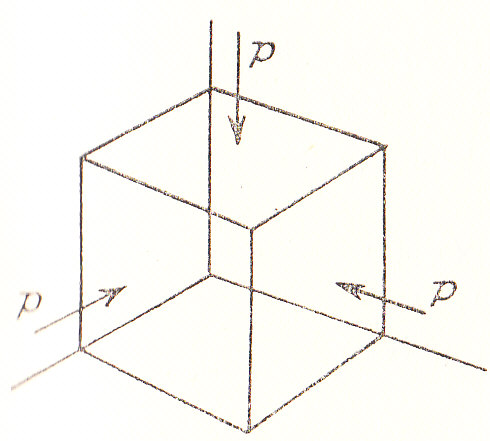
The negative sign allows for the reduction in Volume.
The above diagram is of a Unit Cube of material ( or fluid) which is under the action of a pressure p. It can be seen that the Principal Stresses are -p, -p, and -p and that the linear Strain in each direction is (see Compound Stress and Strain Part 2 equation (49)) :
But using equation (98) from Compound Stress and Strain Part 2:-
Hence by definition:
or
Using Equation (99) of Compound Stress and Strain part 2:
Strain Energy per unit volume (U) in terms of the Principal Stresses is given by:-
Example 1
A frictionless plunger 0.25 inches in diameter and weighing 2 lbs., compresses oil in steel container. A weight of 3 lbs. is dropped from a height of 2 ins. onto the plunger. Calculate the maximum pressure set up in the oil it its volume is 500 cu. ins. and the container is assumed to be rigid.
for Water (U.L.)
Let p lb/sq.in. be the additional momentary maximum pressure produced by the falling weight . If the loss of energy at impact is neglected.
The loss of the Potential energy of the falling weight = The gain in Strain energy of the water
The Volumetric Strain produced p is - p/k and hence the decrease in the volume of water is and this is taken up by the Plunger which will therefore sink a further distance equal to :-
Equating these last two quantities and multiplying through by K/500 produces the quadratic
or
Solving and taking the positive root gives:
Adding the pressure due to the 2 lb. weight gives a final maximum pressure of:
The Relationship between E and C
It is necessary to establish , first of all, the relationship between Pure Shear Stress and a pure normal Stress system at a point in an elastic material.
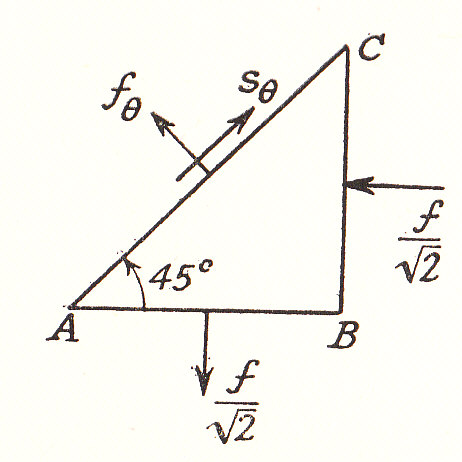
In the diagram the applied Stresses are f tensile on AB and f compressive on BC. If the Stress components on a plane AC at to AB are
then the forces acting are as shown, taking the area on AC as unity.
Resolving along and at right angles to AC
i.e. There is pure shear on planes at to AB and AC of magnitude equal to the applied normal Stresses.
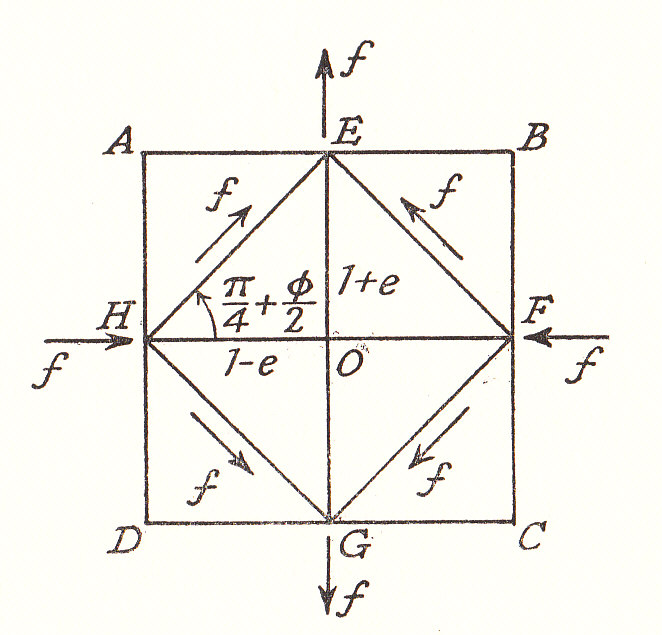
The square element ABCD has sides of unstrained length 2 units which are under the equal normal Stresses f both tension and compression. It has been shown the element EFGH is in pure shear of equal magnitude f.
The linear Strain "e" in the direction
The linear Strain in the direction HF
Hence the Strained lengths of EO and HO are 1+e and 1-e respectively.
( See "Modulus of Rigidity" in pages on Shear Stress)
This distorts the element EFGH and the angle EHG increase to . Angle EHO is half this i.e.
Consider the triangle EHO.
Tan EHO = EO/HO
Expanding this equation gives:
Note and for small angles it is permissible to write
By inspection and by substituting for e and
from equations (20) and (21)
Or re-arranged into a more normal form:-
By using equation (7) it is possible to eliminate Poisson's Ratio from equation (25) and hence it can be shown that:-
In fact if any two elastic constants are known, the other two may be calculated. Experimentally however, it is not satisfactory to calculate Poisson's Ratio by determining E and C separately.
Example 2
Show that if E is assumed correct then an error of !% in the determination of C will involve an error of 5% in the calculation of Poisson,s Ratio.
Let the correct values be and
then
If C is increased to 1.01 C let the calculated value of Poisson's ratio be then:
Eliminating E from equations (27) and (28)
or
The percentage error is given by: