The application of the gas laws to Air Motors

You're viewing an older version of this page (#3809). View the current version.

View versions (3)

Air Motors

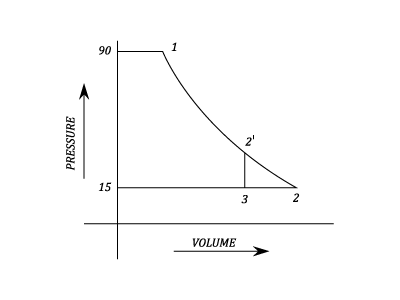
23287/Air-Motors-0026.png

Work done by Air

= \frac{n}{n - 1}\left(P_1V_1 - P_2V_2 \right)
(1)
=\frac{n}{n-1}wR\left(T_1-T_2 \right)
(2)
= \frac{n}{n-1}\;wRT_1\;\left[1-\left(\frac{P_1}{P_2} \right)^{\frac{n-1}{n}} \right]
(3)

Isothermal Operation

Work Done = \displaystyle P_1V_1\;Ln\,\frac{V_2}{V_1}

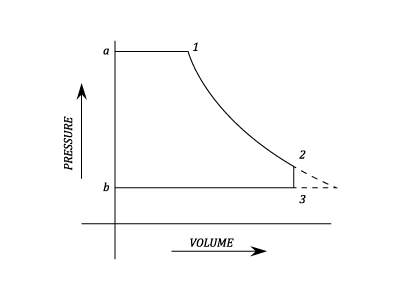
It is not possible to expand the Air down to Atmospheric Pressure. By opening the valve early the small loss in work done is accompanied by a large decrease in the Swept Volume.
23287/Air-Motors-0025.png

Work output = Area of Diagram = \displaystyle P_1V_1+\left(\frac{P_1V_1-P_2V_2}{n\;_\;1} \right) -P_3V_3

Example 1 [imperial]
Problem

A reciprocating Air Motor of bore 13.54 in. and Stroke 18 in. is supplied with Air at 180^0F and 90 psi. Find the Work output per cycle with complete expansion to 15 psi. Find also the percentage loss of output resulting from a decrease of stroke to 12 in. with incomplete expansion. Neglect Clearance and take the Index of expansion as 1.25.

Workings
23287/Air-Motors-0026.png

Bore = 13.54 in. and Stroke = 18 in.

V_2=\frac{\pi (13.54)^2}{4\times 144}\times 1.5=1.5\;ft^3
(4)
P_1V_1^n = P_2V_2^n
(5)
V_1=V_2\left(\frac{P_2}{P_1} \right)^{\frac{1}{1.25}} = 1.5\div 6^{\frac{1}{1.25}} = 0.357\;ft^3
(6)
Work\;out put\;per\;cycle = \frac{n}{n - 1}\left(P_1V_1 - P_2V_2 \right)
(7)

= \frac{1.25}{0.25}(90\times 144\times 0.357 - 15\times 144\times 1.5)= 6910\;ft.lbs./cycle

The Stroke is now reduced to 12 ins.

V_2' = \frac{\pi (13.54)^2\times 1.0}{4\times 144} = 1\.ft^3 = V_3
(8)
V_1 = 0.357\;ft^3
(9)
P_1V_1^{1.25} = P_2V_2^{1.25}
(10)
\therefore\;\;\;\;\;P_2 = P_1\left(\frac{V_1}{V_2} \right)^{1.25}
(11)

\therefore\;\;\;\;\;P_2 = 90\left(\frac{0.357}{1} \right)^{1.25} = 25\;psi.

Work out put per cycle is:

P_1V_1+\left(\frac{P_1V_1-P_2V_3}{n-1 }\right)-P_3V_3
(12)

=(90\times 144\times 0.35)\;+\left(\frac{90\times 144\times 0.357 - 25\times 144\times 1.0}{0.25} \right) - (15\times 144\times 1.0) = 6560\;ft\;lbs. Therefore the loss of Power is: \frac{6910 - 6560}{6910}\times 100\;\approx 5\%

Solution

Work out put per cycle is 6910\;ft.lbs./cycle

The loss of Power is \approx 5\%