
Nozzles and mouthpieces
An analysis of the head lost in a nozzle and the resulting velocity of the jet.
You're viewing an older version of this page (#3720). View the current version.
Introduction
Assumptions
It is assumed that the Head H is the head behind the nozzle and that all pipeline and valve losses have been accounted for elsewhere. There are, of course, losses in the nozzle itself and the actual velocity of discharge will be less than the theoretical value by one to five percent. This is catered for by the use of The Coefficient of Velocity , The Coefficient of Contraction
and the Coefficient of Discharge
:
= Actual Velocity / Theoretical Velocity
= Actual cross sectional area / Geometric cross sectional Area
The head Lost in the Nozzle
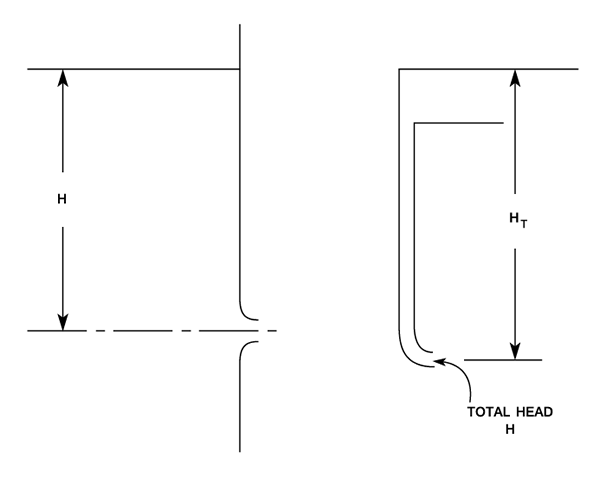
Let = total head at nozzle (i.e. the sum of the pressure and velocity heads)
where represents the Pipe line losses
Head behind the Nozzle = Head after the nozzle + Head lost in Nozzle
where
represents the head lost
Substituting from (#2) above:
Therefore, the head lost in nozzle is
or
Efficiency of the Nozzle
Efficiency in general describes the extent to which time or effort is well used for the intended task or purpose. It may be defined as
where H represents the Head behind the nozzle
i.e.
Thus,
The Power of a Jet
Power is the rate at which work is done, expressed as the amount of work per unit time and commonly measured in units such as the watt and horsepower.
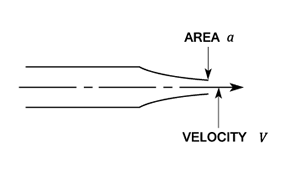
Let the weight of fluid discharged be . Then if the effective cross sectional are of the jet is a and the velocity of discharge is V then the Kinetic Energy of the Jet is:
For the Jet the Work Done equals the change of Kinetic Energy and hence the power available in the jet is