
Screw Threads
An analysis of the torque required to turn a screw thread against a known load.
You're viewing an older version of this page (#3597). View the current version.
Introduction
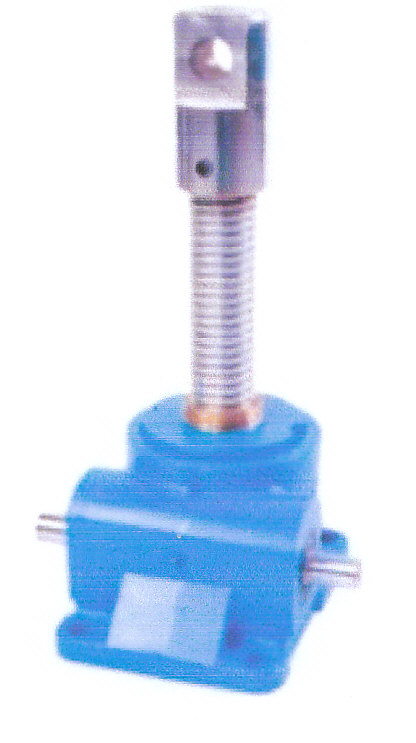
If the invention of the wheel is an important landmark in the history of civilisation, then the development of the screw thread must run it a close second. Imagine building a car without nuts and bolts. Try to design a machine tool without screw threads to make the adjustments and think of the problems that we would have in factories and workshops without clamps; vices or screw driven lifting appliances like the Screw Jack shown, which is capable of lifting loads of up to 100 tons. Indeed the screw thread in one form or another is truly ubiquitous.
This submission examines the relationships between Torque, Axial Load and Frictional Forces
Screw and Nut
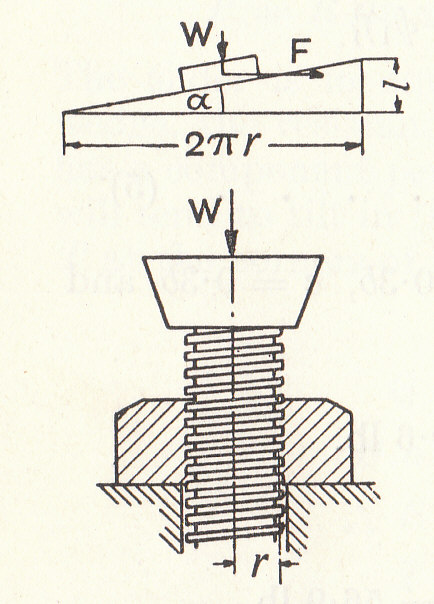
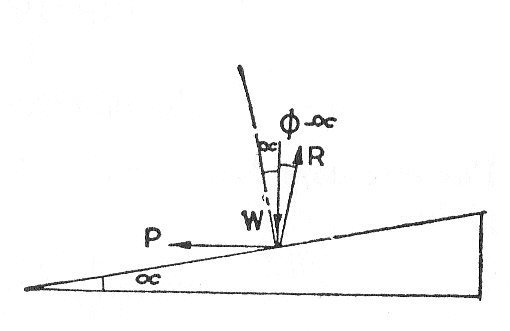
The development of a screw thread when unwound from the body of a screw is an inclined plane in which the inclination of the plane is equal to the helix angle of the thread.
Strictly speaking the helix angle decreases slightly from the root to the tip of the thread. But the depth of the thread is small compared to the radius of the screw and it is sufficiently accurate to take helix angle at the mean radius of the thread.
It can be seen from the diagram that:
A number of thread forms exist but in this submission only two, the most common, will be considered. In the case of "V" threads the included angle is normally
. However British Standard Whitworth (B.S.W.); British Standard Fine (B.S.F.) ; and British Standard Pipe Thread (B.S.T.) use
whilst the small British Association included thread angle is
.
(a) Square Threads
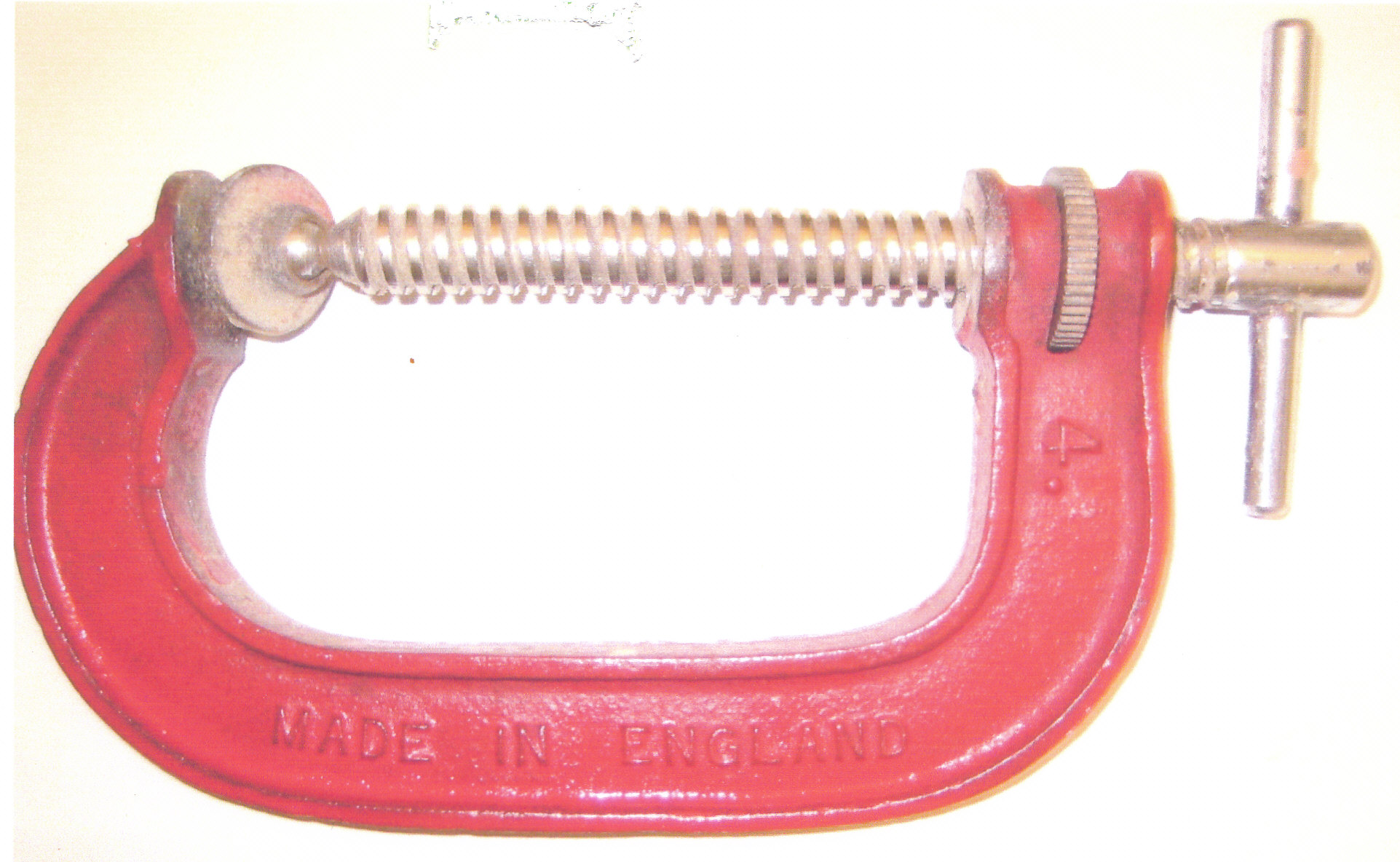
The following picture of a "G" clamp uses a square thread.
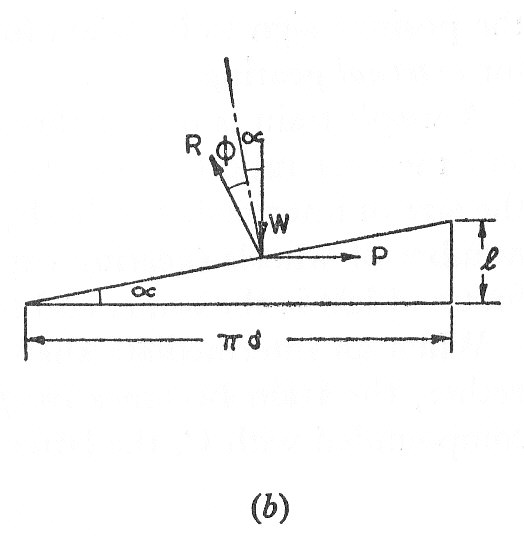
To find the Torque required to turn a nut relative to the screw against an axial load W let:
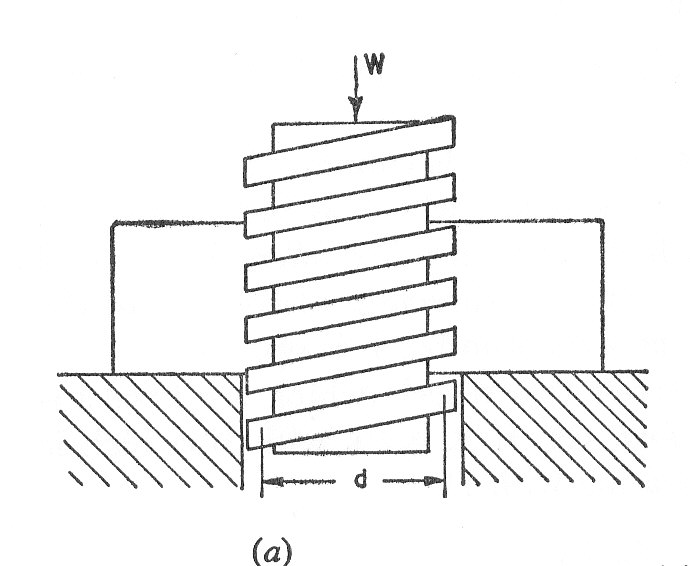
- d be the mean thread diameter.
- P be the Tangential Effort required at the mean thread radius
be the Helix angle of the thread.
be the angle of friction.
The forces are shown in diagram (b) which represents an equivalent system in which all of the load is assumed to be concentrated at one point on the thread. By resolving perpendicular to R
The Force applied at the end of an arm of length r
For one turn of the nut (or screw)
Or using equation (2)
It can be found by differentiation that the thread angle for maximum efficiency is:-
(b) V-thread
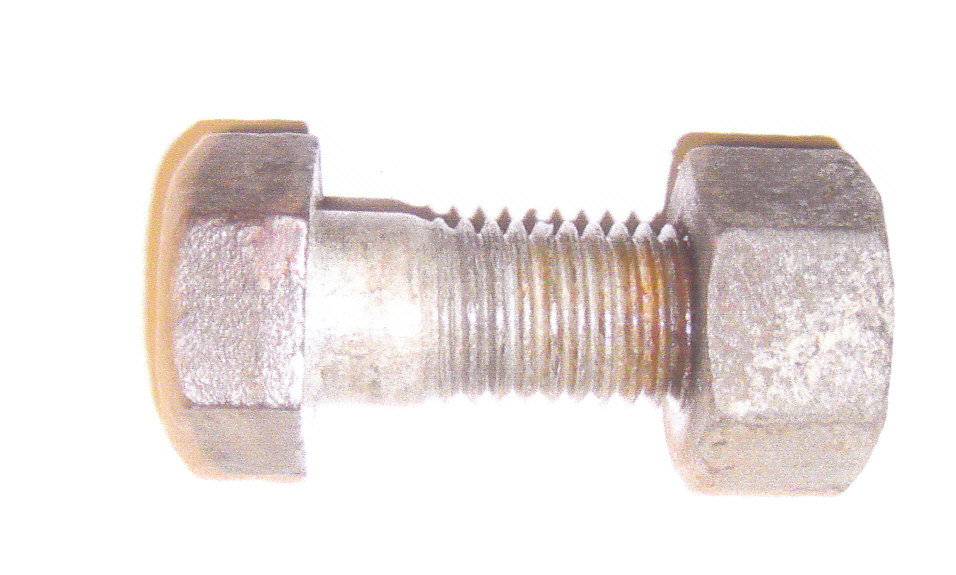
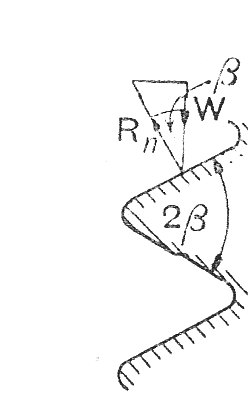
The majority of screws are provided with "V" threads where the normal reaction between the screw and the nut is greater than those found with a square thread. The axial load W shown in the diagram is again assumed to be concentrated at a single point on the thread. Since the axial component of the Normal Reaction must be equal to W -
Where is the included angle between the sides of the thread.
But the friction force acts tangentially to the surface of the threads and is given by -
Where and may be regarded as a virtual coefficient of friction
The conditions for a "V" thread, as far as friction is concerned, are identical for those with a square thread provided that the coefficient of friction is replaced by
. i.e. the friction angle is
. Once this substitution has been made the equations appertaining to square threads apply.
(c) Turnbuckle
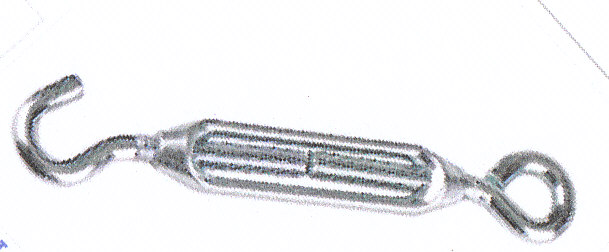
In this a central screw with right and left hand nuts at each end, turns in nuts at each end. The effect is to double the movement of the load and to double the torque required.
Worked Examples
The following examples all have worked solutions which have been hidden. To see the workings please click on the red buttons.
Example 1
Two parts of a coupling are screwed right and left hand and are jointed by a suitably tapped nut to form a turnbuckle. The threads are square with a lead of and a mean diameter of
, the coefficient of friction being 0.14.
Find the couple required at the nut to draw the parts together with a force of 3 tons and also the couple necessary to release them.
Example 2
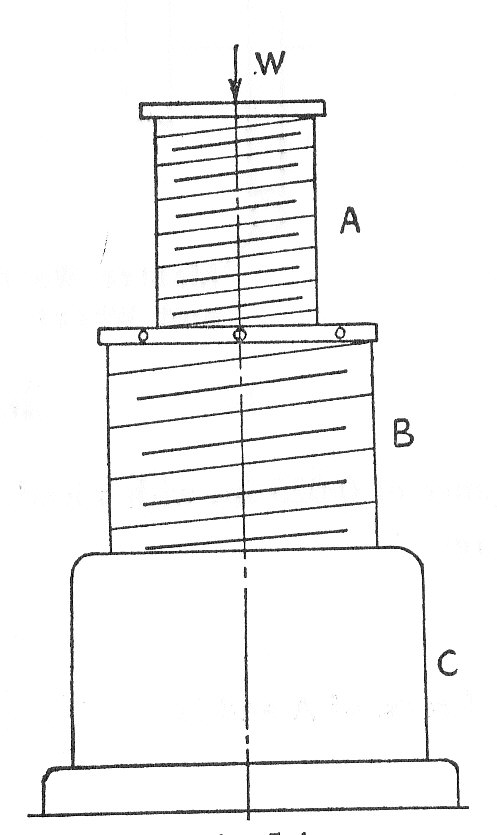
A lifting jack with differential screw threads is shown diagramatically in the diagram. The portion B screws into the fixed base C and carries a square thread of pitch 0.375 in. and a mean diameter of 2.25 in.. The part A is prevented from rotating and carries a right handed thread of 0.25 in. pitch on a mean diameter of 1.25 in., screwing into part B.
If the coefficient of friction for each thread is 0.15 find the Torque necessary to be applied to B to raise a load of 1000 lb. (U.L.)
Example 3
A turnbuckle consists of a box nut connecting two rods, one screwed left-handed and the other right-handed, both having 7 threads per inch on a mean diameter of 0.942 in. The included angle of the thread is . Assuming that the rods do not turn, calculate the torque required on the nut to produce a pull of 4 tons, given that the coefficient of friction
If you use a formula prove it. (U.L.)
Example 4
A sluice gate, weighing 6 tons, is subjected to a normal pressure of 250 tons. It is raised by means of a vertical screw which engages with a screwed bush fixed to the top of the gate. The screw is rotated by a 50 b.h.p. motor running with a maximum speed of 600 r.p.m., a bevel pinion on the motor shaft gearing with a bevel wheel of 80 teeth keyed to the vertical screw. The screw is 5 in. mean diameter and 1 in. pitch. The coefficient of friction for the screw in the nut is 0.08 and between the gate and its guides 0.10.
If friction losses, additional to those mentioned above amount to 15% of the total power available, determine the maximum number of teeth for the bevel pinion. (U.L.)