
Gyroscopes
A gyroscope is a device for measuring or maintaining orientation, based on the principles of conservation of angular momentum. A mechanical gyroscope is a spinning wheel or disk whose axle is free to take any orientation.
Angular Displacement is a vector quantity since it has both magnitude and direction.
The change in direction of the plane of rotation of the disc is known as Precessional motion and is known as the angular velocity of precession.
The angular acceleration is called the Gyroscopic acceleration.
An analysis of gyroscopic couples
You're viewing an older version of this page (#3730). View the current version.
Introduction
Whilst Gyroscopes are used extensively in aircraft instrumentation and have been utilised in monorail trains, the everyday impact of gyroscopic forces on our lives is unappreciated and significant.
The simple example is a child's top which would not work but for the gyroscopic couple which keeps it upright. On a slightly different level, the gyroscopic couple helps us to keep a bicycle upright. It is interesting and instructive to remove a bicycle wheel from its frame, hold it by the axle, spin the wheel and then try to change the orientation of the axle. The force required to do so is considerable!
However these gyroscopic forces are not always beneficial and it will be shown that the effect on the wheels of a car rounding a corner are to increase the tendency for the vehicle to turn over.
Gyroscopic Couple
Without an understanding of Angular movement it is difficult to understand Gyroscopic Couples. For this reason the Paragraph on Angular Displacement; Velocity and Acceleration shown in The Theory of Machines - Mechanisms, has been reproduced here.
Angular Displacement, velocity and Acceleration
Let:
- The line
in the diagram rotates around
- Its inclination relative to
be
radians.
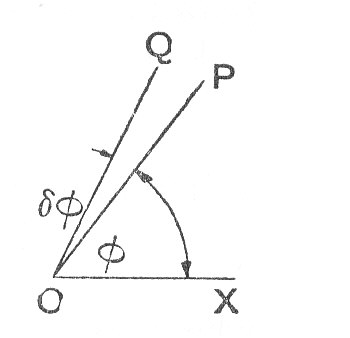
Then if after a short period of time the line has moved to lie along , then the angle
is the Angular Displacement of the line.
Angular Displacement
In order to completely specify and angular displacement by a vector, the vector must fix:-
- The direction of the axis of rotation in space.
- The sense of the angular displacement. i.e. whether clockwise or anti-clockwise.
- The magnitude of the angular displacement.
In order to fix the vector can be drawn at right angles to the plane in which the angular displacement takes place, say along the axis of rotation and its length will be , to a convenient scale, the magnitude of the displacement.
The conventional way of representing the sense of the vector , is to use the right-hand screw rule. i.e,
- The arrow head points along the vector in the same direction as a right handed screw would move, relative to a fixed nut.
- Using the above convention, the angular displacement
shown in the diagram would be represented by a vector perpendicular to the plane of the screen and the arrow head would point away from the screen.
Angular Velocity
Angular Velocity is defined as the rate of change of angular displacement with respect to time. As angular velocity has both magnitude and direction it is avector quantity and may be represented in the same way as angular displacement.
- If the direction of the angular displacement vector is constant. i.e.The plane of the angular displacement does not change its direction,. Then the angular velocity is merely the change in magnitude of the angular displacement with respect to time.
Angular Acceleration
Angular Acceleration is defined as the rate of change of angular velocity with respect to time. It is a Vector quantity. The direction of the acceleration vector is not necessarily the same as the displacement and velocity vectors.
Assume that a given instant a disc is spinning with an angular velocity of in a plane at right angles to the screen and that after a short interval of
its speed has increased to
.
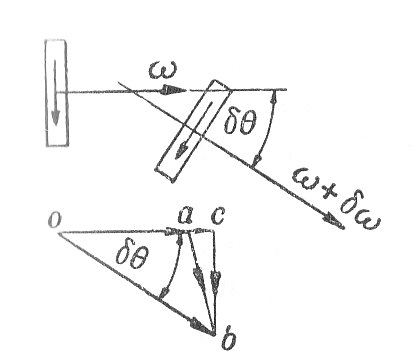
Then applying the right-hand rule:
- The angular velocities at the two instants are represented by the vectors
and
.
- The change of angular velocity in a time of
is represented by the vector
. This can be resolved into two components
and
which are respectively parallel and perpendicular to
Hence.
- The component parallel to
- The component perpendicular to
Note:
is the rate of change of direction of the vector
is the rate of change of the magnitude of the velocity
of the disc.
is the rate at which the direction of
- The total angular acceleration of the disc is the vector sum of
Two particular cases should be noted:
- If the plane of rotation of the disc is constant in direction, then
- If the angular acceleration of the disc is constant in magnitude but the plane of rotation changes direction at the rate
- The direction of this acceleration vector is at right angles to the angular velocity vector and lies in the plane of motion of the velocity vector.
Gyroscopic Couple
If a uniform disc of polar moment of inertia is rotated about its axis with an angular velocity
, its Angular Momentum
is a vector and can be represented in diagram (c), by the line up which is drawn in the direction of the axis of rotation. The sense of the rotation is clockwise when looking in the direction of the arrow.
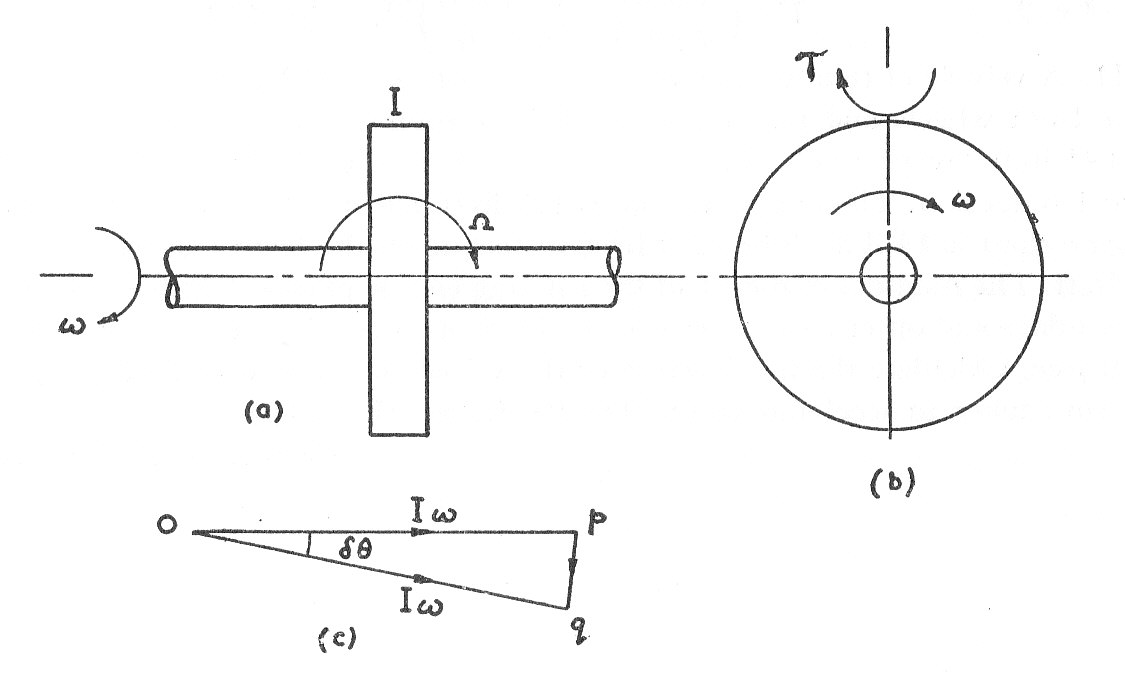
If now the axis of rotation is precessing with a uniform angular velocity about an axis perpendicular to that of
, then after a time
, the axis of rotation will have turned through an angle
and the momentum vector will be
.
The Gyroscopic Couple is given by:
= The rate of change of angular momentum =
(In the limit)
- The direction of the couple acting on the gyroscope is that of a clockwise rotation when looking in the direction
.
- In the limit the direction of the couple is perpendicular to the axe of both
- The reaction couple exerted by the gyroscope on its frame is in the reverse sense( It is advisable to draw the vector triangle
in each case.
Example 1 [imperial]
The diagram shows the Gyro unit of an aircraft instrument in which the rotor is carried in a closed casing mounted in bearings so that its axis is normally vertical but free to take up any direction.
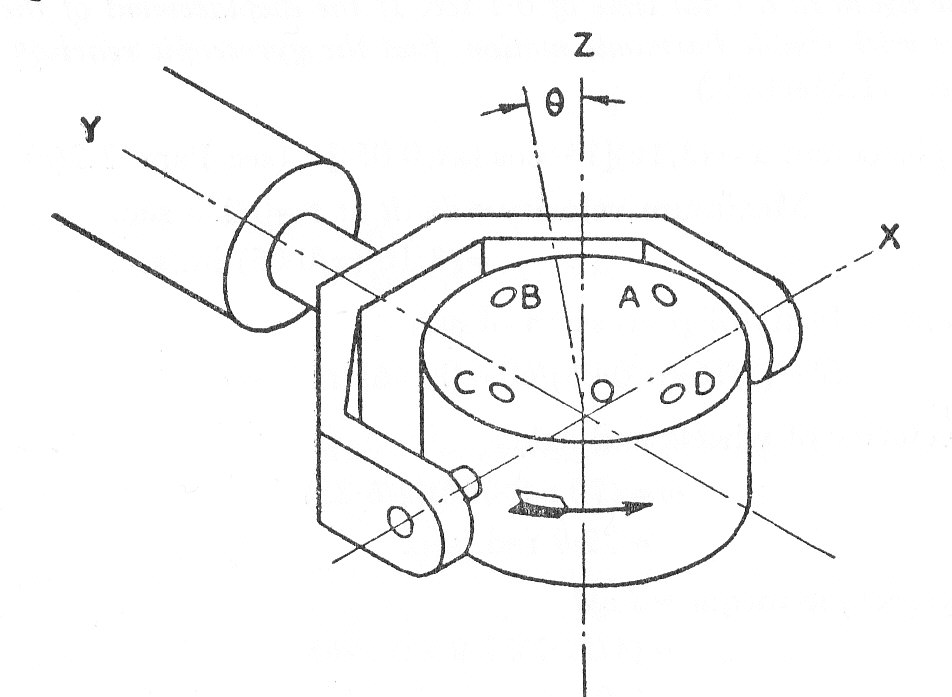
The rotor speed is maintained constant in an anti-clockwise direction, when seen from the top, by air jets inside the casing which impinge onto its slotted periphery. The used air may then leave the casing by the four orifices indicated, these are uncovered as required by gravity controlled vanes. If the rotor axis is tilted through an angle in the XOZ plane, explain which orifice must be uncovered so that the reaction from the jet tends to restore the axis to the vertical.
If this force is 0.0004 lb. at a distance of 0.825 in. from and the wheel is equivalent to a uniform solid disc 1.75 in. in diameter weighing 0.3 lb. and running at 9000 r.p.m., find the time required for the axle to return to the vertical is
is
The axis of rotation has to precess anti-clockwise about when seen from the left. The Gyroscopic torque on the rotor must be anti-clockwise about
when seen from the right and this can be achieved by opening vent
.
The torque applied =
Re-arranging to give the angular velocity of precession gives:-
The time to precess
- The time required is
Example 2 [imperial]
A pair of locomotive driving wheels with the axle have a moment of inertia of . The diameter of the wheels is 6 ft.3 in. and the distance between the wheel centres is 5 ft. When the locomotive is traveling at 70 m.p.h. on a level track, defective ballasting causes one wheel to fall
and to rise again in a total time of 0.1 sec.
If the displacement of the wheel takes place with simple harmonic motion, find the gyroscopic reaction on the locomotive.
The rail is in effect acting as a cam with the wheel as the follower. As the motion is simple harmonic the displacement is given by:
Displacement
Note: For the justification of the above equation see "The theory of Machines - Cams.
The maximum velocity = (at
The maximum velocity of precession of the axle is given by:
The angular velocity of the wheels and axle:
The Gyroscopic torque = (in a horizontal plane)
- The gyroscopic reaction on the locomotive is
Example 3 [imperial]
A pair of flanged wheels 4 ft. in diameter, mounted on an axle, roll along rails spaced 5 ft. apart and at the same level and around a curve of 500 ft. mean radius, at a speed of 40 m.p.h. Each wheel is assumed to be a thin disc weighing 600 lb.
Determine the vertical force between each wheel and the rail allowing for both centrifugal and gyroscopic effects and also the horizontal force assuming this to be at the outer rail.
The angular velocity of the wheels =
The velocity of precession =
The Gyroscopic reaction torque = (Tending to lift the inside wheel)
i.e. clockwise about as shown in the diagram.
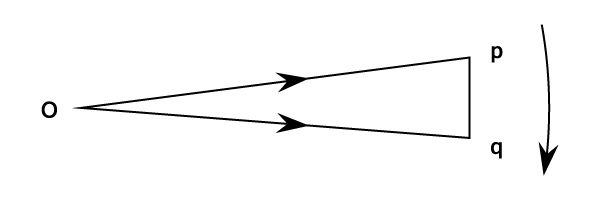
The vertical reaction at each wheel due to the gyroscopic effects =
which is positive at the outside wheel and negative at the inside.
The centrifugal force = (At axle height)
This produces an equal horizontal reaction at the outside rail and a couple of which tends to over turn the wheels. This is balanced by vertical reactions at each wheel of
These are positive at the outside and negative at the inside.
Hence the total vertical reaction at the inside wheel is:
(weight)-
(gyroscopic)-
(centrifugal)=
(weight) +
(gyroscopic)+
(centrifugal)=
The horizontal force at the outer rails = the centrifugal force = 257 lb.
Example 4 [imperial]
The turbine rotor of a ship weighs 6 tons and has a radius of gyration of 19.5 in. It rotates at 1800 r.p.m. clockwise when looking forward from the stern.
Determine the gyroscopic effects set up if:
- a) The ship , when traveling at 15 knots, steers to the left in a curve of 200 ft. radius.
- b) The ship is pitching and the bow is descending with its maximum velocity. The pitching is simple harmonic, the periodic time is 20 sec. and the total angular movement between extreme positions is
- c) The ship is rolling and at a certain instant has an angular velocity of 0.02 radians per second clockwise when looking from the stern.
In each case explain clearly how you determine the direction in which the ship tends to move as a result of the gyroscopic action.
Note One ton = 2240 lb. : One Knot = one nautical mile per hour = 6080 ft. per hour.
- a)
The linear velocity =
The precessional velocity =
The gyroscopic reaction torque,
In the following diagram and
represent the angular momentum, over a short interval of
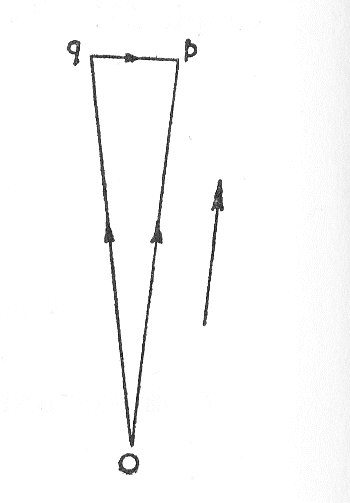
time as the ship turns left. i.e. a clockwise rotation. The direction of the reaction couple is clockwise about i.e. looking from the inside of the curve, and will tend to lif the bows.
- b)
The angle of pitch at time =
Differentiating and equating to zero for the maximum velocity of pitch.
If and
are now taken to be in a vertical plane with
below
( bows descending), the gyroscopic effect is clockwise about
(i.e. looking vertically upwards) tending to turn the ship to the left.
- c)
None, since the axes of roll and the rotor are the same.