
The oscillation of Floating Bodies
Oscillation is the repetitive variation, typically in time, of some measure about a central value or between two or more different states.
Torque (called moment or moment of force) is the tendency of a force to rotate an object about an axis,fulcrum, or pivot.
Weight is the name given to the force on an object due to gravity in science and engineering contexts.
The metacentric height is the distance between the centre of gravity of a ship and its metacentre.
The oscillation of floating bodies including the angle of heel and the period of oscillations
You're viewing an older version of this page (#3707). View the current version.
Introduction
A single hulled ship subjected to any disturbing force will heel or roll. This page investigates the degree of roll and the periodic time of the movement.
The Period of Oscillation of a Floating Body.
Torque formula
The most used formula to define torque is :
where
is the torque
is the moment of inertia
is the angular acceleration of the body
Oscillation equation
Let General solution is given by:
For small angles of heel, the Body can be regarded as Oscillating about it's Metacentre, in a manner similar to a Pendulum about it's point of suspension.
If:
= The weight of the Ship.
= The Metacentric Height.
= The Radius of Gyration of the Ship about a horizontal Axis through the C.of.G.
= The Rotation after a time t.
Angular Acceleration (Direction towards equilibrium position)
The Moment of Inertia of the ship about the of
is
The Moment of Inertia of the ship about is
.
Provided that is small compared with
, these two can be regarded as equal.
For small angles of heel , the Righting Couple =
The Solution of this Equation is given by:
When
= 0 and therefore
When = 0 and
i.e.
= the time of a complete oscillation.
Since
The simplest solution:
The Periodic Time
Example 1 [imperial]
A Solid Cylinder of Uniform material and with height equal to the Diameter is to float in water with it's axis vertical.
Calculate the metacentric hight and the specific gravity of the Cylinder so that it may have a Rolling Period of six seconds when the Diameter is 4 ft.
The Rolling Period is given by \f.
Where is the Metacentric Height and
is the Radius of Gyration of the Body about it's
of
.
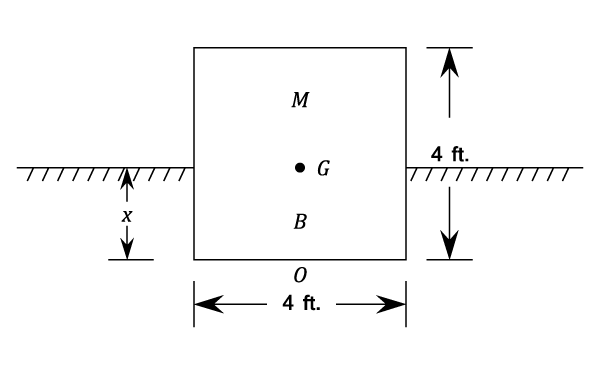
To find :
To Find The Specific Gravity:
And:
\f
Solving the quadratic ft.
From which the specific gravity .
- The metacentric hight is
- The specific gravity is
Example 2 [imperial]
A model ship weighs 80 lb. and floats in a tank of water. A ball of weight 1.6 oz. traveling horizontally at 15 ft./sec is arranged to strike the model broadside at a point 2 ft. vertically above its centre of gravity. The ball after striking, moves with the model and the amplitude of the resulting roll is . The natural period of roll of the system is 1.5 sec.
Find the metacentric height of the system assuming it to be constant over this amplitude. ( Assume that the vessel oscillates about its centre of gravity.
Let be the radius of gyration of the model about the longitudinal axis through
and let the metacentric height which equals
be
.
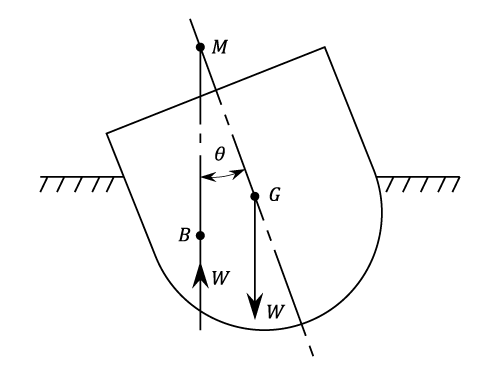
When oscillating, the unbalanced couple, when which acts on the model is:
Re-writing:
This is Simple Harmonic motion with a periodic time of:
Note: For more details on Simple Harmonic Motion please see" Maths: Differential Equations: Equations of Motion".
It can be assumed that the ball, on striking the model looses its momentum and produces an impulsive torque which starts the oscillations of the model.
To consider the impact of the ball on the model, let:
be the weight of the ball. (Note in the question, the weight is given in ounces and therefore must be divided by 16 to convert it to lb.)
be the velocity just before impact.
be the angular velocity of the model after impact.
be the distance of the point of impact, measure from the centre of gravity,
of the model.
be the maximum angular velocity of the model during its Simple Harmonic Motion.
be the periodic time.
Substituting in given values:
As the model starts at the centre of its harmonic motion, it can be seen that is the maximum angular velocity.
Then:
From equations (#2) and (#3)
Substituting in equation (#1)
From which:
- The metacentric height is