
Uniform run off
A pipe is a tubular section or hollow cylinder, usually but not necessarily of circular cross-section, used mainly to convey substances which can flow-liquids and gases (fluids), slurries, powders, masses of small solids.
Head Loss (or friction head or resistance head) is due to the frictional forces acting against a fluid's motion by the container.
Friction loss refers to that portion of pressure lost by fluids while moving through a pipe, hose, or other limited space.
The head lost due to friction in Pipes with uniform run off. Also covered are Tapered Pipes
You're viewing an older version of this page (#3698). View the current version.
Introduction
In the supply of water for Domestic, Commercial and Irrigation, it is common for water to be taken from the pipe line, in many places along the length. This paper analysis the head lost in a pipe with uniform head lost. Also included is the frictional loss in tapered pipes.
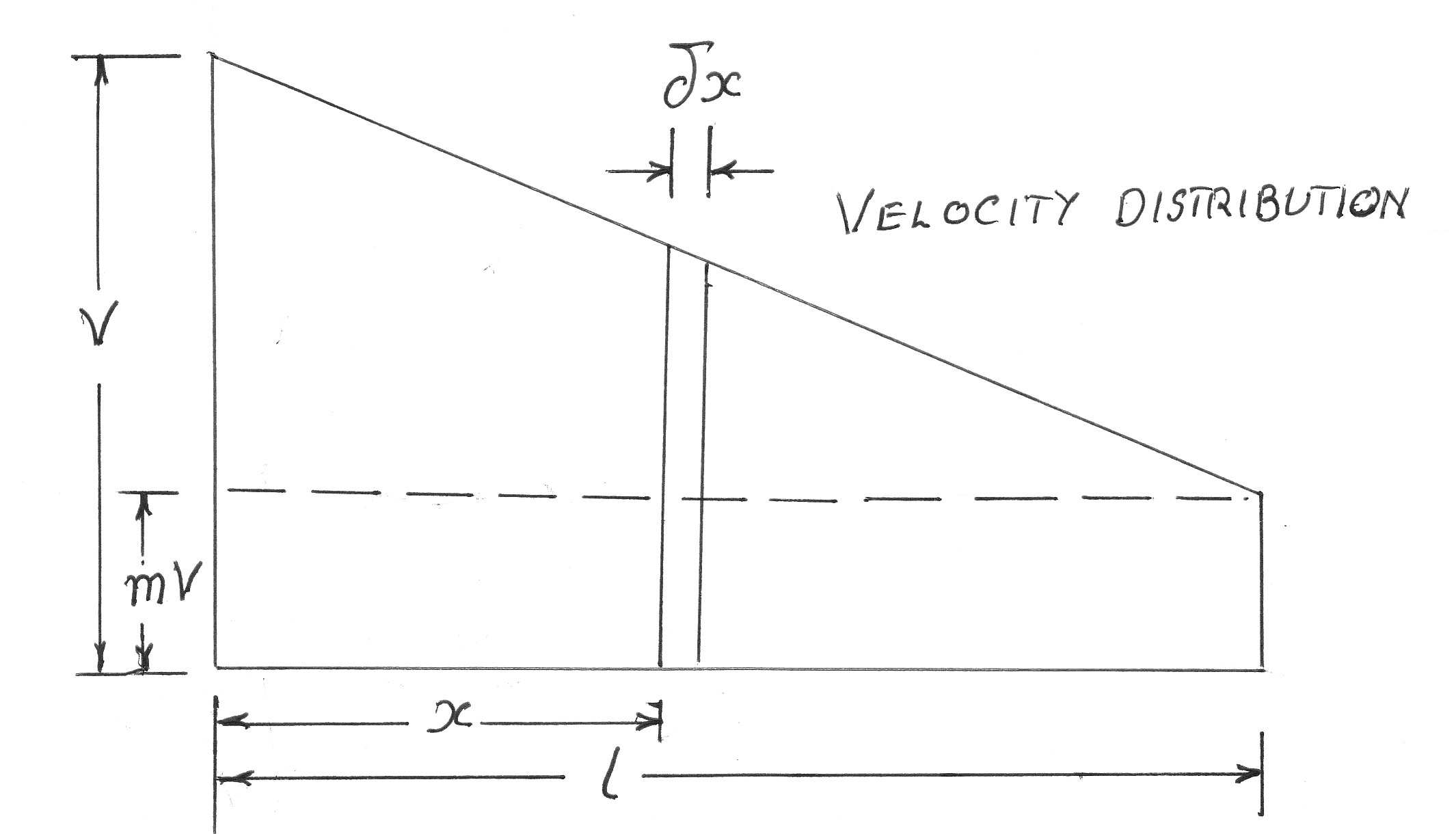
Let the rate of flow at the pipe entry be and that at the pipe exit be
.
Consider a short length of pipe at a distance
from the entry point.
The velocity at this section is:
Or:
The frictional head lost over:
Thus the Total Head Lost over the pipe length is given by:
It can be seen that the above equation assumes that not all the water is discharged over the length . If however this is not the case
= 0 and:
And the Head Lost:
i.e. A third of the head loss which would have been lost with a uniform velocity of flow .
Example 1 [imperial]
A horizontal water-main comprises 5000 ft. of 6 in pipe followed by 3000 ft. of 4 in. pipe (=0.007 for both). All the water is drawn off at a uniform rate per ft. length of pipe.
If the total input is , find the total pressure drop along the main, neglecting all losses except friction. Also draw the Hydraulic Gradient diagram taking the pressure head at inlet as 180 ft.
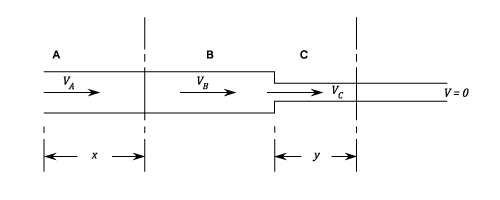
The velocity of flow at is:
As the water is drawn off at a steady rate, the rate of flow at the end of the 6 in. pipe is given by :
The quantity flowing And the rate of flow
Since:
And:
Substituting the above values into equation (1) of Total Head Lost:
For the 4 in length of pipe = 0 since all the water is used up and nothing flows out of the end of the pipe. The velocity of flow is now given by:
Using equation (1) of Total Head Lost again:
Hence the total head lost
The Hydraulic Gradient
Three points on the graph are already known. The inlet pressure of 180 ft. and consequently the pressures at the end of the 6 in. pipe and the 5 in. pipe. It is now necessary to establish the pressure varies between these points.
enters the pipe and it is all drawn off at a uniform rate over the complete length of the pipe. Thus at any point distant
from the start of the pipe the quantity flowing will be:
When is in the 6 in. diameter section of the pipe:
Hence the head lost due to friction between the inlet and the point (
being in the 6 in. section of the pipe) is given by Equation (1) of Total Head Lost:
i.e.
Thus the pressure at which is
ft. from the
is given by:
At the start of the 4 in. pipe the velocity of flow is 3.88 ft./sec. and at the end of the pipe the velocity is zero. Hence the velocity at any point from
is given by:
Hence the frictional head lost over the distance is given by:
Which can be written as:
Hence, using equations (#1) (#2) (#3) and (#4) the following graph can be drawn.
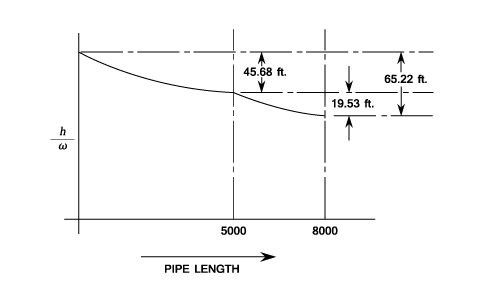
This is the required Hydraulic Gradient. The values between the known points are functions of .
Frictional Loss in a Tapered Pipe
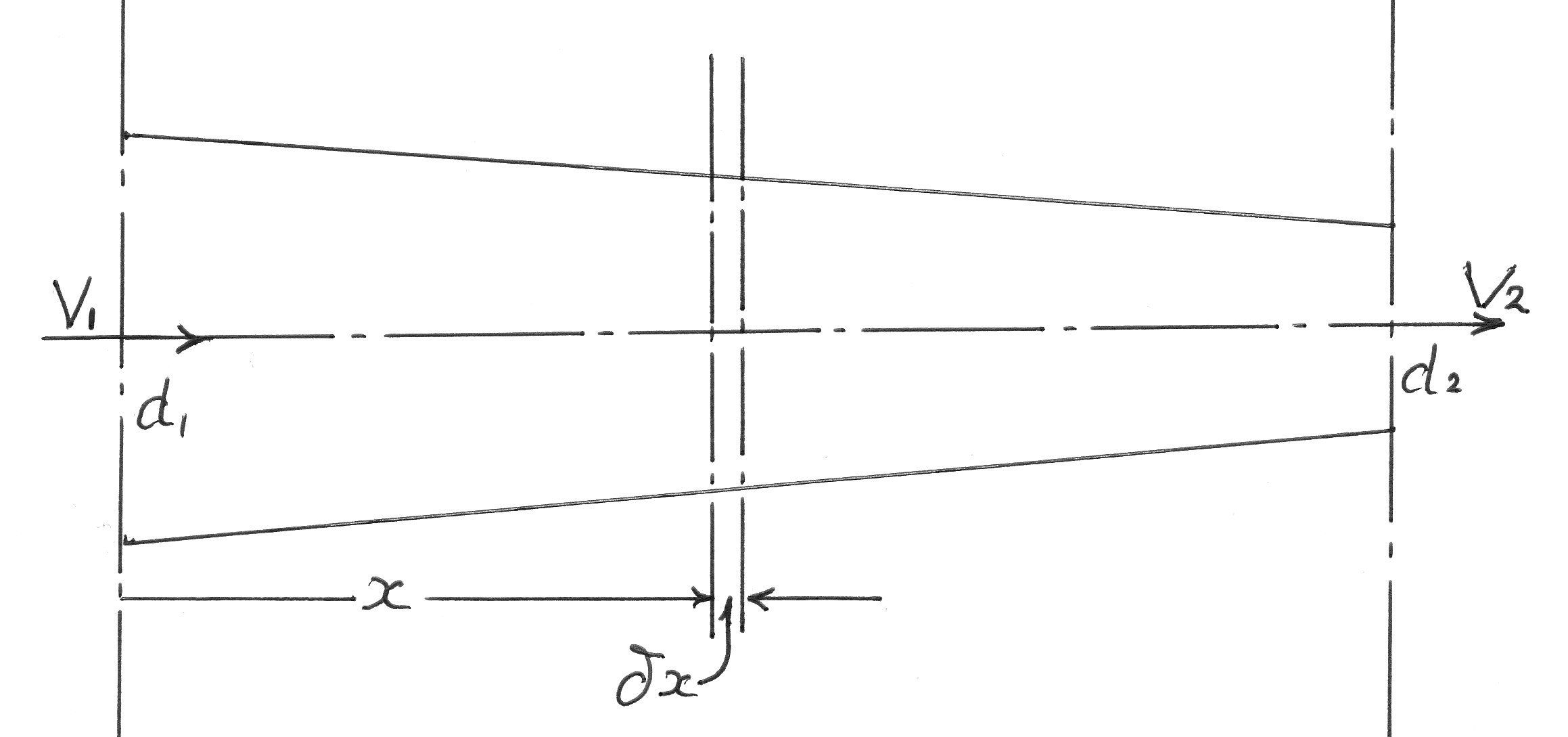
Let the velocity and diameter at the sections 1 and 2 be as shown on the diagram. Consider the head lost over a short length which is a distance
from position 1 and let the velocity and diameter associated with this short length be
and
.
The head lost over the element
But:
Note that
is the half angle of the taper.
Or:
Using the continuity equation:
Or:
The head lost over the elemental length is given by:
Thus the head lost over the total length
is:
Putting:
Thus the head lost can also be written as: