
Forces on Pipe Bends
The forces created in Pipe bends by a combination of static, dynamic,and frictional forces.
You're viewing an older version of this page (#3819). View the current version.
Fluids flowing round bends in pipes suffer from an increase in turbulence and a consequential increase the head lost in the pipe. They also produce forces on the bend which are examined in this section.
Theory
The Total or Resultant Thrust on a Pipe Elbow will be made up of :
- The Static Pressure Force;
- A Dynamic Force due to the change in direction of the fluid flow. This is the product of the mass of fluid passing through the bend per second times the change in velocity;
- The frictional forces on the Pipe;
- The weight of the elbow and the fluid contained in it.
In general these last two are small and can be neglected.
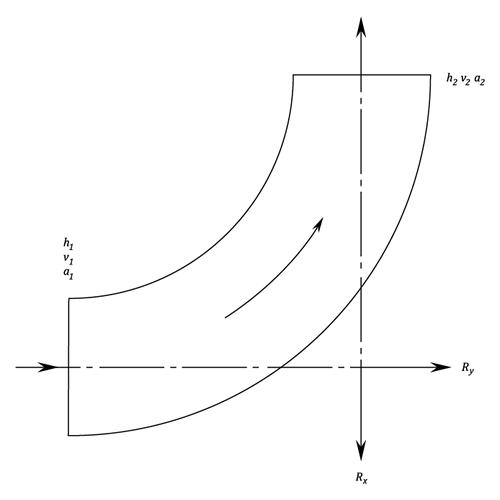
Considering the elbow shown in the diagram.
Force in Direction X:
Force in Direction Y:
Resultant Force R: R has a direction measured from the
axis of :
Example 1 [imperial]
A pipe of 1 ft. diameter carries water at 12 ft./sec. down to a Power-house. At
and
there are frictionless expansion joints and the pipe which weighs 40 lb./ft.run, is mounted on frictionless rollers, except where it is tied in the concrete block
.
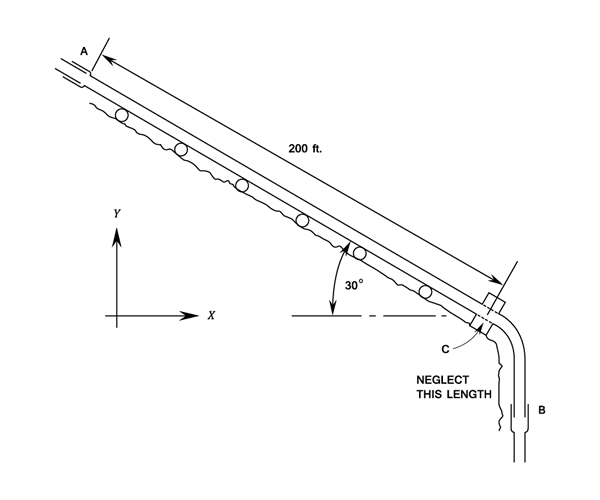
At the head is 120 ft. and
for the pipe is 0.0075.
Determine the horizontal and vertical components of the force on the block due to the pipe line.
The length of the short vertical section is ignored and so:
Applying Bernoulli at and
:
And:
The static pressure in the direction is:
(where is the area)
The static pressure in the direction is:
The weight of water per sec. is:
The Dynamic Force in the direction is:
The Dynamic Force in the
direction is:
The weight of pipe plus contents:
The reaction on the rollers is:
Component in the direction is:
Component in the
direction is:
Thus the Total force in the direction is :
And the Total force in the direction is:
The Total force in the direction is
The Total force in the direction is