
Venturi Meters
Velocity is the measurement of the rate and direction of change in the position of an object. It is a vector physical quantity (both magnitude and direction are required to define it).
The measurement, using a Venturi meter, of incompressible liquids flowing down a pipe
You're viewing an older version of this page (#3699). View the current version.
Introduction
Venturi Meter are used to measure the velocity of flow of fluids in a pipe. They consist of a short length of pipe shaped like a vena contracta, which fits into a normal pipe-line.
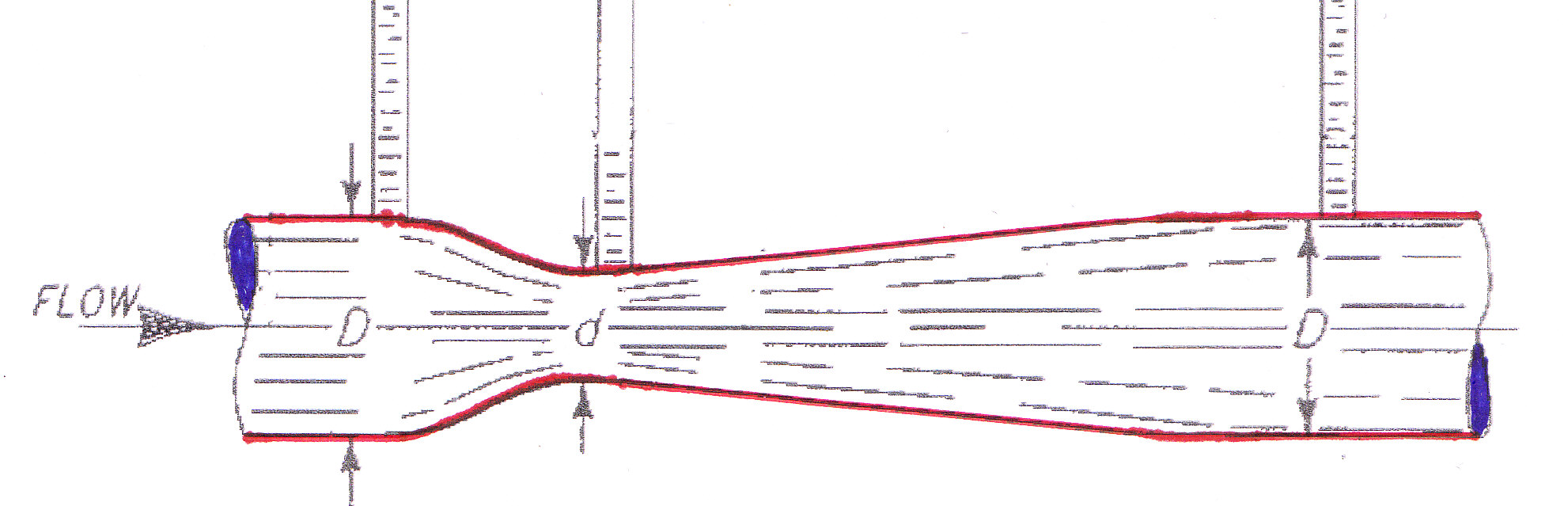
Venturi Meters have the following characteristics:
- Theoretically there is no restriction to the flow down the pipe.
- They can be manufactured to fit any required pipe size.
- The temperature and pressure within the pipe does not affect the meter or its accuracy.
- There are no moving parts.
- Unfortunately the accurate shape required of the inside of the meter makes them relatively expensive to manufacture.
Measurement of Flow.
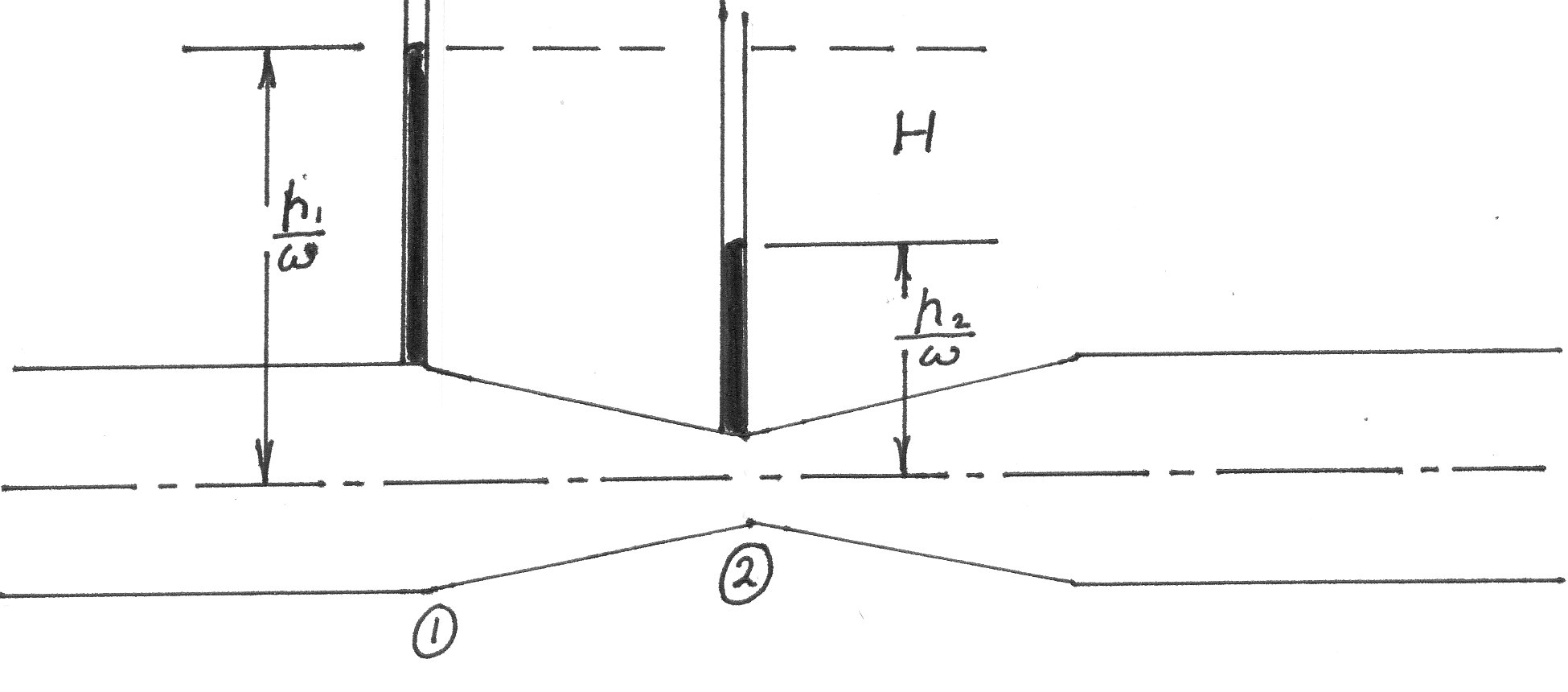
For a meter with the above arrangements of manometers, the quantity flowing is given by:
Applying Bernoulli'\b{s equation} at stations 1 and 2:
where
Which can be written as:
In practice, because of fluid resistance, the actual velocity and consequently actual discharge is LESS than that given by the above equations. A coefficient of discharge is therefore introduced, which usually lies between 0.96 to 0.99.
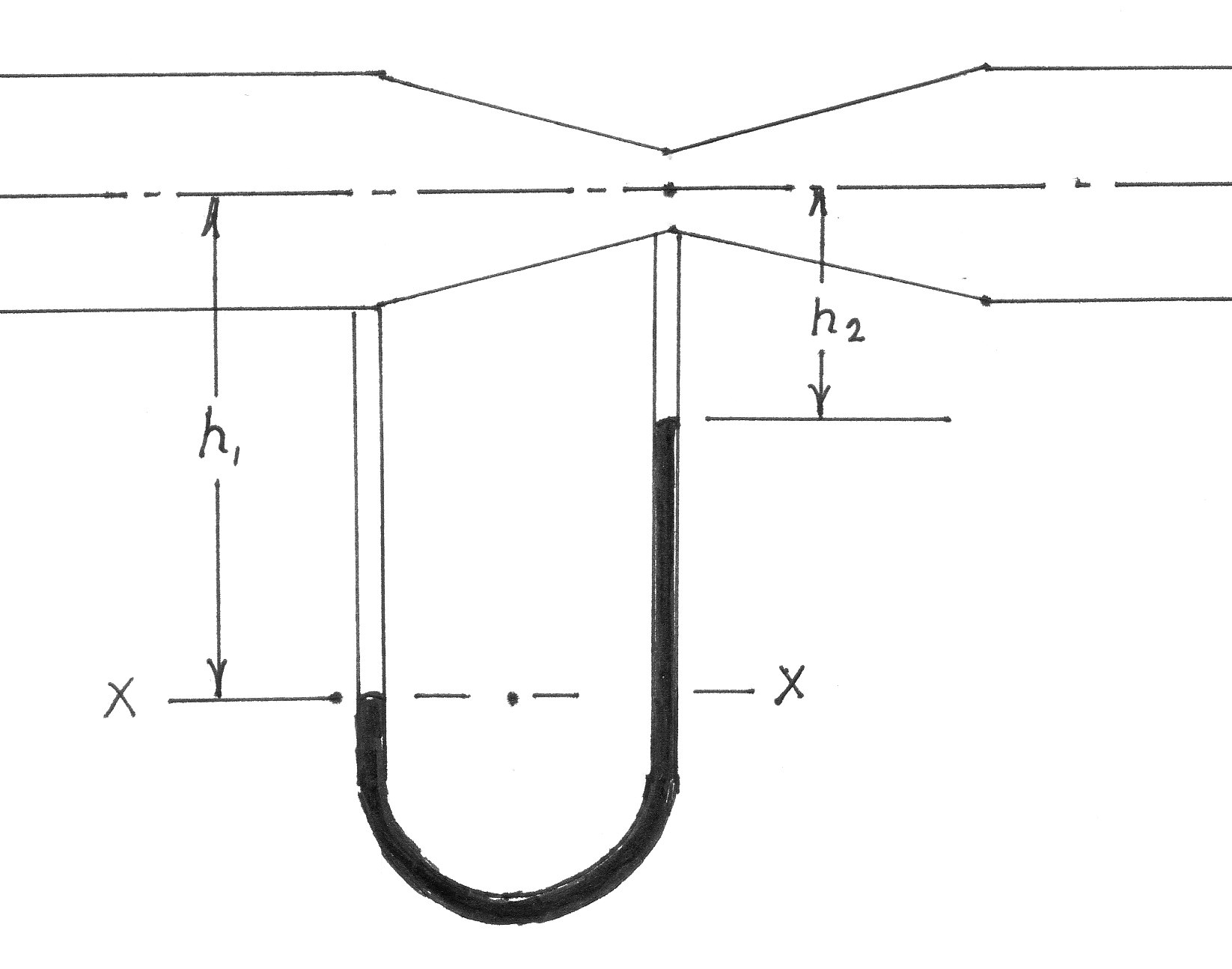
In an actual meter it is not be practical for the tubes to be taken straight up as shown, since the pressures would require the use of long tubes. A more practical arrangement is to measure the difference in pressure rather than the absolute values. This is achieved as shown in the following diagram.
For the above arrangement the Quantity flowing is given by. Where the constant
is specific to a particular meter and will include an allowance for a coefficient of discharge.
Where
is the specific weight of the liquid in the
tube.
For any given meter this can be written as:
Example 1 [imperial]
A venturi meter with a 3 in. diameter throat is installed in a 6 in. pipe-line. The pressure at the entrance to the meter is gauge and it is undesirable that the pressure should at any point, fall below
absolute.
Assuming that for the meter is 0.96, find the maximum flow for which it may be used. Take the specific weight of the liquid as
and atmospheric pressure
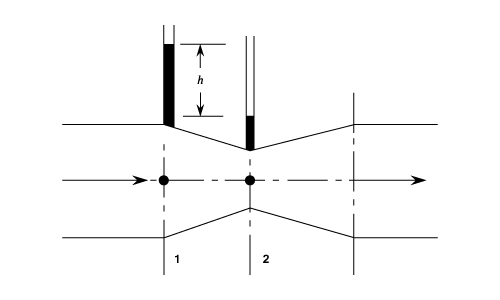
Applying Bernoulli to an ideal horizontal venturi eter, i.e. one with no losses :
Re-writing the equation:
The quantity of fluid flowing along the pipe is given by:
From equations (#1) and (#2)
And:
Thus for an Ideal meter:
For the actual meter taking into account the of 0.96:
The maximum flow is
Example 2 [imperial]
Water is discharged from a pit through a 9 in. diameter pipe 200 ft.long, at the output of which is fitted a horizontal venturi meter having a throat diameter of 6 in. and . A constant head of 70 ft. of water (gauge) is maintained at the pipe inlet, which is at 60 ft. below the meter.
If the barometric pressure corresponds to 34 ft. of water and the absolute pressure at the meter throat is not to fall below 10 ft. of water, find the maximum discharge that may be permitted. =0.007 for the pipe.
Under these conditions what would be the difference of level between two columns of a -tube mercury manometer connected between the inlet and throat of the venturi meter, the connecting tubes above the mercury being full of water. The specific gravity of mercury =13.6

Applying Bernoulli at and
:
where
Losses between
and
As the pipe is of constant cross section there can be no change in velocity between and
. It can also be seen that at the Datum the Potential Energy is zero and so substituting in given values to the above equation:
where
Losses between
and
The pressure at was given 70 ft. gauge which means that it was measured above atmospheric pressure which was 34 ft. The above equation can be therefore written in absolute form as:
The head in the venturi meter throat must not fall below 10 ft. of water absolute. As a result ,the reduction in head in the throat of the meter is given by:
And thus:
If the difference in Mercury levels is :
Then: Thus:
- The maximum discharge is
- The difference of level is
Vertical Venturi Meters.
All the examples above and the theory have examined horizontal meters.
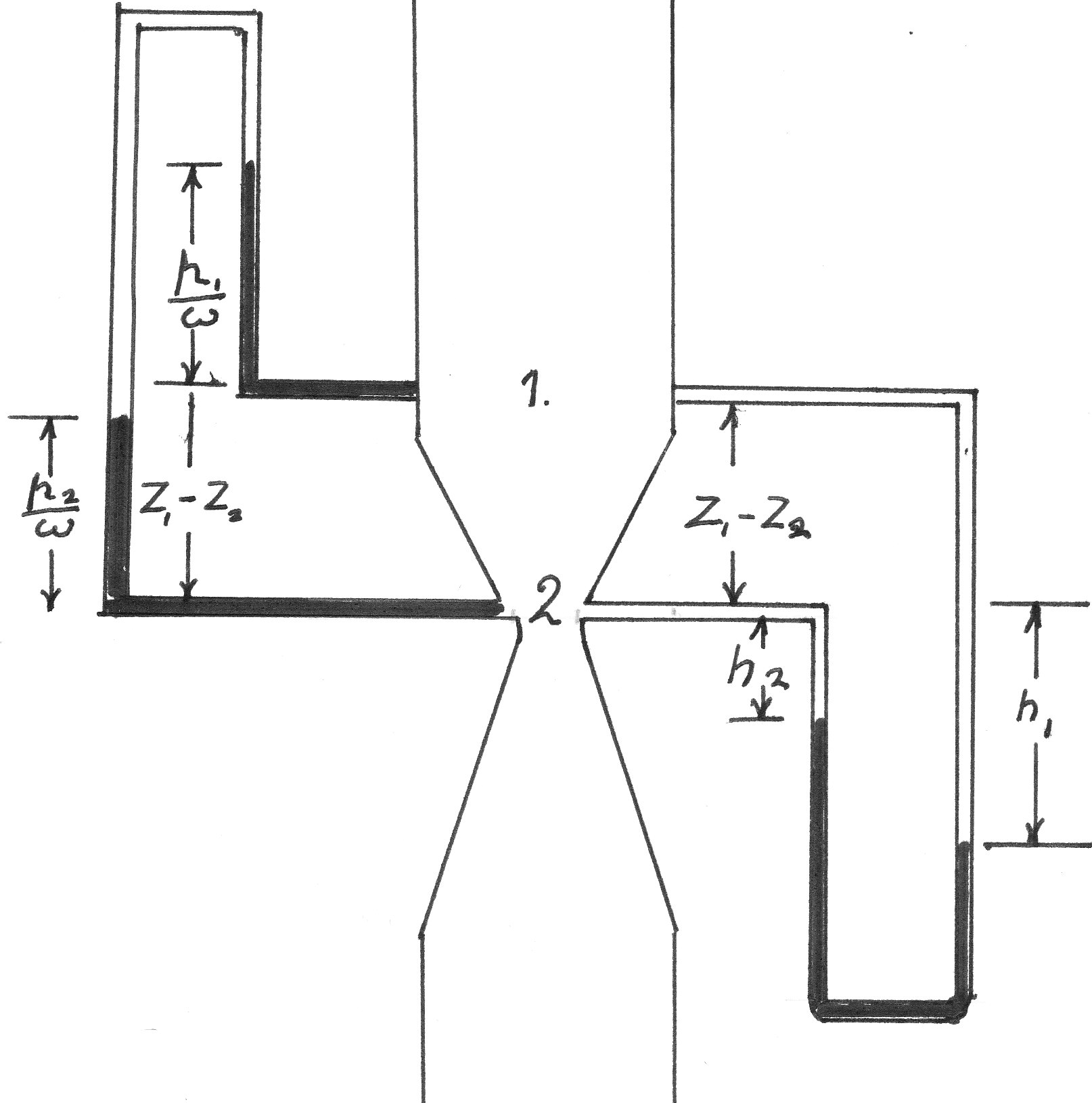
The following section considers a meter mounted in the vertical. It will be found that the formulae which have already been proved are equally applicable to vertical meters.
Applying Bernoulli and ignoring losses:
A note is required too to explain the following equation!
Which is the same as equation (#1) which was proved for a horizontal meter. It is worth noting however that the pressures are different.
The following example is of a non-horizontal meter.
Example 1
A venturi meter is connected at the main and throat sections by tubes filled with the fluid being metered by a differential mercury manometer. Prove that for any flow the reading is unaffected by the slope of the meter.
If the mains diameter is in. and the throat diameter
in., calculate the flow of fuel oil in gals./hr. if its relative density relative to water is 0.8 and the difference of level of the mercury columns is 7 in.
Use a direct application of Bernoulli's theorem taking the relative density of mercury to water as 13.6 and the meter coefficient as 0.96.

Applying Bernoulli:
But for a given flow
and
are constant:
is constant
Now the pressures at level , in the
-tube are equal and if the subscript
refers to mercury, then:
or:
From equations (#1) and (#2)
where Constant
Now:
From equations (#3) and (#4) and substituting values:
From which:
Thus the flow of oil in gallons/hour
The flow of oil in gallons/hour is .