
Pascals Law
Blaise Pascal (1623-1662) was a French mathematician, physicist, inventor, writer and Catholic philosopher.
Proof of Pascal's law
You're viewing an older version of this page (#4104). View the current version.
Pascal's Law states,
" The intensity of pressure at any point in a fluid at rest, is the same in all direction."
Theorem Proof
Consider a very small right angled triangular element ABC of a liquid as shown in figure.
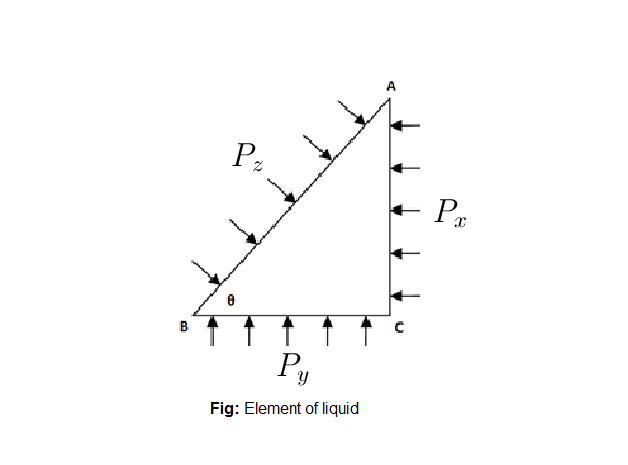
Let:
= Intensity of horizontal pressure on the element of the liquid
= Intensity of vertical pressure on the element of the liquid
= Intensity of pressure on the diagonal of the triangular element of the liquid
= Angle of the triangular element of the liquid
Now total pressure on the vertical side AC of the liquid,
Similarly,total pressure on the horizontal side BC of the liquid,
and total pressure on the diagonal side AB of the liquid,
Since the element of the liquid is at rest, therefore sum of the horizontal and vertical components of the liquid pressure must be equal to zero.
Now using eqilibrium condition for horizontal pressure,
From the geometry of the figure, we find that,
Now using equilibrium condition for vertical pressure, i.e., (where W = Weight of the liquid)
As the triangular element is very small, the weight of the liquid W is neglected, so,
From the geometry of the figure, we find that
Now from equation (#4) and (#5), we find that
Thus the intensity of pressure at any point in a fluid, at rest, is the same in all direction.