
Transfer
The transfer of liquid from one vessel into another
You're viewing an older version of this page (#4167). View the current version.
When two vessels,containing liquid, are connected together by means of an orifice, the liquid will flow from the vessel with a higher level to the vessel with a lower level irrespective of their areas. In such a case the liquid level will fall in one vessel with a corresponding rise in the other. The orifice, through which the flow takes place, is a drowned one and the liquid head causing flow will be the difference between the two liquid levels.
Consider two tanks connected at their bottom by a small orifice as shown in figure.
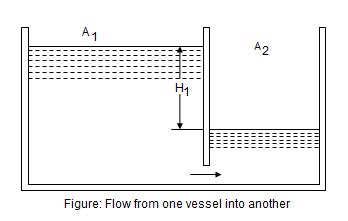
Let,
= Area of the larger vessel
= Area of the smaller vessel
= Area of the orifice
= Initial difference between the liquid levels of the two vessels
= Final difference between the liquid levels of the two vessels
= Time, in seconds, required to bring the difference of liquid levels from
At some instant, let the difference between the two liquid levels be h.
The theoretical velocity,
After a small interval of time dt, let the liquid level in the vessel fall down by an amount equal to x.
The volume of liquid that has passed from the tank
=
and the rise of liquid level in the other tank =
If the change of liquid level in the tanks be dh in time dt, then
(-) negative sign of dh is taken, as the value of h will decrease as the discharge will increase
In time dt, the volume of water that has passed from tank
= Coefficient of discharge Area
Theoretical Velocity
Time
Equating equations (#1) and (#2),
Now the total time (T)required to bring the differences of liquid levels from to
may be found out by integrating the above equation between the limits
and
i.e.,
Taking minus sign out of the bracket as is greater than
Example 1 [metric]
A tank 6m long and 1.5m wide is divided into two parts, so that area of one part is 7.2m\^2 and that of the other is 1.8m\^2. The water level in the larger part is 3m higher than in the lower one. Find the time taken for difference in water levels to reach 1m if the water flows through a submerged orifice of 75mm diameter, in the partition. Assume coefficient of discharge for orifice as 0.6.
Given,
- Size of the tank = 6
1.5 = 9 m\^2
= 75mm = 0.075m
= 0.6
We know that the area of the orifice,
So, time taken for the difference of water levels,
Time taken for the difference of water level = 3 min
Example 2 [metric]
Two tanks of 9m 6m and 6m
3m are connected at their bottom by a circular orifice of 150mm diameter. When the flow started, the water level in the larger tank was 4m higher than that in the smaller one. Find the time taken to flow 27 m\^3 water from the larger tank into the smaller one if coefficient of discharge for the orifice is 0.64.
Given,
= 27 m\^3
We know that the fall of water level in the larger tank,
The rise in water level in the smaller tank,
The final difference in water levels,
= 4 - (0.5 + 1.5) = 2 m
We also know that the area of the orifice,
So, time taken for the flow of water,
Time taken for the flow of water = 5 minutes 16 seconds