
Triangular Notch
Discharge over a Triangular Notch
You're viewing an older version of this page (#4206). View the current version.
A triangular notch is also called a V-notch. Consider a triangular notch, in one side of the tank, over which water is flowing as shown in figure.
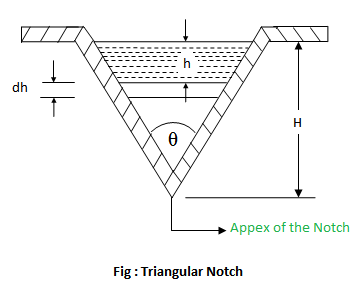
Let,
- H = Height of the liquid above the apex of the notch
- θ = Angle of the notch
- C\_d = Coefficient of discharge
From the geometry of the figure, we find that the width of the notch at the water surface,
Area of the strip =
We know that the theoretical velocity of water through the strip =
and discharge over the notch,
The total discharge over the whole notch may be found out only by integrating the above equation within the limits 0 and H.
A triangular notch gives more accurate results for low discharges than rectangular notch and the same triangular notch can measure a wide range of flows accurately.
Example 1 [metric]
A right-angled V-notch was used to measure the discharge of a centrifugal pump. If the depth of water at V-notch is 200mm, calculate the discharge over the notch in liters per minute. Assume coefficient of discharge as 0.62.
Given,
We know that the discharge over the triangular notch,
Discharge over the notch = 1560 liters/s
Example 2 [metric]
Water flows over a rectangular notch of 1m length over a depth of 150mm. Then the same quantity of water passes through a triangular right-angled notch. Find out the depth of water through the notch.
Take the coefficient of discharges for the rectangular and triangular notch as 0.62 and 0.59 respectively.
Given,
For rectangular notch:
= 1m
= 150 mm = 0.15 mm
= 0.62
For triangular notch:
= ?
First of all, consider the flow of water over the rectangular notch. We know that the discharge over the rectangular notch,
Now consider the flow of water over the triangular notch. We know that discharge over the triangular notch, (Q),
Depth of water through the triangular notch = 0.357 m