
Sluice Gates
Water Pressure on Sluice Gates
You're viewing an older version of this page (#4209). View the current version.
Introduction
A sluice gate is provided, in the path of a river or a stream, to regulate the flow of water. For doing so, the sluice gate is made to move up and down with the help of rollers fixed to the vertical plates (called skin plates) which travel on vertical rails called guides. These rails are fixed on piers or vertical walls as shown in Figure. In between these two skin plates , a number of I-beams are provided horizontally to withstand the water pressure. As the water pressure varies with the depth, the spacing between the I-beams is lesser at the bottom than that at the top of the sluice gate.
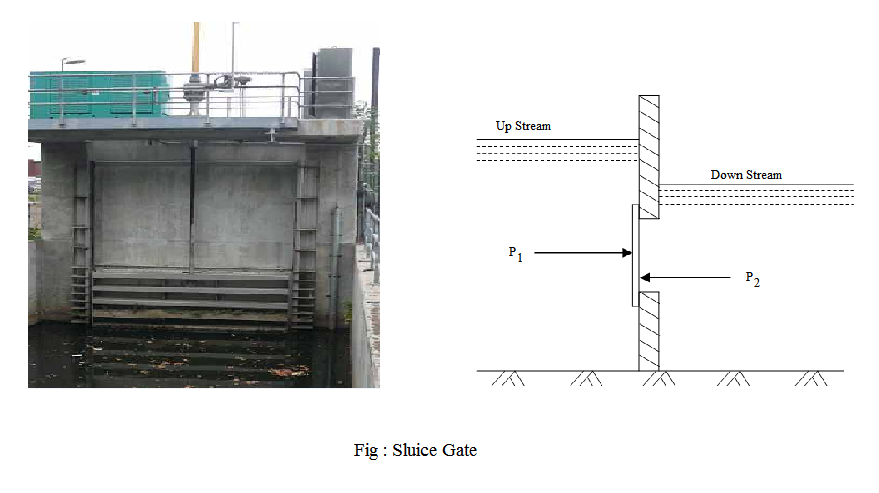
Water acts on both sides of a sluice gate as shown in figure. The resultant pressure on the sluice gate is obtained as follows:
Let,
= Wetted area on the upstream of the gate
= Depth of center of gravity of the wetted area on the upstream side of the gate, and
= Corresponding values for the downstream side of the gate
Pressure on the upstream side of the gate,
Similarly, pressure on the downstream side of the gate,
As the two pressure are acting in opposite directions, therefore the resultant pressure,
The point of application of the resultant pressure (P) may be found out by taking moments of the two pressure (P\_1 and P\_2) about the top or bottom of the gate.
Example 1 [metric]
A vertical sluice gate 3m wide and 2.5m deep contains water on both of its sides. On the upstream side, the water is 5m deep and on the downstream side it is 2m deep from the bottom of the sluice. What is the resultant pressure on the gate?
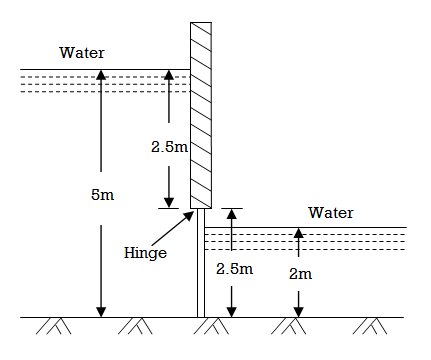
Given,
- Width of the sluice gate, b = 3m
- Depth of the sluice gate = 2.5m
- Depth of water on the upstream side = 5m
- Depth of water on the downstream side = 2m
The area of sluice gate submerged on the upstream side,
and depth of c.g. of the sluice gate from the water level on the upstream side,
Similarly, area of sluice gate submerged on the downstream side,
and depth of c.g. of the sluice gate from the water level on the downstream side,
Pressure due to water on the upstream side of the gate,
and Pressure due to water on the downstream side of the gate,
Resultant pressure on the gate,
Resultant pressure on the gate = 217 KN
Example 2 [metric]
A vertical sluice gate 4m wide and 2m deep is hinged at the top. A liquid of specific gravity 1.5 stands on the upstream side of the gate up to a height of 3.5m above the top edge of the gate and water on the downstream side up to the top edge of the gate.
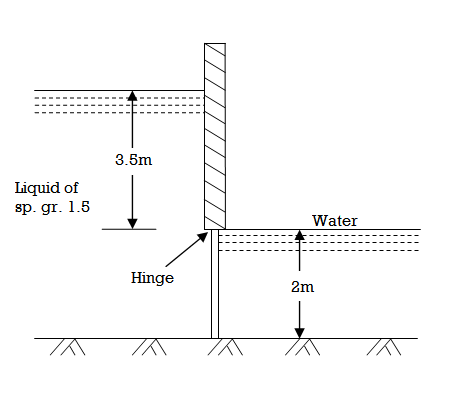
Find: (i) resultant pressure acting on the gate (ii) point at which the resultant pressure acts.
Given,
- Width of sluice gate, b =4m
- Depth of sluice gate, d = 2m
- Specific gravity of liquid = 1.5
- Height of liquid above the top edge of the gate on its upstream side = 3.5m
- Height of water on the downstream side = 2m
(i) Resultant pressure acting on the sluice gate,
We know that area of the sluice gate,
and depth of c.g. of the sluice gate from the liquid level on the upstream side,
Similarly depth of c.g. of the sluice gate from the water level on the downstream side,
Pressure due to liquid on the upstream side of the sluice gate,
and pressure due to water on downstream side of the gate,
Resultant pressure acting on the gate,
(ii) Point at which the resultant pressure acts,
Let, = Depth of center of resultant pressure from the hinge (i.e., top of the sluice gate)
We know that moment of inertia of the rectangular section about its c.g. and parallel to liquid (or water) surface,
and depth of center of pressure on the upstream on the upstream side of the gate from the liquid surface,
Similarly,
Now taking moments about the hinge and equating the same,
(i) Resultant pressure acting on the gate, = 451.2 KN
(ii) Point at which the resultant pressure acts, = 1.03 m