
Discharge
Discharge over different types of weirs
Discharge Over a Rectangular Weir
Consider a rectangular weir over which the water is flowing as shown in figure -
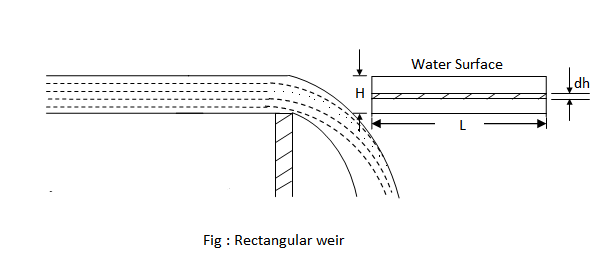
Let,
- H = Height of the water above the crest of the weir
- L = Length of the weir and
- C\_d = Coefficient of discharge
Let us consider a horizontal strip of water of thickness at a depth
from the water surface as shown in
figure.
Area of the strip =
We know that the theoretical velocity of water through the strip =
Discharge through the strip,
=
Area of strip
Theoretical Velocity
The total discharge, over the weir, may be found out by integrating the above equation within the limits 0 and H.
Example 1 [metric]
A weir of 8m long is to be built across a rectangular channel to discharge a flow of 9m\^3 /s. If the maximum depth of water on the upstream side of weir is to be 2m, what should be the height of the weir ? Adopt C\_d = 0.62.
Given,
- L = 8 m
- Q = 9 m\^3 /s
- Depth of water = 2m
- C\_d = 0.62
Let, H = Height of water above the sill of the weir.
So, the discharge over the weir,
Therefore height of weir should be = 2.0 - 0.72 = 1.28 m
Height of weir = 1.28 m
Example 2 [metric]
The daily record of rainfall over a catchment area is 0.2 million cubic meters. It has been found that 80% of the rain water reaches storage reservoir and then passes over a rectangular weir. What should be the length of the weir, if the water is not to rise more than 400 mm above the crest ?
Assume the value of coefficient of discharge for the weir as 0.61.
Given,
- Rainfall = 0.2
10\^6 m\^3 /day
- Discharge into the reservoir = 80% of rain water
- H = 400 mm = 0.4 m
- C\_d = 0.61
Let, L = Length of the water in meters
We know that the volume of water which reaches the reservoir from the catchment area,
We also know that the discharge into the reservoir over the rectangular weir (Q),
Length of the weir = 4.06 m
Discharge Over a Cippoletti Weir
The "Cippoletti" weir is a trapezoidal weir, having 1 horizontal to 4 vertical side slopes, as shown in figure. The purpose of the slope, on the sides, is to obtain an increased discharge through the triangular portions of the weir, which, otherwise would have been decreased due to end contractions in the case of rectangular weirs. Thus the advantage of a Cippoletti weir is that the factor of end contraction is not required, while using the Francis' Formula.
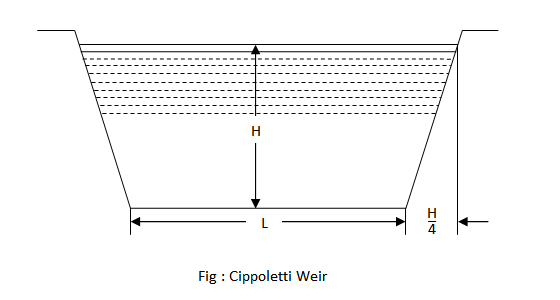
Let us split up the trapezoidal weir into a rectangular weir and a triangular notch.
Now discharge over a rectangular weir,
and discharge over a www.codecogs.com/reference/engineering/fluid_mechanics/notches/triangular_notch.php "triangular notch",
So total discharge,
Since the main idea of Cippoletti was to avoid the factor of end contraction, and as such he gave the formula for the
discharge,
Example 1 [metric]
Water is flowing over a Cippoletti weir of 4 meters long under a head of 1 meter. Compute the discharge, if the coefficient of discharge for the weir is 0.6.
Given,
- L = 4m
- H = 1m
- C\_d = 0.62
We know that the discharge over the Cippoletti weir,
Discharge = 7.32 m\^3 /s
Discharge over a Narrow Crested Weir
If the height of water above the weir crest is greater than two times of the width of the crest of weir, the weir is called a Narrow Crested weir.
A narrow crested weir is hydraulically similar to an ordinary weir or to a rectangular weir. Thus the same formula for discharge over a narrow-crested weir holds good, which was derived from an ordinary weir.
Example 1 [metric]
A narrow-crested weir of 10 meters long is discharging water under a constant head of 400 mm. Find discharge over the weir in liters/s. Assume coefficient of discharge as 0.623.
Given,
- L = 10 m
- H = 400 m = 0.4 m
- C\_d = 0.623
We know, the discharge over the weir,
Discharge over a Broad Crested Weir
If the height of water above the weir crest is not greater than two times of the width of the crest of weir, the weir is called a Broad Crested weir.
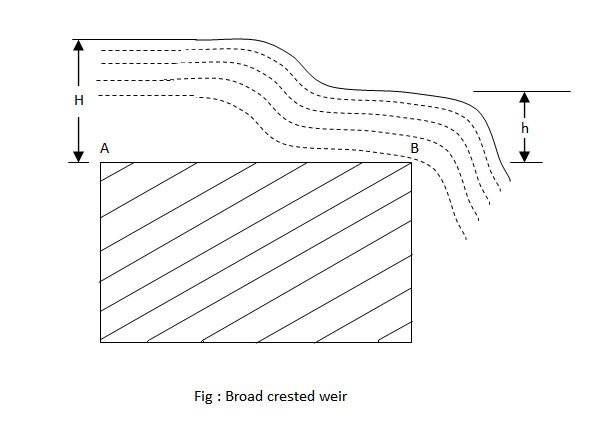
Consider a broad crested weir as shown in figure. Let A and B be the upstream and downstream ends of the weir.
Let,
- H = Head of water on the upstream side of the weir
- h = Head of water on the downstream side of the weir
- v = Velocity of the water on the downstream side of the weir (i.e., at B)
- C\_d = Coefficient of discharge and
- L = Length of the weir
Applying Bernoulli's equation at A and B,
Discharge over the weir,
The discharge will be maximum, when is maximum. Therefore differentiating the equation
and
equating the same to zero,
Substituing this value of in the equation (#1)
Example 1 [metric]
Determine the maximum discharge over a broad-crested weir 60 meters long having 0.6 m height of water above its crest. Take coefficient of discharge as 0.595. Also determine the new discharge over the weir, considering the velocity of approach. The channel at the upstream side of the weir has a cross-sectional area of 45 sq meters.
Given,
- L = 60 m
- H = 0.6 m
- C\_d = 0.595
- A = 45 m\^2
\subsection{Maximum discharge over the weir without considering the velocity of approach} We know that the maximum discharge over the weir,
\subsection{Maximum discharge over the weir considering the velocity of approach}
We know that velocity of approach,
and the head due to velocity of approach,
We also know that the maximum discharge over the weir,
Maximum discharge over the weir = 29.6 m\^3 /s
Discharge over a Sharp-crested Weir
It is a special type of weir having a sharp-crest as shown in figure. The water flowing over the crest comes in contact with the crest line and then springs up from the crest and falls as a trajectory.
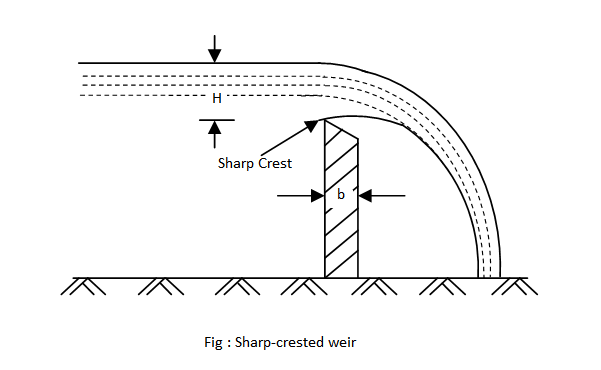
In a sharp-crested weir, the thickness of weir is kept less than half of the height of water on the weir, i.e.,
where,
- b = Thickness of the weir
- H = Height of water, above the crest of weir
The discharge equation, for a sharp-crested weir, remains the same as that of a rectangular weir, i.e.,
Example 1 [metric]
A rectangular sharp-crested weir is to be constructed in a testing station with small stream in which the discharge varies from 50 liters/s and 1250 liters/s. Find the suitable length of the weir, if the minimum head to be measured is 50 mm and the maximum head on it does not exceed one-third of its length.
Given,
- Q\_max = 50 liters/s = 0.05 m\^3 /s
- Q\_min = 1250 liters/s = 1.25 m\^3 /s
- H\_min = 50 mm = 0.05 m
Let, H = Length of weir in meters
Maximum head of water, H\_max = L/3
We know that the minimum discharge over the weir (Q\_min)
and maximum discharge over the weir (Q\_max)
Dividing equation (2) by (1)
Length of weir = 1.28 m
Discharge over an Ogee Weir
It is another special type of weir, generally used as a spillway of a dam as shown in figure. The crest of an ogee weir slightly rises up rom the point A (i.e., crest of the sharp-crested weir) and after reaching the maximum rise of (where
is the height of the water above the point A) falls in a parabolic form as shown in figure.
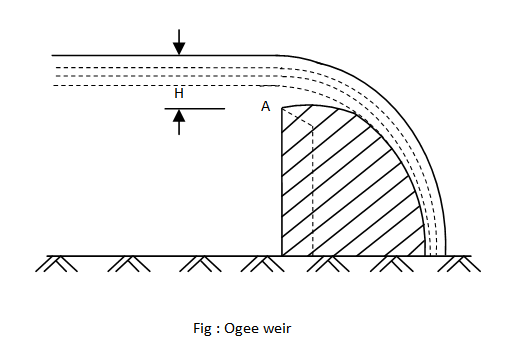
The discharge equation for an ogee weir remains the same as that of a rectangular weir, i.e.,
Example 1 [metric]
An ogee weir 4 meters long has 500 mm head of water. Find the discharge over the weir, if C\_d = 0.62.
Given,
- L = 4 m
- H = 500 mm = 0.5 m
- C\_d = 0.62
The discharge over the weir,
The discharge over the weir = 2590 liters/s
Discharge over a Submerged or Drowned Weir
When the water level on the downstream side of a weir is above the top surface of weir, it is known as submerged or drowned weir as shown in figure.
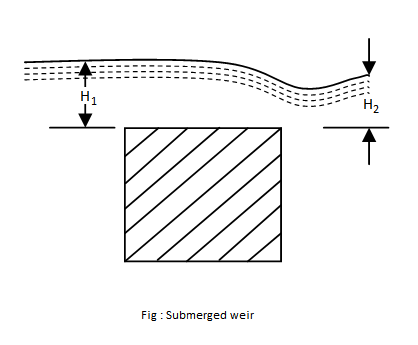
The total discharge, over such a weir, is found out by splitting up the height of water, above the sill of the weir,
into two portions. Let,
- H\_1 = Height of water on the upstream side of the weir
- H\_2 = Height of water on the downstream side of the weir
The discharge over the upper portion may be considered as a free discharge under a head of water equal to . And the discharge over the lower portion may be considered as a submerged discharge under a head of
.
Thus discharge over the free portion (i.e., upper portion)
and the discharge over the submerged (i.e., lower portion)
Total Discharge,
Example 1 [metric]
A submerged sharp crested weir 0.8m high stands clear across a channel having vertical sides and a width of 3m. The depth of water in the channel of approach is 1.25m. And 10m downstream from the weir, the depth of water is 1m. Determine the discharge over the weir in liters per second. Take C\_d as 0.6.
Given,
- L = 3m
- C\_d = 0.6
From the geometry of the weir, we find that the depth of water on the upstream side,
and depth of water on the downstream side,
We know that the discharge over the free portion of the weir,
and discharge over the submerged portion of the weir,
Total discharge,
Total discharge = 1461 liters/s