 CodeCogs®
Tag: Weirs
Introduction
Definition
A structure, used to dam up a stream or river, over which the water flows, is called a weir. The conditions of flow, in the case of a weir, are practically the same as those of a rectangular notch. That is why, a notch is, sometimes, called a weir and vice versa.
The only difference between a notch and a weir is that the notch is of a small size and the weir is of a bigger one. Moreover, a notch is usually made in a plate, whereas a weir is made of masonry or concrete.
Types of Weirs
There are many types of weirs depending upon their shape, nature of discharge, width of crest and nature of crest. But the following are important from the subject point of view :
1. According to the shape :
- Rectangular weir
- Cippoletti weir
2. According to the nature of discharge :
- Ordinary weir
- Submerged or drowned weir
3. According to the width of crest :
- Narrow crested weir
- Broad crested weir
4. According to the nature of crest :
- Sharp crested weir
- Ogee weir
Velocity of Approach
Sometimes, a weir is provided in a stream or a river to measure the flow of water. In such a case, the water, approaching the weir, has got some velocity, known as velocity of approach. It is assumed to be uniform over the whole weir. Let,
- A = Cross sectional area of the channel on the upstream side of the weir, and
- Q = Discharge over the weir
$\therefore$ Velocity of approach, $v = \frac{Q}{A}$
Ventilation of Rectangular Weirs
It has been observed that whenever water is flowing over a rectangular weir, having no end contractions, the nappe (i.e., the sheet of water flowing over the weir) touches the side walls of the channel. After flowing over the weir, the nappe falls away from the weir, thus creating a space beneath the water as shown in fig-1. In such a case, some air is trapped beneath the weir.
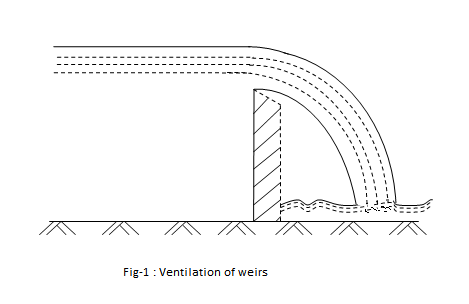
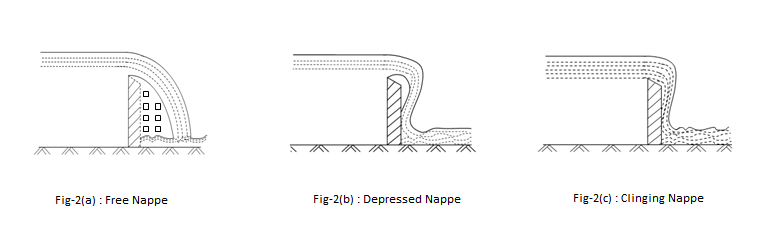
This air is carried away by the flowing water, which results in creating a negative pressure beneath the nappe. The negative pressure drags the lower side of the nappe towards the surface of the weir wall. This results in more discharge than the normal discharge. In order to keep the atmospheric pressure in the space below the nappe holes are made through the channel walls which are connected through the pipes to the atmosphere as shown in figure. Such holes are called 'Ventilation' of a weir. Though there are many types of the nappes, yet the following are important from the subject point of view :
- Free nappe
- Depressed nappe
- Clinging nappe
Free Nappe
If the atmospheric pressure exists beneath the nappe, it is known as a free nappe as shown in fig-2(a). A free nappe is obtained by ventilating a weir.
Depressed nappe
Sometimes a weir is not fully ventilated, but is partially ventilated as shown in fig-2(b). If the pressure below the nappe is negative, it is called a depressed nappe.
The discharge of the nappe, in this case, depends upon the amount of ventilation and the negative pressure. Generally, the discharge of a depressed nappe is 6% to 7% more than that of a free nappe.
Clinging nappe
Sometimes, no air is left below the water, and the nappe adheres or clings to the downstream side of the weir as shown in fig-2(c). Such a nappe is called clinging nappe or an adhering nappe. The discharge of a clinging nappe is 25% to 30% more than that of a free nappe.
-
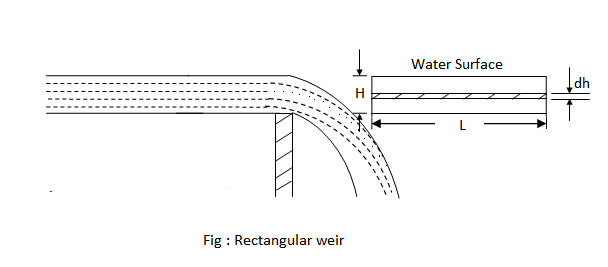
Discharge over different types of weirs