
RandomSample
Generates random numbers following a discrete distribution.
You're viewing an older version of this page (#368). View the current version.
Interface
#include <codecogs/statistics/distributions/discrete/discrete/randomsample.h>
using namespace Statistics::Distributions::Discrete::Discrete;
RandomSample(int n, T *p, T *val, bool normalise=true, double seed = 0.2354) :
Stats::Random::Mersenne(seed), m_n(n), m_val(val)
RandomSample(int n, T *p, bool normalise=true, double seed = 0.2354) : Stats::Random::Mersenne(seed), m_val(0)~RandomSample()void init(int n, T *p, bool normalise=true)inline unsigned int genIndex()inline T genReal()int sample(int N, double* p, bool normalise=true, double seed=0.1234)
Overview
This class generates random numbers from a discrete distribution and is optimised for sampling a small population many times.
The discrete statistical distribution can only take discrete values. It has probability function
cumulative distribution function
and population mean
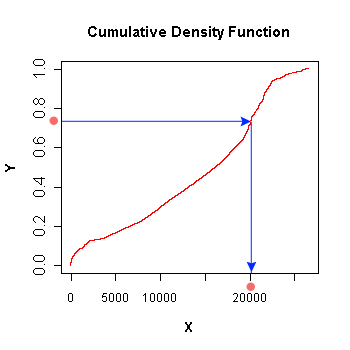
When this class is first initialised, it calculates the CDF of the probability array (so there is a small initialisation cost). With each request for a new random number, it generates an uniform random deviate between 0 and 1 and finds its corresponding abscissa value, as illustrated in the graph below. A binary search is used to detect the interval in which that value is situated, which in return gives the actual discrete random number. For instance if the ordinate would be approximately equal to as in the graph, the corresponding abscissa would be around
, which corresponds to an index in the values array that finally gives the random number.
Speed
The average running time for generating 100,000,000 random numbers using this class on a 750MHz microprocessor is 16 seconds.
Example 1
The given example displays 20 random floating point numbers from a discrete distribution. It uses two different generators to achieve this. The first generator uses a particular value to initialize the seed, while the second one is using the system timer. Notice that it was necessary to divide the timer by the <em> MERSENNEDIV </em> value in order to keep the seed in the interval from 0 to 1. Since the seed of the first generator is never changed, the first 10 numbers will always remain the same. However since the second generator is initialized via the system timer, the next 10 numbers will obviously vary with each execution of the program.
Also notice the declaration of the probability array P and value array V. They are used as constructor arguments when declaring the generators to specify the probabilities P[i] associated to each value V[i] in the values table. Always make sure that the components of P sum up to 1.
#include <iostream>
#include <time.h>
#include <codecogs/statistics/distributions/discrete/discrete/randomsample.h>
using namespace std;

int main()
{
  double P[4] = {   0.4,   0.1,   0.2,   0.3 };
  double V[4] = { 1.234, 2.345, 3.456, 4.567 };

  Stats::Dists::Discrete::Discrete::RandomSample<double> A(4, P, V, false, 0.3416);
  Stats::Dists::Discrete::Discrete::RandomSample<double> B(4, P, false, time(0) / MERSENNEDIV);

  for (int i = 0; i < 20; ++i)
    cout << A.genReal() << " ";
  cout << endl;

  for (int i = 0; i < 20; ++i)
    cout << B.genReal() << " ";
  cout << endl;

  return 0;
}
Output:
4.567 1.234 4.567 1.234 4.567 3.456 1.234 2.345 1.234 1.234 1.234 3.456 3.456 2.345 2.345 3.456 4.567 3.456 1.234 2.345
0 0 0 3 0 0 2 0 2 1 1 0 3 0 3 0 0 3 2 0
References
- MathWorld, http://mathworld.wolfram.com/DiscreteDistribution.html
- The Newran03 random number generator library of Robert Davies, http://www.robertnz.net/nr03doc.htm
Members of RandomSample
CLASS METHOD
RandomSample
Constructor that sets up the class variables and initializes the associated random number generator with the given seed.
Parameters
V[n] = {0, 1, 2, ..., n - 1}Parameters
CLASS METHOD
RandomSample
Constructor that sets up the class variables and initializes the associated random number generator with the given seed.
Parameters
CLASS METHOD
RandomSample
CLASS METHOD
init
Parameters
CLASS METHOD
genIndex
CLASS METHOD
genReal
CLASS METHOD
sample
This function is a simple wrapper around the randomsample class provided in this module. It uses a static to keep a single instance of this class, so that each call to this function returns a new random number. As a result this function is not necessarily thread safe, in the sense that with an identical initial seed, the sequence of random numbers may differ on a multitasking or multi threaded system.
The seed is only set on the first call to this function. Thereafter this parameter is ignored. If you do no want to set the seed, then we suggest you use the system clock the first time you call this function, i.e.
#include <time.h>
 ...
 sample(N,  p, time(0) / MERSENNEDIV);
If you require more advance behaviour, we strongly recommend that you directly use the underlying class randomsample that is provided with this module.