
FUNCTION
right_triangle
Computes the area of a trapezium within a right angled triangle with a fixed edge.
You're viewing an older version of this page (#397). View the current version.
Interface
#include <codecogs/maths/geometry/area/right_triangle.h>
using namespace Maths::Geometry::Area;
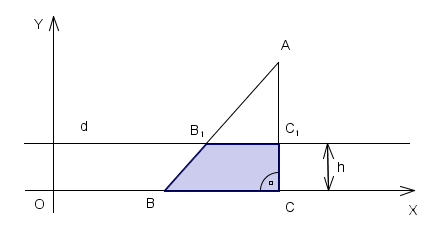
This module computes the area of the trapezium formed between a right angled triangle with a fixed edge on a reference line and a line found at a given distance distance from this reference line.
This situation is described by the following image. The area which we want to compute is that of the filled trapezium .
Solution
Let be an orthogonal coordinate system and let
be a right angled triangle (
) so that
and
where are fixed numbers. Also let
so that the distance from line
to
is
and
,
.
Obviously , which implies:
Thus:
To conclude, the solution of the problem is:
Example 1
#include <codecogs/geometry/area/right_triangle.h>
#include <stdio.h>

int main()
{
  // the lengths of the sides
  double a = 3.0, b = 4.0, c = 5.0;

  // display the lengths of the sides
  printf("a = %.1lf\nb = %.1lf\nc = %.1lf\n\n", a, b, c);

  // display the area for different values of h
  for (double h = 0.1; h < 1.09; h += 0.1)
    printf("h = %.1lf   Area = %.2lf\n", h, Geometry::Area::right_triangle(a, b, c, h));

  return 0;
}
Output
a = 3.0
b = 4.0
c = 5.0

h = 0.1   Area = 0.30
h = 0.2   Area = 0.59
h = 0.3   Area = 0.87
h = 0.4   Area = 1.14
h = 0.5   Area = 1.41
h = 0.6   Area = 1.66
h = 0.7   Area = 1.92
h = 0.8   Area = 2.16
h = 0.9   Area = 2.40
h = 1.0   Area = 2.62
Parameters
Returns
The values of the sides must be Pythagorean numbers, i.e. satisfying the equality:
Interactive Calculator
Computing…
Set a range above first to export a graph.