
FUNCTION
flow_shield
Computes the radiative heat flow between two plane surfaces that are separated by a number of absorptive thin shields.
You're viewing an older version of this page (#452). View the current version.
Interface
#include <codecogs/engineering/thermodynamics/radiation/flow_shield.h>
using namespace Engineering::Thermodynamics::Radiation;
This module calculates the radiative heat flow per unit surface between two plane surfaces, considering the case when these are separated by a number of absorptive thin shields.
On account of the Stefan-Boltzmann law, the unit radiative heat flow between the two surfaces separated by shields is given by
where
and
with ,
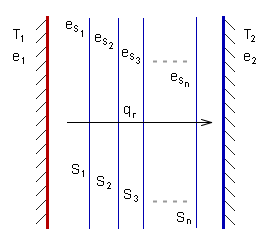
the emissivity factors of the first and second surface
,
the emissivity factor of the
-th shield
,
the emissivity constant of the black body
and
,
the corresponding absolute temperatures of the two plane surfaces.
The above expression of the unit heat flow can be further simplified to the following formula
In the diagram below is shown the radiative heat transfer between two plane surfaces, separated by shields
,
,
,
.
Example 1
The example below computes the unit radiative heat flow between an oxidated aluminium plane surface at 873.16 degrees Kelvin and an oxidated copper plane surface at 403.16 degrees Kelvin, separated by two thin shields. The first shield is made of zinc-covered iron at 297.16 degrees Kelvin, while the second is made of brass at 323.16 degrees Kelvin. You may notice that in the presence of these two thin shields, the heat flow between the given plane surfaces decreases by a factor of 72% than in the case of a non-absorptive medium, as calculated in the flow_noshield module.
#include <codecogs/engineering/heat_transfer/radiation/flow_shield.h>
#include <stdio.h>

int main()
{
  // the temperature of the oxidated aluminium surface
  double T1 = 873.16;

  // the temperature of the oxidated copper surface
  double T2 = 403.16;

  // the emission factor of the aluminium surface
  double e1 = 0.19;

  // the emission factor of the copper surface
  double e2 = 0.76;

  // the number of shields
  int n = 2;

  // the emission factors of the iron and brass shields
  double es[3] = {0.276, 0.22};

  // display radiative heat flow between the two plane surfaces
  printf("Radiative heat flow = %.5lf W per sq. meter\n",
  Engineering::Heat_Transfer::Radiation::flow_shield
  (T1, T2, e1, e2, n, es));

  return 0;
}
Output
Radiative heat flow = 1579.33128 W per sq. meterParameters
Returns
A table with the emissivity factors of various materials at different temperatures can be found at the following link http://www.monarchserver.com/TableofEmissivity.pdf
References
Dan Stefanescu, Mircea Marinescu - "Termotehnica"