
Frictionless
The flight of a Frictionless Projectiles
Interface
#include <codecogs/engineering/projectiles/frictionless.h>
using namespace Engineering::Projectiles;
Overview
With a Frictionless system the influence of air on the projectile is ignored. On earth this leads to a optimistic estimate for the distance travelled by the projective, although on an airless planet/moon these calculations would be appropriate.
In this module, the initial velocity of the projectile is R, released at an angle at a height h. i.e.
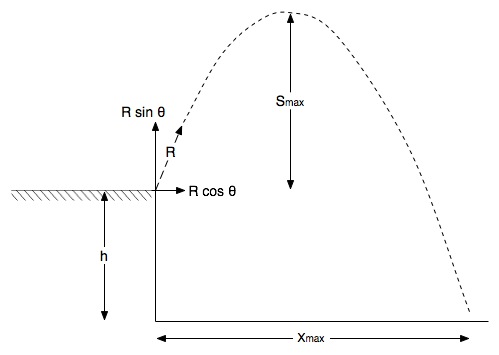
The only force acting on a frictionless projectile is that of gravity. As can be seen from the diagram the initial launch velocity,R, is resolved into it's vertical and horizontal components. As there are no forces in the horizontal direction, the horizontal component of the initial velocity lasts for the duration of the flight. Therefore the main equations of motion need only be applied in the vertical direction:
Where
- u is the initial vertical velocity [m/s]
- v is the final vertical velocity [m/s]
- s is the vertical distance traveled [m]
- t is the time taken [s]
- a is acceleration [m/s\^2]
FUNCTION
height
In the vertical direction the only force acting on the projectile is Gravity, g, which is assumed to be constant. With an initial vertical velocity of , then Eq (1) gives
which is the vertical height of the projectile at any given time.
Parameters
Interactive Calculator
Computing…
Set a range above first to export a graph.
FUNCTION
max_height
At its greatest height, the vertical velocity is zero, therefore from Eq (2) the maximum vertical height is:
We can show from Eq(3) that the time to reach this maximum is
Parameters
Interactive Calculator
Computing…
Set a range above first to export a graph.
FUNCTION
impact_velocity
The velocity of the projectile as it hits the ground is
where
- vhorz =
- vvert is computed from Eq (2), with the initial assumptions that u = 0 (at maximum height) and height of the projectile from its final landing point is
Therefore
or
Parameters
Interactive Calculator
Computing…
Set a range above first to export a graph.
FUNCTION
position
To conveniently plot the position of the projectile, it is necessary to compute the height of the projectile, y, for a given horizontal position x.
Therefore at a given x position, the time taken to reach that point is merely:
From Eq(3) and maximum flight time of the projectile is:
which serves as an upper limit for Eq(11)
Using the height function (above), y is computed.
Parameters
Interactive Calculator
Computing…
Set a range above first to export a graph.