
Lagrange
Interpolates a given set of points using the Lagrange polynomial.
You're viewing an older version of this page (#79). View the current version.
Interface
#include <codecogs/maths/approximation/interpolation/lagrange.h>
using namespace Maths::Approximation::Interpolation;
Overview
The Lagrange interpolating polynomial is the polynomial of degree n - 1 that passes through the n points
It is given by
where
The formula was first published by Waring (1779), rediscovered by Euler in 1783, and published by Lagrange in 1795 (Jeffreys and Jeffreys 1988). An important detail when using this class is that the abscissas array given as argument to the constructor needs to be sorted in ascending order.
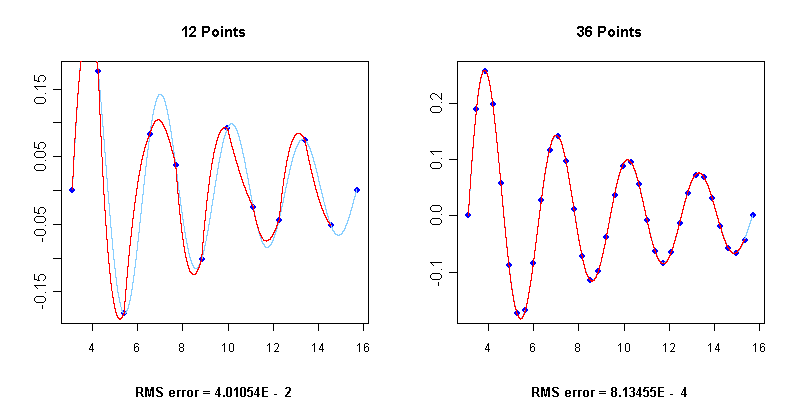
Below you will find the interpolation graphs for a set of points obtained by evaluating the function , displayed in light blue, at particular abscissas. The Lagrange polynomial, displayed in red, has been calculated using this class. In the first graph there had been chosen a number of 12 points, while in the second 36 points were considered. The level of interpolation in both graphs is 3. The root mean squared error is also displayd in each of the cases.
References
- MathWorld, http://mathworld.wolfram.com/LagrangeInterpolatingPolynomial.html
- Jean-Pierre Moreau's Home Page, http://perso.wanadoo.fr/jean-pierre.moreau/
- F.R. Ruckdeschel, "BASIC Scientific Subroutines, Vol. II, BYTE/McGRAWW-HILL, 1981
Example 1
The following example displays 20 interpolated values (you may change this amount through the N_out variable) for the given function with abscissas equally spaced in the
interval. The X and Y coordinate arrays are initialized by evaluating this function for N = 12 points equally spaced in the domain from
to
.
#include <codecogs/maths/interpolation/lagrange.h>

#include <cmath>
#include <iostream>
#include <iomanip>
using namespace std;

#define PI  3.1415
#define N   12

int main()
{
    // Declare and initialize two arrays to hold the coordinates of the initial data points
    double x[N], y[N];

    // Generate the points
    double xx = PI, step = 4 * PI / (N - 1);
    for (int i = 0; i < N; ++i, xx += step) {
        x[i] = xx;
        y[i] = sin(2 * xx) / xx;
    }

    // Initialize the Lagrange interpolation routine with known data points
    Maths::Interpolation::Lagrange A(N, x, y);

    // Interrogate Lagrange polynomial to find interpolated values
    int N_out = 20;
    xx = PI, step = (3 * PI) / (N_out - 1);
    for (int i = 0; i < N_out; ++i, xx += step) {
        cout << "x = " << setw(7) << xx << "  y = ";
        cout << setw(13) << A.getValue(xx, 3) << endl;
	}
    return 0;
}
Output:
x =  3.1415  y = -5.89868e-005
x = 3.63753  y =      0.216649
x = 4.13355  y =      0.208793
x = 4.62958  y =    -0.0536974
x = 5.12561  y =     -0.186543
x = 5.62163  y =      -0.10577
x = 6.11766  y =     0.0268879
x = 6.61368  y =     0.0875189
x = 7.10971  y =     0.0993752
x = 7.60574  y =     0.0512131
x = 8.10176  y =    -0.0885626
x = 8.59779  y =     -0.123293
x = 9.09382  y =    -0.0160297
x = 9.58984  y =     0.0787203
x = 10.0859  y =     0.0791771
x = 10.5819  y =     0.0216086
x = 11.0779  y =    -0.0212055
x = 11.5739  y =    -0.0727429
x =   12.07  y =    -0.0621462
x =  12.566  y =     0.0312161
See Also
Also consider the regression methods: Discrete, Forsythe, Orthogonal, Stiefel
Members of Lagrange
CLASS METHOD
Lagrange
Initializes the necessary data for following evaluations of the polynomial.
Parameters
CLASS METHOD
Lagrange
Class destructor
CLASS METHOD
getValue
Returns the approximated ordinate at the given abscissa.
Parameters
The value of the x parameter needs to be in the X[0]...X[N - L + 1] interval (including endpoints), where l > 1 is the level of interpolation. For example a level 3 interpolation would have the maximum working interval between X[0] and X[N - 2].
CLASS METHOD
Lagrange_once
This function implements the Lagrange class for one off calculations, thereby avoid the need to instantiate the Lagrange class yourself.
Example 1
The following graph is constructed from interpolating the following values:
x = 1  y = 0.22
x = 2  y = 0.04
x = 3  y = -0.13
x = 4  y = -0.17
x = 5  y = -0.04
x = 6  y = 0.09
x = 7  y = 0.11
\graph N=7 l=2 x="1 2 3 4 5 6 7" y="0.22 0.04 -0.13 -0.17 -0.04 0.09 0.11" a=1:6 .input