
Forsythe
Approximates an arbitrary function using Forsythe orthogonal polynomials.
You're viewing an older version of this page (#90). View the current version.
Interface
#include <codecogs/maths/approximation/regression/forsythe.h>
using namespace Maths::Approximation::Regression;
Overview
This class approximates an arbitrary function by least squares fitting using Forsythe orthogonal polynomials. It uses a generalization of the three-term relation by G. Forsythe (1957), generating recursively a system of orthonormal polynomials over arbitrary sets of data points.
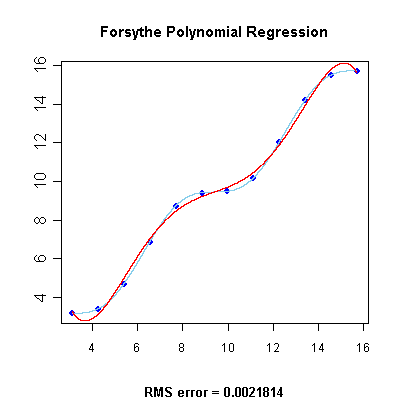
Below you will find the regression graph for a set of points obtained by evaluating the function , displayed in light blue, at particular abscissas. The regression polynomial, displayed in red, has been calculated using this class. The root mean squared error is also displayed.
References
- Jean-Pierre Moreau's Home Page, http://perso.wanadoo.fr/jean-pierre.moreau/
- F.R. Ruckdeschel, "BASIC Scientific Subroutines", Vol. II, BYTE/McGRAWW-HILL, 1981
Example 1
The following example displays 10 approximated values (you may change this amount through the N_out variable) for the given function with abscissas equally spaced in the
interval. The X and Y coordinate arrays are initialized by evaluating this function for N = 12 points equally spaced in the domain from π to 5 π .
#include <codecogs/maths/regression/forsythe.h>

#include <cmath>
#include <iostream>
#include <iomanip>
using namespace std;

#define PI  3.1415926535897932384626433832795
#define N   12

int main() {
    // Declare and initialize two arrays to hold the coordinates of the initial data points
    double x[N], y[N];

    // Generate the points
    double xx = PI, step = 4 * PI / (N - 1);
    for (int i = 0; i < N; ++i, xx += step) {
        x[i] = xx;
        y[i] = sin(xx) + xx;
    }

    // Initialize the regression approximation routine with known data points
    Maths::Regression::Forsythe A(N, x, y, 11);

    // Interrogate the regression function to find approximated values
    int N_out = 10;
    xx = PI, step = (3 * PI) / (N_out - 1);
    for (int i = 0; i < N_out; ++i, xx += step) {
        cout << "x = " << setw(7) << xx << "  y = ";
        cout << setw(11) << A.getValue(xx) << endl;
	}
    return 0;
}
Output:
x = 3.14159  y =     3.14159
x = 4.18879  y =     3.32358
x = 5.23599  y =     4.36968
x = 6.28319  y =     6.28329
x = 7.33038  y =     8.19637
x = 8.37758  y =     9.24362
x = 9.42478  y =     9.42478
x =  10.472  y =     9.60593
x = 11.5192  y =     10.6532
x = 12.5664 y = 12.5663Members of Forsythe
CLASS METHOD
Forsythe
Initializes the necessary data for following evaluations of the polynomial.
Parameters
CLASS METHOD
Forsythe
Class destructor
CLASS METHOD
getValue
Returns the approximated ordinate at the given abscissa.
Parameters
CLASS METHOD
Forsythe_once
This function implements the Forsythe class for one off calculations, thereby avoid the need to instantiate the Forsythe class yourself.
Example 1
The following graph are constructed by forming a regression of the following values, using a 3rd order orthogonal polynomials
x = 1  y = 0.22
x = 2  y = 0.04
x = 3  y = -0.13
x = 4  y = -0.17
x = 5  y = -0.04
x = 6  y = 0.09
x = 7  y = 0.11
\graph n=7 x="1 2 3 4 5 6 7" y="0.22 0.04 -0.13 -0.17 -0.04 0.09 0.11" degree=3 a=1:7 .input