
FUNCTION
Falseposition
Calculates the zeros of a function using the Regula-Falsi method.
You're viewing an older version of this page (#98). View the current version.
Interface
#include <codecogs/maths/rootfinding/falseposition.h>
using namespace Maths::Rootfinding;
The false position method, on contrast with Newton's method, in which the calculation of the derivative was required, replaces it with its approximation
Given and
, the main algorithm is based on the following recurrence relation
This method has rate of convergence , therefore inferior to the method of Newton. However it is more accurate than Newton because only one function evaluation is required,
,
being calculated in the previous iteration, while Newton requires two,
and
.
To give you a better idea on the way this method works, the following graph shows different iterations in the approximation process. Here is the associated list of pairs chosen at consecutive steps
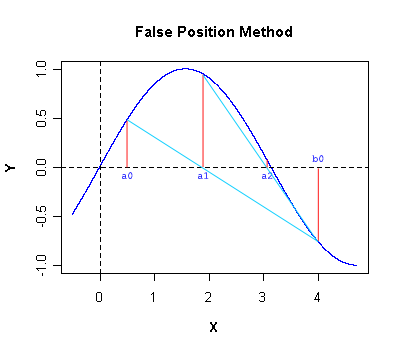
This algorithm finds the roots of the user-defined function f starting with an initial interval [x0, x1] and iterating the sequence above until either the accuracy eps is achieved or the maximum number of iterations maxit is exceeded.
Example:
#include <codecogs/maths/rootfinding/falseposition.h>

#include <iostream>
#include <iomanip>
#include <cmath>

// user-defined function
double f(double x) {
    return cos(x);
}

int main()
{
  double x = Maths::RootFinding::falseposition(f, 1, 3);

  std::cout << "The calculated zero is X = " << std::setprecision(12) << x << std::endl;
  std::cout << "The associated ordinate value is Y = " << f(x) << std::endl;
  return 0;
}
Output:
The calculated zero is X = 1.70614146372
The associated ordinate value is Y = -0.134932299622
References
- Jean-Pierre Moreau's Home Page, http://perso.wanadoo.fr/jean-pierre.moreau/
- F.R. Ruckdeschel, "BASIC Scientific Subroutines", Vol. II, BYTE/McGRAWW-HILL, 1981