
Angular Velocity and Acceleration
Key facts
Angular velocity is the rate of change of the position-specific angle $\theta$ with respect to time:
Angular acceleration is the rate of change of angular velocity with respect to time:
The centripetal acceleration can be defined as:
The Coriolis component of acceleration, or compound supplementary acceleration can be defined as:
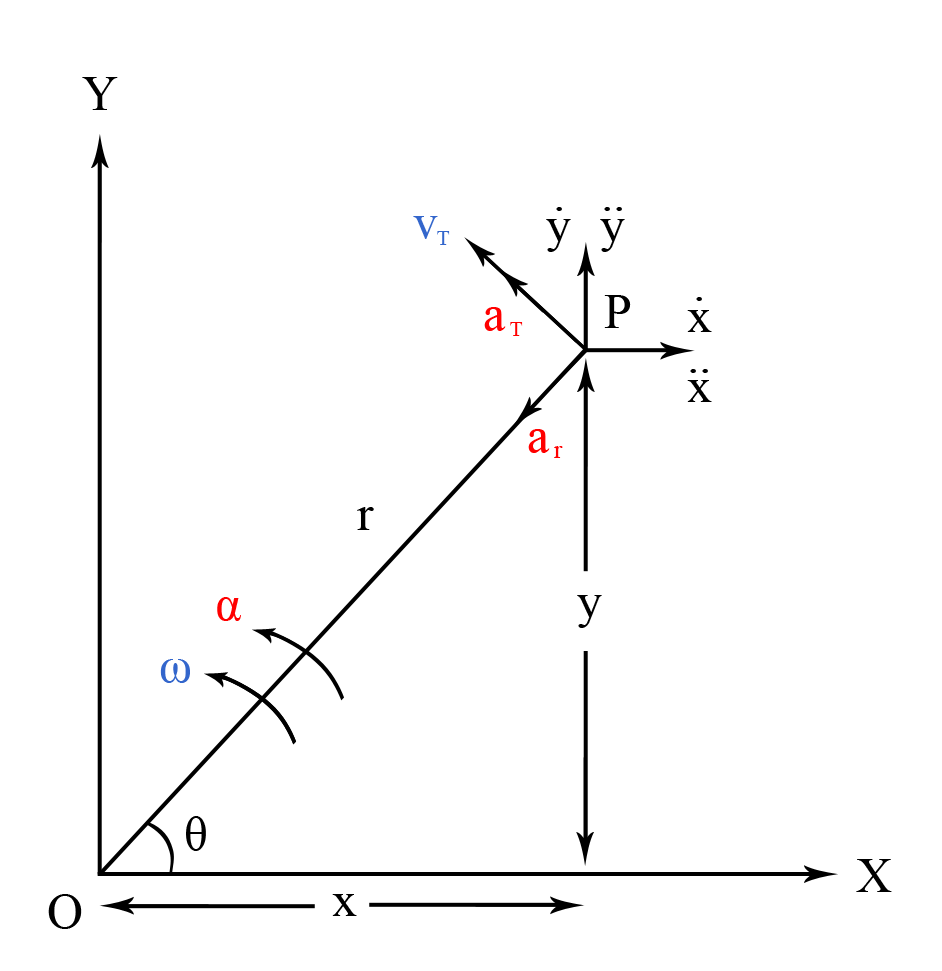
Angular velocity and acceleration, including centripetal and coriolis acceleration.
Angular velocity and acceleration are vector quantities that describe an object in circular motion. When an object, like a ball attached to a length of string, is rotated at a constant angular velocity, it is said to be in uniform circular motion. However, if the object is rotated at increasing or decreasing speeds, it can be said to be in a state of angular acceleration. The acceleration can have a centripetal component (acting inwards toward the axis of rotation) or a Coriolis component(acting perpendicular to the direction of velocity and the axis of rotation).
Angular Velocity
In order to define angular velocity, consider a particle $P$ moving in a $XOY$ reference plane, as diagramed in Figure 1. Let $x$ be the projection of $P$ on the $OX$ axis, $y$ the projection of $P$ on the $OY$ axis, $r$ the length of $OP$, and $\theta$ the $\angle{POX}$ angle.
We can then write that:
$x = r\cos\theta$
$y = r\sin\theta$
By differentiating these equations with respect to time, we have:
We can write the tangential component of velocity, $v_T$, which is the component of velocity perpendicular to $OP$, as:
$v_T = \dot y \cos\theta - \dot x \sin\theta$
and, by using the expressions of $\dot x$ and $\dot y$ from equations (5) and (6) respectively, we obtain:
We define the angular velocity $\omega$ as the rate of change of $\theta$ with respect to time:
$v_T = r\omega$
from which the angular velocity becomes:
$\omega = \frac{v_T}{r}$
Angular Acceleration
In order to define the acceleration, we first have to calculate $\ddot x$ and $\ddot y$. To do this we differentiate equations (5) and (6) with respect to time, when we obtain that:
We can write the radial component of acceleration, $a_r$, which is the component of acceleration in the direction of $OP$, as:
$a_r = \ddot x \cos\theta + \ddot y \sin\theta$
and, by using the expressions of $\ddot x$ and $\ddot y$ from equations (9) and (10) respectively, we get:
We can also write (11), by using (8), as:
$a_r = \dot v - r\omega^2$
where $\dot v$ is the rate of change of velocity, while the $r\omega^2$ term is called the Centripetal Acceleration ($a_c$).
The tangential component of acceleration on the other hand, $a_T$, can be written as:
$a_T = \ddot y \cos\theta - \ddot x \sin\theta$
and, again by replacing $\ddot x$ and $\ddot y$ from equations (9) and (10) respectively, we obtain:
We define the angular acceleration $\alpha$ as the rate of change of the angular velocity $\omega$ with respect to time:
Equation (12) can also be written, by taking into account (13), as:
$a_T = r \alpha + 2v\omega$ where the $2v\omega$ term is called the compound supplementary acceleration, or the Coriolis component of acceleration $a_C$.
Reference
For an application of angular velocity to mechanics, also see the reference page on Velocity and Acceleration of a Piston .