
Angular Velocity and Acceleration
Key facts
Angular velocity is the rate of change of the position-specific angle with respect to time:
Angular acceleration is the rate of change of angular velocity with respect to time:
The centripetal acceleration can be defined as:
The Coriolis component of acceleration, or compound supplementary acceleration can be defined as:
Angular velocity, acceleration, including centripetal and coriolis acceleration
You're viewing an older version of this page (#3639). View the current version.
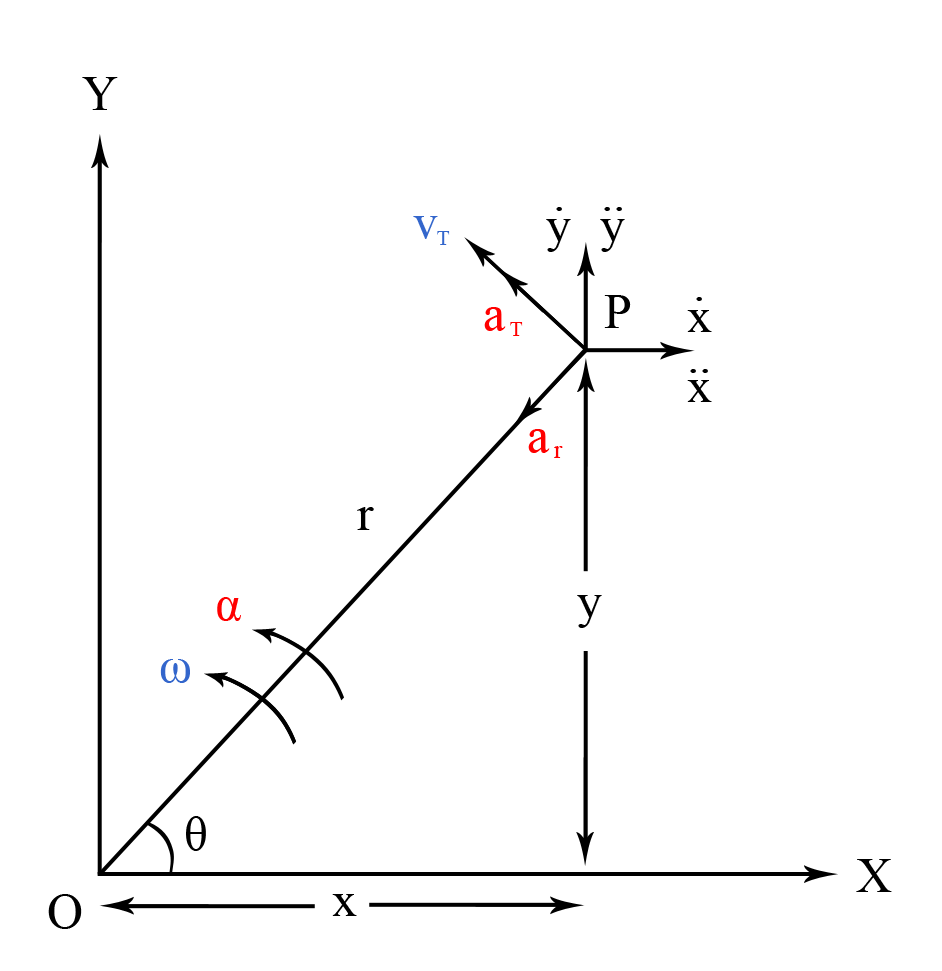
In order to define angular velocity, consider a particle moving in a
reference plane, as diagramed in Figure 1. Let
be the projection of
on the
axis,
the projection of
on the
axis,
the length of
, and
the
angle.
We can then write that:
By differentiating these equations with respect to time, we have:
We can write the tangential component of velocity, , which is the component of velocity perpendicular to
, as:
and, by using the expressions of and
from equations (#1) and (#2) respectively, we obtain:
We define the angular velocity as the rate of change of
with respect to time:
Using (#4) in (#3) we get that:
from which the angular velocity becomes:
In order to define the acceleration, we first have to calculate and
. To do this we differentiate equations (#1) and (#2) with respect to time, when we obtain that:
We can write the radial component of acceleration, , which is the component of acceleration in the direction of
, as:
and, by using the expressions of and
from equations (#5) and (#6) respectively, we get:
We can also write (#7), by using (#4), as:
where is the rate of change of velocity, while the
term is called the centripetal acceleration (
).
The tangential component of acceleration on the other hand, , can be written as:
and, again by replacing and
from equations (#5) and (#6) respectively, we obtain:
We define the angular acceleration as the rate of change of the angular velocity
with respect to time:
Equation (#8) can also be written, by taking into account (#9), as:
where the
term is called the compound supplementary acceleration, or the Coriolis component of acceleration
.
Example 1 [imperial]
Consider that the hard disk of a computer is circular and rotates with an angular velocity of 7200 revolutions per minute.
Calculate the linear velocity (in miles per hour) of a particle which is found 2 inches away from the center of the hard disk.
The angular velocity of the hard disk expressed in SI units is:
As the linear velocity can be defined as , we obtain the linear velocity of the particle as:
or, by converting it in miles per hour:
Example 2 [metric]
Consider that the hard disk of a computer is circular and rotates with an angular velocity of 7200 revolutions per minute.
Calculate the linear velocity (in kilometers per hour) of a particle which is found 5 centimeters away from the center of the hard disk.
The angular velocity of the hard disk expressed in SI units is:
As the linear velocity can be defined as , we obtain the linear velocity of the particle as:
or, by converting it in miles per hour:
Reference
For an application of angular velocity to mechanics, also see the reference page on Velocity and Acceleration of a Piston .