
Angular Velocity and Acceleration
Angular velocity and acceleration with applications to mechanics
You're viewing an older version of this page (#3350). View the current version.
Angular Velocity and Acceleration with Application to Mechanics
The diagram shows a point P moving in a plane XOY. The length OP = r and the
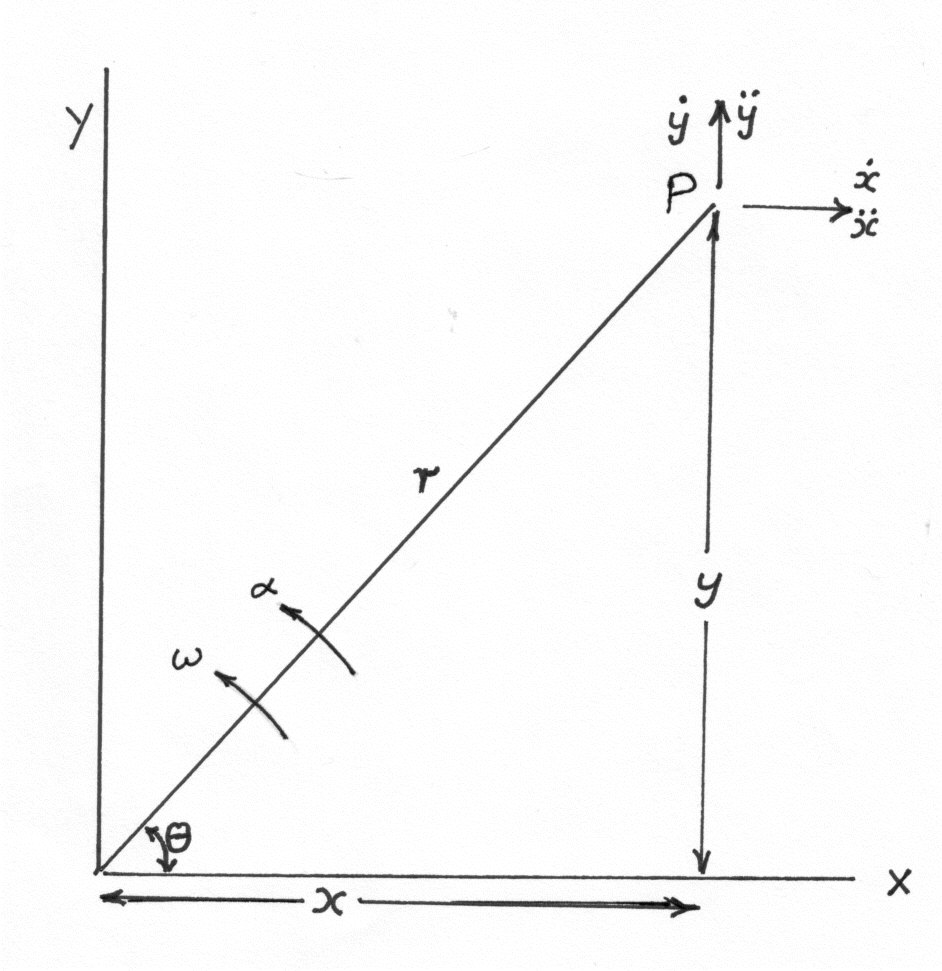
Then
and
Differentiating with respect to time
The radial component of velocity ( i.e. perpendicularr to OP in the direction of increasing
Differentiating equations 4 and 5
Radial components of acceleration
Tangential components of acceleration
Of these four terms in equations ( 14 ) and ( 17 )
= the rate of change of radial velocity.
= the centripetal acceleration due to the rotation of OP.
= due to the change in angular velocity.
is called the compound supplementary acceleration or "Coriolis component. Notice that the direction of the latter is the same as
when v is radially outwards.
Velocity and Acceleration of a Piston
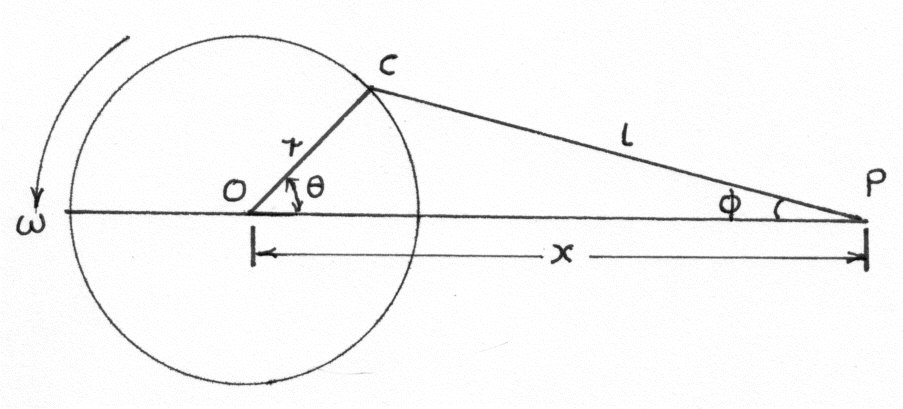
From the diagram it can be seen that
but
and
Piston velocity
Piston Acceleration
where is the uniform angular velocity of the crank and the positive direction of velocity and acceleration is away from the crankshaft.
Normally can be neglected in comparison to
and the above equations can be reduced to
Example 1
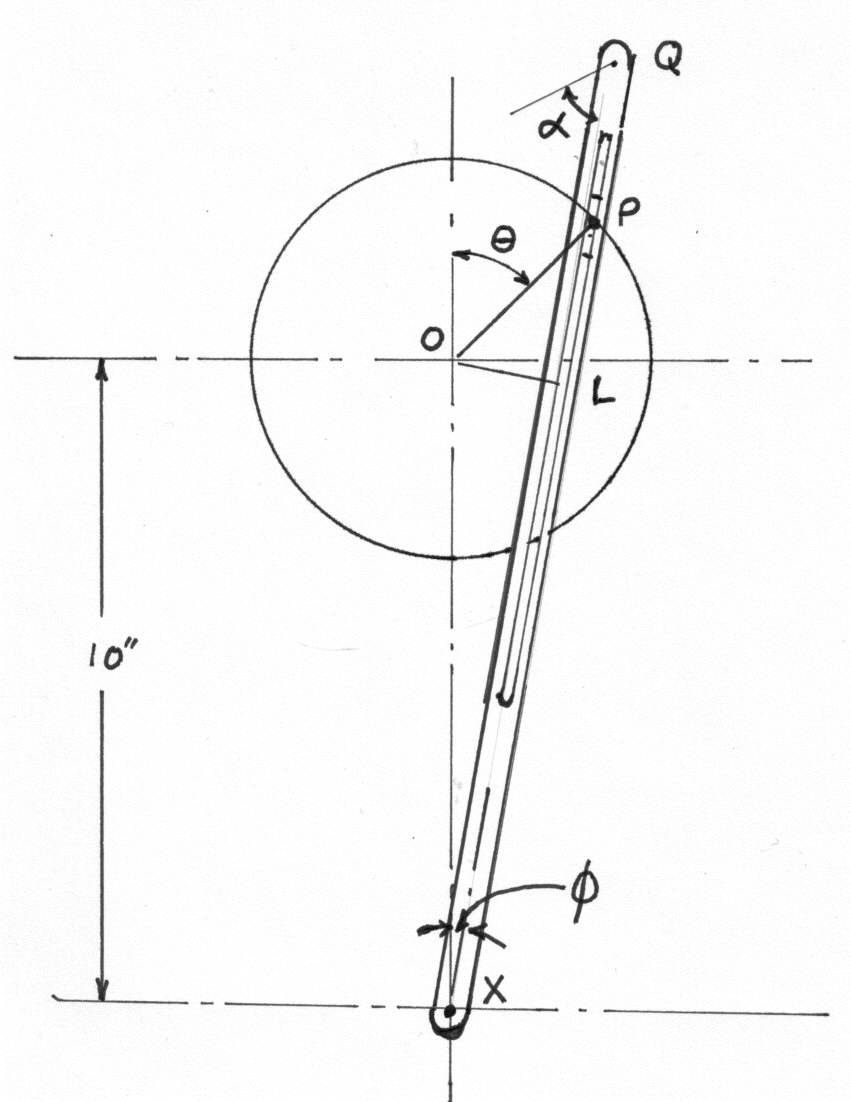
In the crank and slotted -lever mechanism shown, the crank OP is driven at a uniform speed of . If OL is the perpendicular from O on WQ the centre-line of the slotted lever, prove that the angular acceleration of the slotted lever is given by
Hence or otherwise find the acceleration of the point Q in magnitude and direction when the crank angle
OP = 3in. and XQ = 18in.
Differentiate with respect to t
or
i.e. or
Differentiating ( ),
Substituting for from ( ) and making use of the geometry of the mechanism, this reduces to:-
or
from ( )
From which
Thus
The acceleration components of Q are:
and
perpendicular to XQ to the "Left"
The magnitude of acceleration
at an angle