
Rigid Column Theory
The sudden opening of a valve at the end of a pipe
You're viewing an older version of this page (#3355). View the current version.
Sudden Valve Opening
Sudden opening of a valve using the rigid column theory.
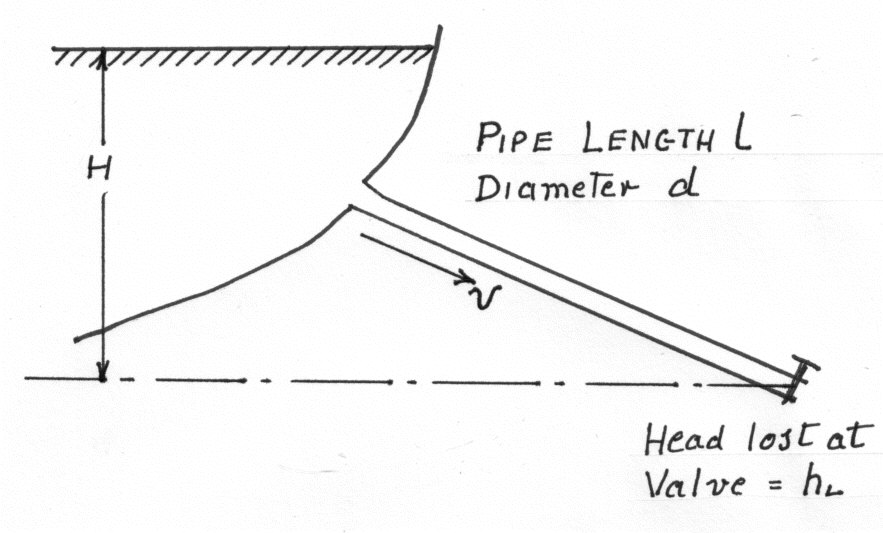
Let
- the pipe velocity at an instant t secs after the valve is thrown open be v
- H is the head causing the flow, which equals the entry loss + pipe friction + velocity head + valve loss + acceleration head, i.e.
(1)
where h\_L may given as or as an equivalent length of pipe
Using an equivalent length of pipe be L, then
(2)
i.e.
(3)
(4)
Let
(5)
(6)
(7)
oe
(8)
The final pipe velocity v\_s is when
(9)
(10)
Substituting in the equation for dt above we get
(11)
(12)
Integrating over the time t, when the velocity goes from 0 to v, gives
(13)
(14)
_________________________________________________________________________________
NOTE: This equation will give the time taken (t) for the pipe velocity to reach a given value or the velocity after a given time