
Rigid Column Theory
The sudden opening of a valve at the end of a pipe
You're viewing an older version of this page (#3789). View the current version.
Sudden Valve Opening
A valve is a device that regulates, directs or controls the flow of a fluid by opening, closing, or partially obstructing various passageways.
Sudden opening of a valve using The Rigid Column Theory.
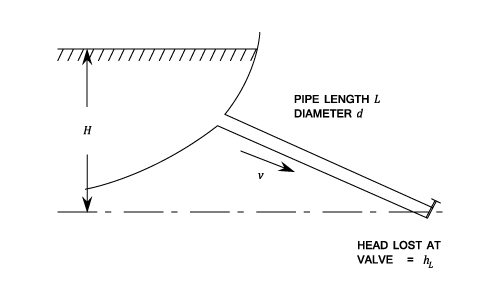
Let:
- the pipe velocity at an instant
secs after the valve is thrown open be
is the head causing the flow, which equals the entry loss + pipe friction + velocity head + valve loss + acceleration head, i.e.
where
may given as
or as an equivalent length of pipe.
Using an equivalent length of pipe be , then:
i.e.
Let:
Or:
The final pipe velocity is when:
Substituting in the equation for above we get:
Integrating over the time , when the velocity goes from 0 to
, gives:
NOTE: This equation will give the time taken for the pipe velocity to reach a given value or the velocity after a given time.