
Curved Beams
Moment of resistance is a term in structural engineering. It is found from the moment of inertia and the distance from the outside of the object concerned to its major axis.
A piston ring is a split ring that fits into a groove on the outer diameter of a piston in a reciprocating engine such as an internal combustion engine or steam engine.
Deflection is a term that is used to describe the degree to which a structural element is displaced under a load.
Castigliano'\b{s method} is a method for determining the displacements of a linear-elastic system based on the partial derivatives of the strain energy.
An analysis of stresses and strains in curved beams.
You're viewing an older version of this page (#3915). View the current version.
Stress in bars of small initial curvature.
Where the radius of curvature is large compared to the dimensions of the cross section, the analysis of stress is similar to that for pure bending.
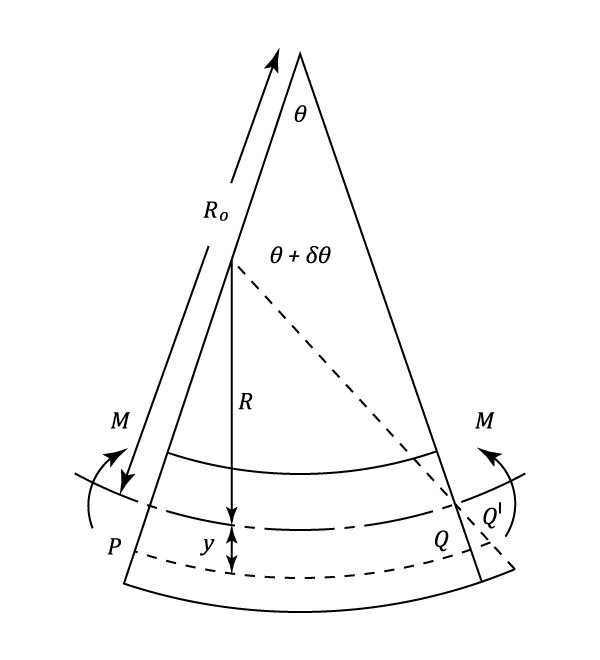
Let be the initial (unstrained) radius of curvature of the neutral surface and
the radius of curvature under the action of a pure bending moment
.
Then the strain in a element at a distance
from the neutral axis is given by:
Strain =
Since = length along the neutral axis
If is neglected in comparison with
and noting from
that
Then strain,
Neglecting lateral stress, the normal stress, strain
Substituting in equation (#1)
Total normal stress = 0, i.e.
which shows that the neutral axis passes through the centroid of the section.
Moment of resistance,
from equation (#3)
Combining equations (#2) and (#4), the strain energy of a short length
(measured along the neutral surface) under the action og bending moment
is:
From equation (#3)
Application to the design of a piston ring
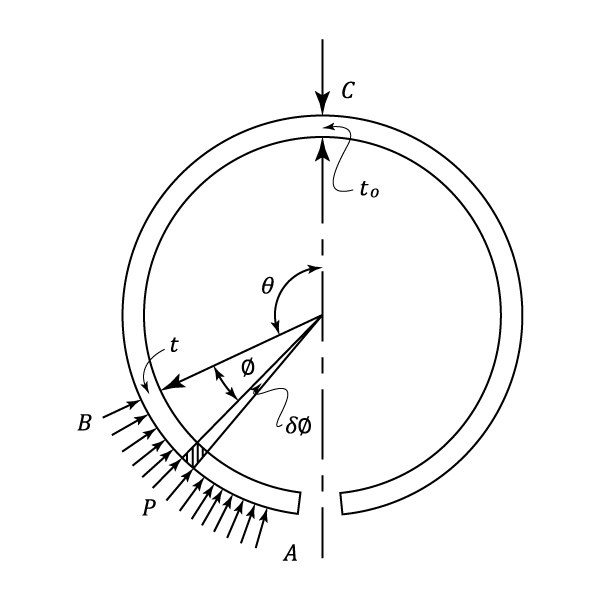
Suppose it is required to design a split ring so that its outside surface will be circular in both the stressed and unstressed conditions and the radial pressure exerted will be uniform. If is the uniform pressure on the outside then the bending moment at
is given by:
approx
where is the depth of the ring in the axial direction integrating
But = a constant for a given condition
i.e. = constant
when
and
Which is the required variation of thickness. Using equation (#5), the maximum bending stress at any section
which has it's greatest value when
i.e.
From which,
which determines the initial radius when values for
and
are assumed.
Stresses in Bars of Large Initial Curvature.
When the radius of curvature is of the same order as the dimensions of the cross section, it is no longer possible to neglect in comparison to
, and it will be found that the neutral axis does not pass through the centroid. Further, the stress is NOT proportional to the distance from the neutral axis
where is the strain,
is the distance from the neutral axis as before and
is the initial
radius of the neutral surface.
For pure bending the Total normal force on the cross section = .
Moment of resistance,
But
Where is the distance between the neutral axis and the principle axis which is through the centroid (
is positive when the neutral axis is on the same side of the centroid as the centre of curvature)
Substituting in equation (#7)
Rearranging,
In this equation is positive measured outwards, a positive bending moment being one that tends to increase the curvature.
Rectangular Cross-section
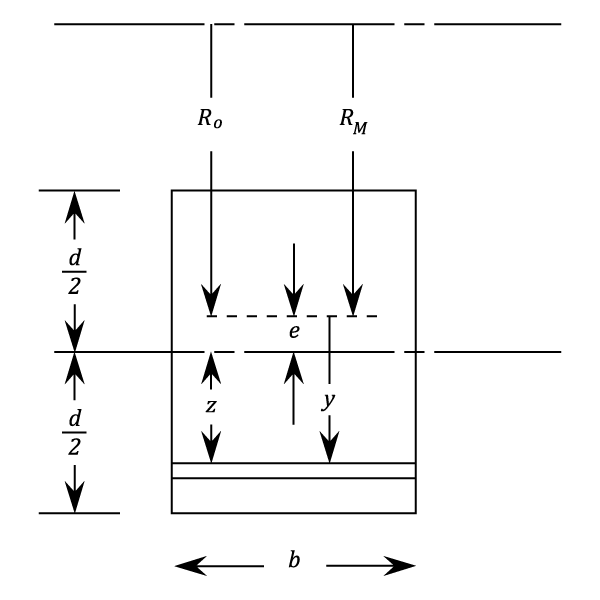
From equation (#6),
Let = the distance from the centroid. Also the mean radius of curvature
and
Then,
i.e.
Hence,
Giving,
As is small compared to
and
, it is difficult to calculate with sufficient accuracy from this equation, and the expansion of the log term into a convenient series is of advantage.
Then,
Example 1 [imperial]
A curved bar, initially unstressed, of square cross section, has sides and a mean radius of curvature of
If a bending moment of is applied to the bar tending to straighten it, find the stresses at the outer and inner faces.
and
But
and
At the inside face,
Thus, Tension
At the outside face,
compression
The actual stress distribution is shown in the diagram.
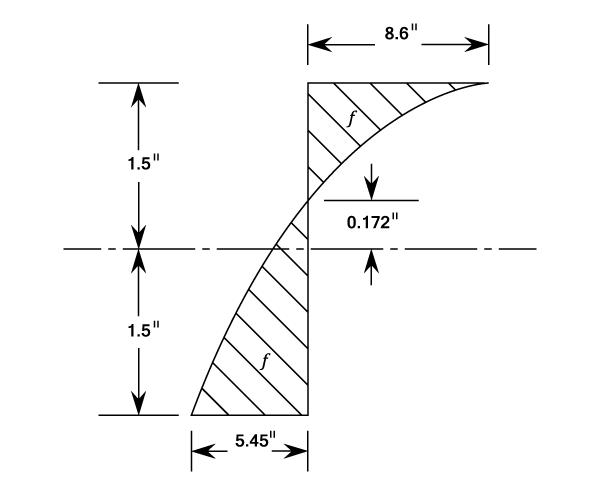
Tension
Compression
Trapezoidal Cross-section.
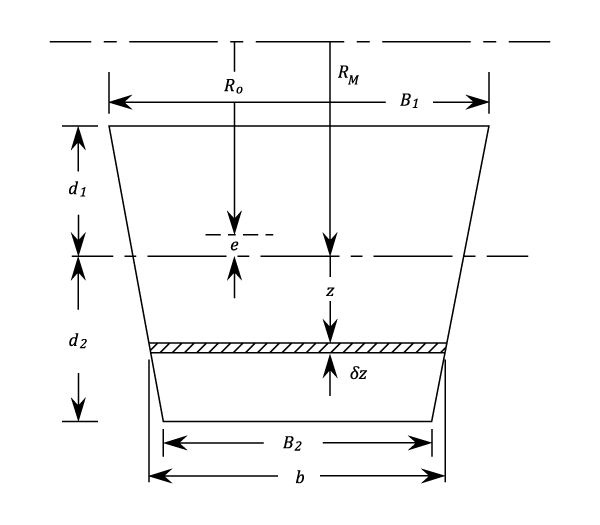
By Moments,
By putting and
equation (#6) becomes
i.e. or,
From which,
And since,
can be evaluated from equations (#8) and (#9).
Example 1 [imperial]
A crane hook whose horizontal cross-section is trapezoidal, wide on the inside and
wide on the outside by
thick, carries a vertical load of one ton whose line of action is
from the inside edge of this section. The centre of curvature is
from the inside edge.
Calculate the maximum tensile and compressive forces set up.
Referring to the last figure.
From equation (9)
Direct stress = load / area = in. tensile
Bending stress =
At the inside edge,
(tending to decrease the curvature)
Bending stress = in tension
The combined stress = tensile.
At the outside edge,
Bending stress =
Combined stress = in compression
Circular Cross section
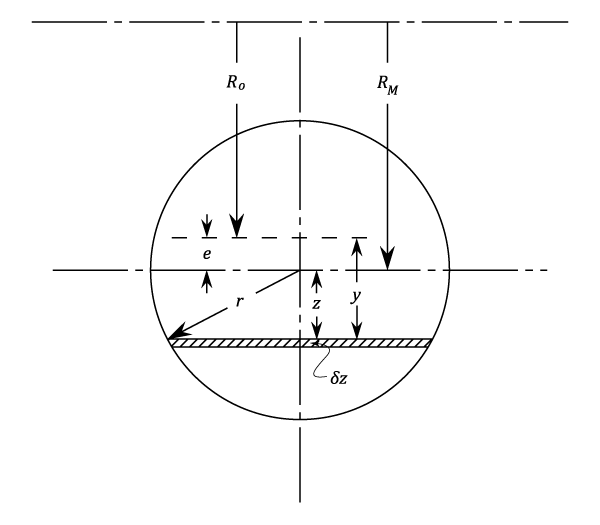
The analysis follows the same method as was used in the previous section on Trapezoidal cross sections.
Hence,
And,
To evaluate the above expand:
And
Deflection of Curved Beams (Direct Method)
If the length of an initially curved beam is acted upon by a bending moment
, it follows from equation (#4) that:
But is the change of angle subtended by
at the centre of curvature and consequently is the angle through which the tangent at one end of the element rotates relative to the tangent at the other end.
i.e.
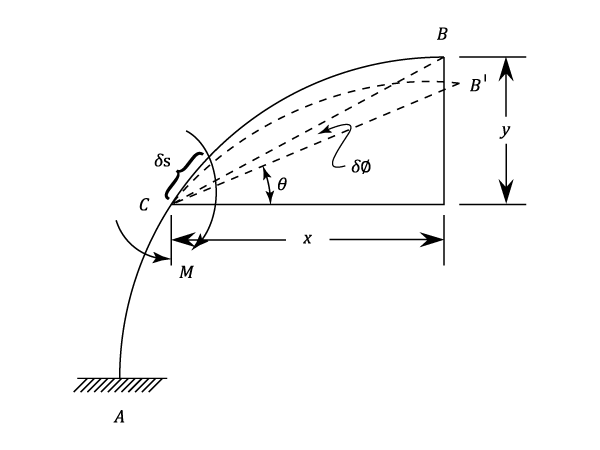
The diagram shows a loaded bar which is fixed in direction at and it is required to find the deflection at the other end
.
Due to the action of on
at
only, the length
is rotated through an angle
.
moves to
', where
The vertical deflection of
The horizontal deflection of
Due to the bending of all the elements along ,
The vertical deflection at
And the horizontal deflection =
Example 1 [imperial]
A steel tube having an outside diameter of and a bore of
is bent into a quadrant of
radius. One end is rigidly attached to a horizontal base plate to which the tangent at that end is perpendicular.
If the free end supports a load of , determine the vertical and horizontal deflection of the free end.
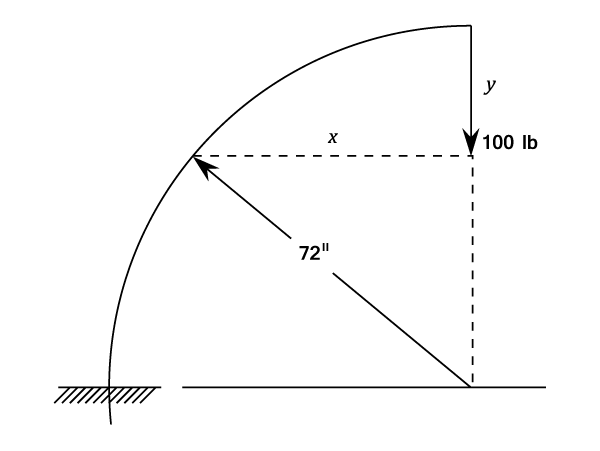
and
Vertical deflection =
Horizontal deflection =
- Vertical deflection is
- Horizontal deflection is
Deflection from Strain Energy ( Castigliano's Theorem)
Theorem:
If is the total strain energy of any structure due to the application of external loads,
at
in the direction
and to the couples
, then the deflections at
in the directions
are
and
and the angular rotations of the couples are
,
at their applied points.
Proof for concentrated loads:
If the displacements (in the directions of the loads) produced by gradually applied loads are
then,
Let alone be increased by
then, = increase in external work done
Where,
are increases in
But if the loads were applied gradually from zero, the total strain energy,
Subtracting equation (#10) and neglecting the products of small quantities,
Subtracting equation (#11), or
Similarly for and
and the proof can be extended to incorporate couples.
It is important to stress that is the total strain energy expressed in terms of loads and not including statically determinate reactions. The partial derivative with respect to each load in turn (treating the others as constant) gives the deflection at the load points in the direction of the load.
The following principles should be observed in applying the theorem
- 1) In finding the deflection of curved beams and similar problems only strain energy due to
bending need normally be taken into account (i.e. )
- 2) Treat all loads as variables initially carry out the partial differentiation and integration
and only putting in numerical values at the final stage.
- 3) If the deflection is to be found at a point where, or in a direction there is no load, a load
may be put in where required and given a value of zero in the final reckoning (i.e. )
Generally it will be found that the strain energy method requires less thought in application than the direct method, it being only necessary to obtain an expression for the bending moment. Also, there is no difficulty over the question of sign as the strain energy is bound to be positive and deflection is positive in the direction of the load. The only disadvantage occurs when a case such as mentioned in note 3 above has to be dealt with in which case the direct method will probably be shorter.