
Velocity and Acceleration
Velocity is the measurement of the rate and direction of change in the position of an object. It is a vector physical quantity; both magnitude and direction are required to define it.
Acceleration is the time rate of change of velocity with respect to magnitude or direction; the derivative of velocity with respect to time.
The analysis of velocity and acceleration in a range of mechanisms including Klein's Construction for piston acceleration.
You're viewing an older version of this page (#3902). View the current version.
Introduction
The Theory of Machines is concerned with the Motion of parts of machines and the forces which act on those parts. In most cases these forces are not constant and their calculation demands that we know the velocities and accelerations which occur in the various components.
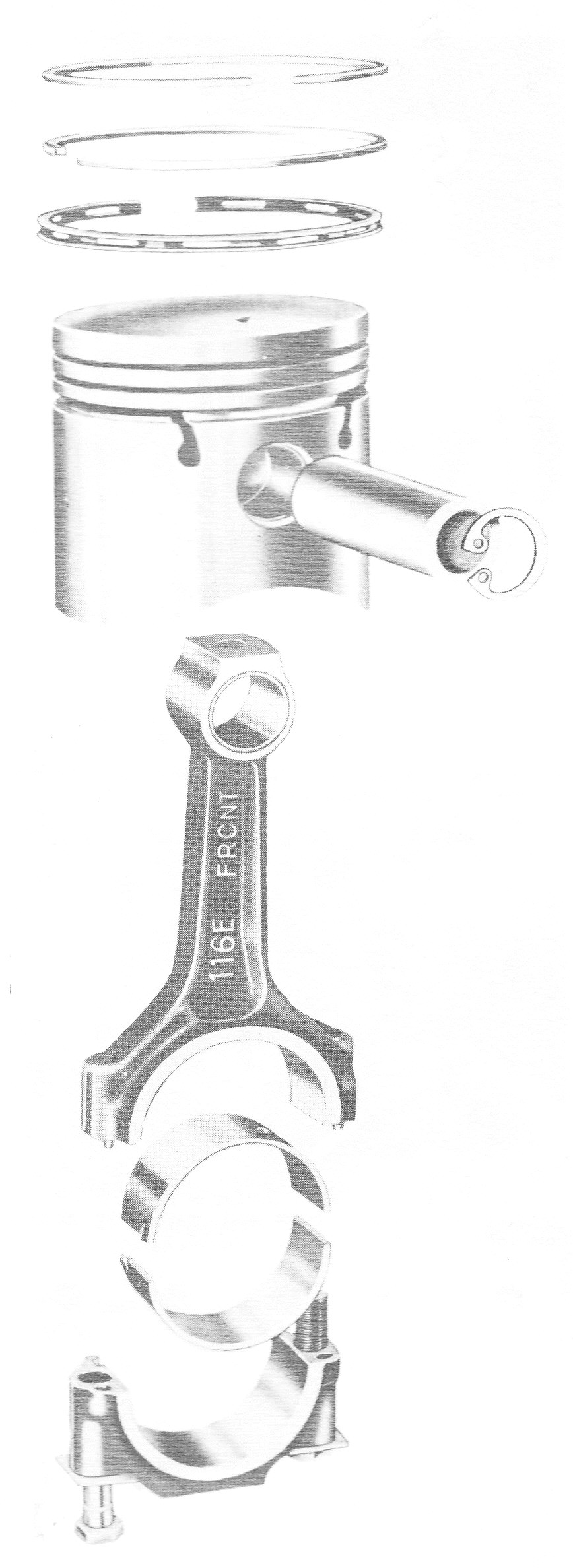
The concept of Instantaneous Centres of Velocity was covered in the section on Mechanisms. In this section the Analysis of Velocity and Acceleration are considered with particular reference to Cranks and Pistons. Klien's Construction for Piston Acceleration is introduced and a description of the Coriolis Component is given.
Analysis of Velocity and Accelerations Components
Velocity
In the diagram the point moves in the plane
. The length
and the
.
Then:
And,
Differentiating with respect to time :
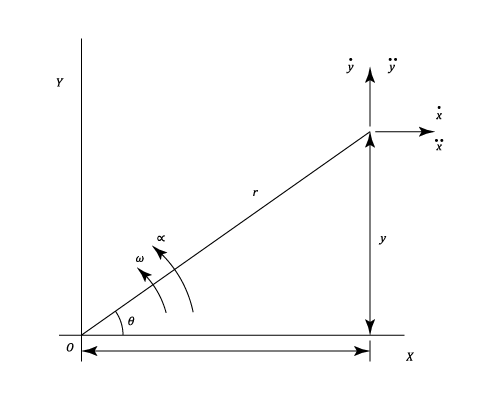
The radial component of Velocity ( i.e. in the direction of
) is given by:
And using equations (#1) and (#2)
Which is the rate of increase of
The tangential component of velocity (i.e. Perpendicular to in the direction of
increasing)
Where = angular velocity of
Acceleration
Differentiating (#1) and (#2)
The Radial components of acceleration
And from equation (#3)
The Tangential component of acceleration
By substitution:
(Note = Angular acceleration of
)
Of these four terms in equations (#4) and (#5)
is the rate of change of radial velocity
is the centripetal acceleration due to the rotation of
is due to the change in angular velocity.
is called the compound supplementary acceleration or Coriolis Component. Notice that the direction of this is the same as
when
is radially outwards.
The Velocity and Acceleration of a Piston by Analysis
In the following analysis is the uniform angular velocity of the crank. The positive direction of velocity and acceleration is away from the crankshaft.
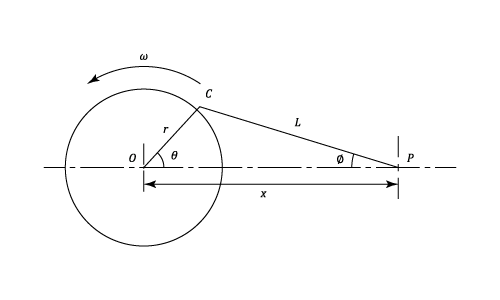
And,
From the above three equations:
Thus Piston velocity,
And Piston acceleration,
Normally can be neglected in comparison with
and equations (#6) and (#7) can be reduced as follows:
Instantaneous Centre Method for Velocities.
This has been covered in the section on Mechanisms.
The Vector Method for Velocity and Acceleration
The Law of addition of velocities states that:
Velocity of = Velocity of
+ Velocity of
relative to
i.e.
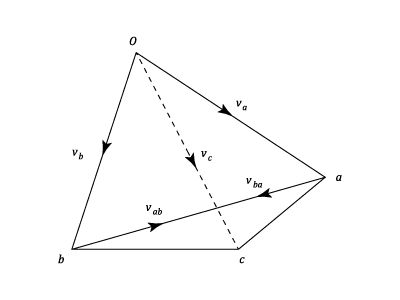
Absolute velocities (or accelerations) are given from to the corresponding point on the diagram.
For Velocities
- The relative velocity between two points
and
on the same link of a mechanism must be perpendicular to the line joining the points and is equal to
(Equation (#2))since
is constant and
is zero.
- The relative velocity for two points sliding over one another is along the common tangents of their paths and represents the component
For Acceleration
The relationships for acceleration are similar to those given for velocity:
- Acceleration of
- Equations (#4) and (#5) are the general expressions for the radial and tangential components of relative acceleration.
- For two points on the same link
leaving centripetal component
(which can be calculated when the velocities are determined) and the tangential component
- For a uniformly rotating Crank
leaving the centripetal as the only term.
- The Coriolis component arises when a point on one link is sliding along another link which is itself rotating.
If ,
,
, are three points on the same link of a mechanism and
,
,
, are the corresponding points on the velocity (or acceleration) diagram, it can be shown that the triangles
and
are similar.
is called the Velocity (or acceleration) image of the link.
Klein's Construction for Piston Acceleration
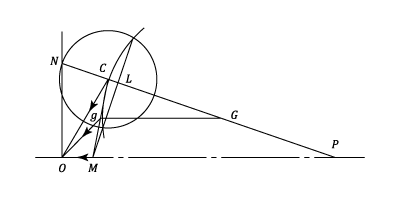
The above is a diagramatic sketch of a piston, connecting rod, and crank assembly where,
is the connecting rod with
the Crank Pin.
is the crank.
is the line of stroke.
is the gudgeon pin
The Construction is as follows:
- Extend
perpendicular to the line of stroke. Let the point of intersection be
.
- Draw a circle centre
.
- Draw a circle with
as diameter.
- Let the common cord cut the line
and the line of stroke
at
.
Then the quadrilateral represents, to a certain scale, the acceleration diagram for
. It can be shown that this scale is
.
- The Centripetal acceleration of the crank pin is
- The piston acceleration is
is the Centripetal component and
the Tangential component of the acceleration of
is the acceleration image of
- For any point
on
. The acceleration of
in magnitude and direction.
Example 1 [imperial]
An aeroplane flying at 180 m.p.h. in a direction
North of West sights another
due North of
. After 30 seconds flying
is seen to be in a North-Easterly direction from
and after a further 45 seconds
is directly astern of
. If
is flying at a constant speed in a direction due South, find:
- a) The speed of
- b) For how long
In the following diagram the Paths of and
are shown. Their three particular positions are
and
respectively.
(30 seconds flying)
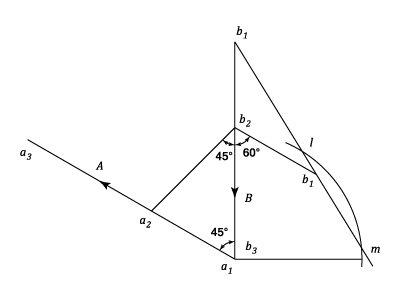
By scaling or by calculation and occupies 45 seconds of flying time.
Hence, Speed of =
Relative displacement of to
= displacement of
- displacement of
i.e.
In the first 30 seconds
Assuming that A is at rest at , the relative path of
is
produced and a circle centre
and of radius 2 miles cuts this path at 1 and
. Between 1 and
,
lies within 2 miles of
.
But
This represents 30 seconds of relative displacement
But, Time corresponding to 1 mile =
- a) The speed of
- b)
Example 2 [imperial]
The quick return mechanism for a shaping machine is shown in the diagram. The upper end of the slotted lever is pin jointed to the ram and tool box at D so that this point moves in a horizontal straight line whilst the lower end slides over a block at mounted on trunnion bearings.
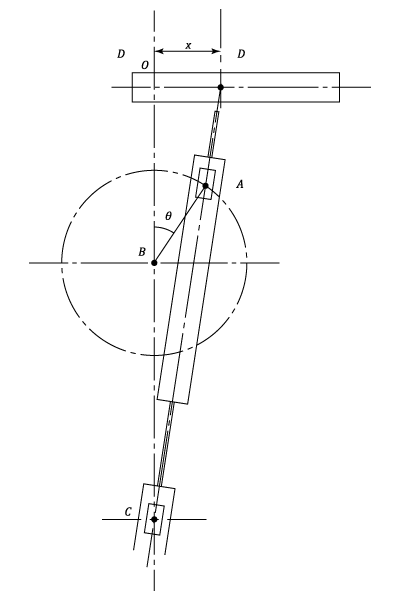
It is driven by the crank which turns at uniform angular velocity
about the fixed centre
, through the slide block at
. If the ratio of the lengths
is denoted by
and
is the angle
has turned from the upwards vertical, show from the geometry that the displacement of the tool box from its mid point is :
And determine the corresponding velocity and acceleration.
and the crank speed is
, find these values for
From the diagram it can be seen that:
But,
Combining equations (#1) and (#2)
Differentiating to find the velocity:
which is constant
The second differentiation gives the acceleration:-
At the given values:
Example 3 [imperial]
In the mechanism shown in the diagram, the crank is 5 in. long and rotates clockwise about a centre
with a speed of 100 r.p.m.. The slotted lever
rotates about a fixed centre
, 10 in. vertically below
. Its centre of gravity
is 9 in. from
, its weight 25 lb. and its radius of gyration about
is 8 in.
For the position shown in which the angle is
determine graphically,
- The angular velocity of
.
- The linear velocity of
.
- The velocity of the sliding block in slot.
- The angular velocity of the pin at
Also calculate the kinetic energy stored in the lever .
Let the point at the end of the crank be and the "coincident" point on
be
. Note that these two points are slidding over each other in the direction of the common tangent
.
- Velocity of
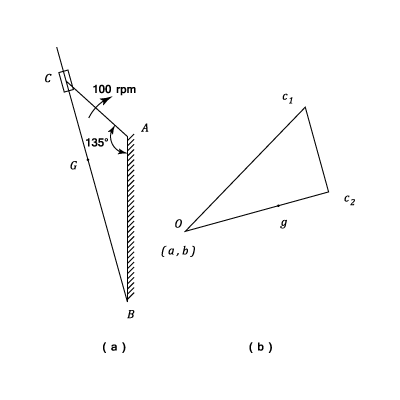
The Construction of the vector diagram (b)
Draw perpendicular to
to represent
From draw a line parallel to
to represent the velocity of sliding of
relative to
.
From draw a line perpendicular to
to represent the velocity of
which is turning about the fixed centre at
.
The intersection of these last two lines gives the point
- The angular velocity of
- Velocity of
Velocity of sliding =
- Angular Velocity of pin relative to the block
- Kinetic Energy stored
Total K.of BC = Linear + Angular Energy
(Note For any of you not used to the Imperial system of measurements, the 32.2 is the acceleration due to gravity in ft./sec sq. and the 12 converts this to in/sec.sq.)
- The angular velocity of
- The linear velocity of
- The Velocity of
is
- The angular velocity of the pin at
- The Kinetic Energy is
Example 4 [imperial]
In the linkwork shown in the following Diagram, the crank rotates about
at a uniform speed of 120 r.p.m. The lever
oscillates about the fixed point
being connected to
by the coupler
. The block
moves in horizontal guides and is driven by the link
.
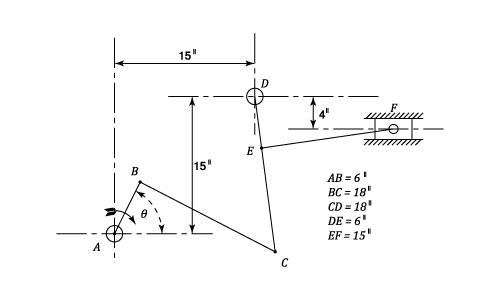
When the angle determine:
- a) The velocity of
- b) The angular velocity of
- c) The rubbing speed at the pin
= 6 in.
= 18 in.
= 18 in.
= 6 in. and
= 15 in.
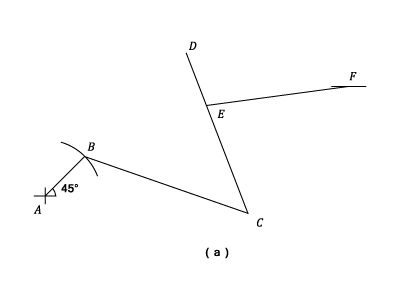
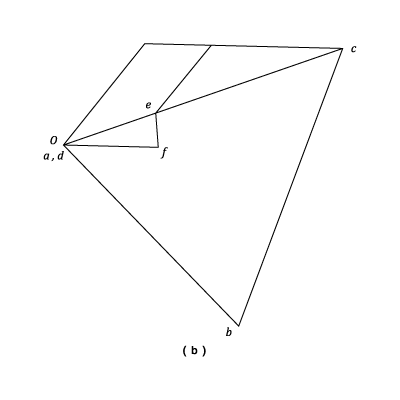
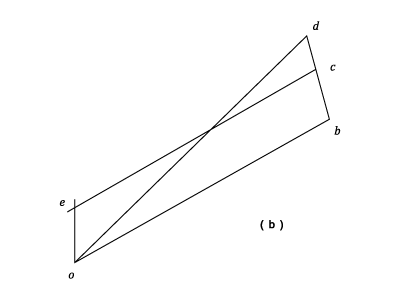
The configuration of the links when is shown in diagram (a). The velocity diagram (b) is drawn as follows:
and is drawn perpendicular to
=
+ velocity of
where
is perpendicular to
and hence its absolute velocity is
which is found by intersection with
is a fixed point and coincides with
. Hence
is the velocity image of
.
divides
divides
i.e.
- The velocity of
is perpendicular to
, but
must move horizontally, hence the point
is determined.
Velocity diagram
Answers
- Velocity of
- Angular velocity of
anti-clockwise.
- Angular velocity of
Angular velocity of is
This is anti-clockwise movement since , relative to
, is moving "upwards".
- The rubbing velocity at
difference of angular velocity = 0
- a) The velocity of
- b) The angular velocity of
- c) The rubbing speed at the pin
.
Example 5 [imperial]
In the mechanism shown in the diagram, the crank rotates at a constant speed of 60 r.p.m., in a clockwise direction, imparting a vertical reciprocating motion to the rack
, by means of the toothed quadrant
.
and
are fixed centres and the slotted bar
and the quadrant
rock on
.
Determine:
- a) The linear speed of the rack when the angle
is
.
- b)The ratio of the times of lowering and raising the rack.
- c) The length of the stroke of the rack.
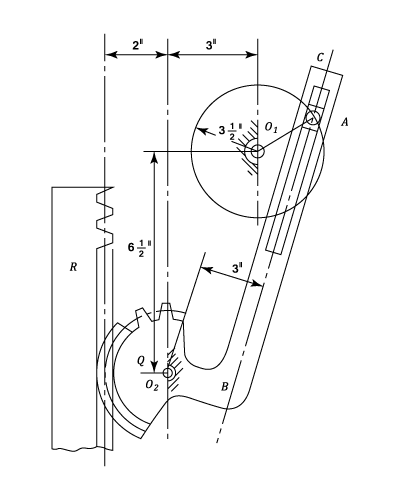
The position of the mechanism when is shown in diagram (a) and the Velocity diagram (b)
fig 2.11 a and b
Velocity of block
perpendicular to
= The velocity of sliding of
.
= The velocity of the point on
The Angular velocity of the quadrant
Answers
- a) The Linear speed of the rack = The radius of the quadrant
- b) If a circle, centre
, and radius 3 in. is drawn, the limits of the stroke of
Therefore, The Ratio of times =
- c) The length of stroke = The radius of the quadrant
- a) The linear speed of the rack is
- b)The ratio of the times is
- c) The length is
Example 6 [imperial]
The diagram shows a mechanism in which the crank turns uniformly at 180 r.p.m., the blocks at
and
working in frictionless guides.
;
;
;
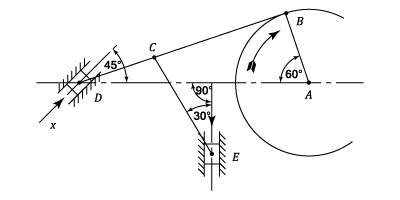
Draw the velocity vector diagram and state the velocities of the blocks and
in their guides.
Find the turning moment at if a force of 100 lb. acts on
in the direction of the arrow
and a force of 150 lb. acts on
in the direction of arrow
.
The mechanism is drawn to scale in the following diagram
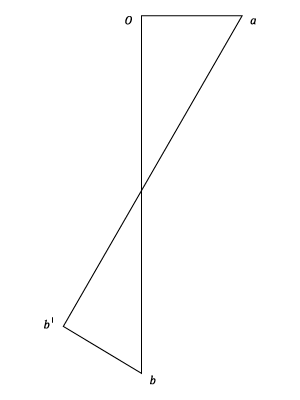
The Velocity diagram, drawn to scale
- The relative velocity
is perpendicular to
and
is parallel to the movement of
and the relative velocity ce is perpendicular to
.
is in the direction of motion of
- Velocity of
to the right.
- Velocity of
upwards.
Power input = Force velocity.
The Force at is opposing motion
Therefore, Power is
Thus the Power Input = The power output ( Neglecting losses)
Example 7 [imperial]
For the engine shown in the Diagram, the crank radius is 2.25 in. and the length of the connecting rod
is 9.25 in. between centres.
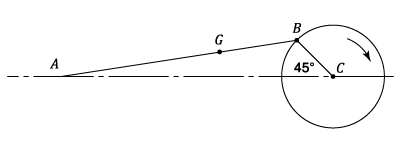
The centre of gravity of the rod is at which is 3 in. from
. The engine speed is 1200 r.p.m.
For the position shown, in which is turned
from
, find graphically the velocity of
and the angular acceleration of
. Indicate the direction of each of these values.
The velocity of ,
. Note that
is perpendicular to
- Draw
to represent
- The velocity of
and is represented by
.
- A must move in the direction
and hence its absolute velocity is represented by
.
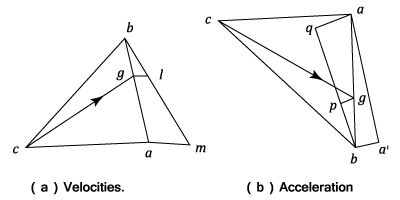
divides it in the ratio
. The line
is used for this construction.
- The Angular velocity of
The acceleration is anti-clockwise since the velocity of
relative to
is parallel to
.
- The Acceleration of
in the direction of
- The acceleration of
represented by
Tangentiallyrepresented by '
perpendicular to
. The Absolute acceleration
is ca parallel to
.
is the image of
and
divides it in the ratio
as before.
- The acceleration of
- The acceleration of
clockwise since the tangential acceleration of
'
- The velocity of
- The angular acceleration of
Example 8 [imperial]
In a four bar chain ,
and
are fixed centres 2.5 in. apart on a horizontal line. The driving crank
, the driven crank
and the coupler
with its centre of gravity
at 0.5 in. from
. When
is turned through
anti-clockwise from
,
and
are on the same side as
.
If, for this position, the angular velocity of is 20 rad. / sec. anti- clockwise, find the angular velocity of
and
and the linear velocity of
.
If also for this position the angular acceleration of is
anti-clockwise, find the angular acceleration of
and
and the linear acceleration of
.
On the velocity Diagram (a) let be the instantaneous centre of
.
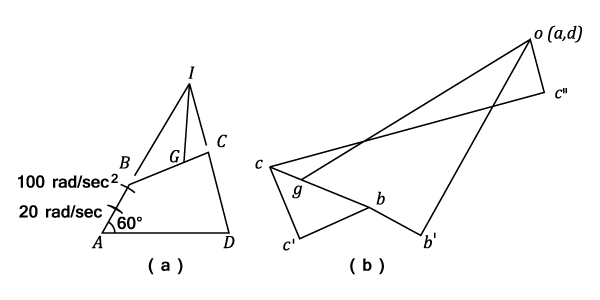
On the acceleration Diagram (b)
Acceleration of =
'(Centripetal) +
(Tangential)
Acceleration of relative to
=
'(Centripetal) +
(Tangential)
an unknown
an unknown
Acceleration of relative to
''(Centripetal) +
''
(Tangential)
an unknown
an unknown
The point is found from the intersection of the two lines of unknown magnitude.
The Angular acceleration of is given by:
Similarly the Angular acceleration of
The linear acceleration of where
- The angular velocity of
and for
- The \b{linear velocity of
- The angular acceleration of
and for
- The linear acceleration of