
Clutches
Friction clutches with examples on singler, multiple and conical plates
You're viewing an older version of this page (#3551). View the current version.
Introduction
By definition A Clutch is
A device by which two shafts or rotating members may be connected or disconnected either whilst at rest or in relative motion.
Examples of types of clutch are:
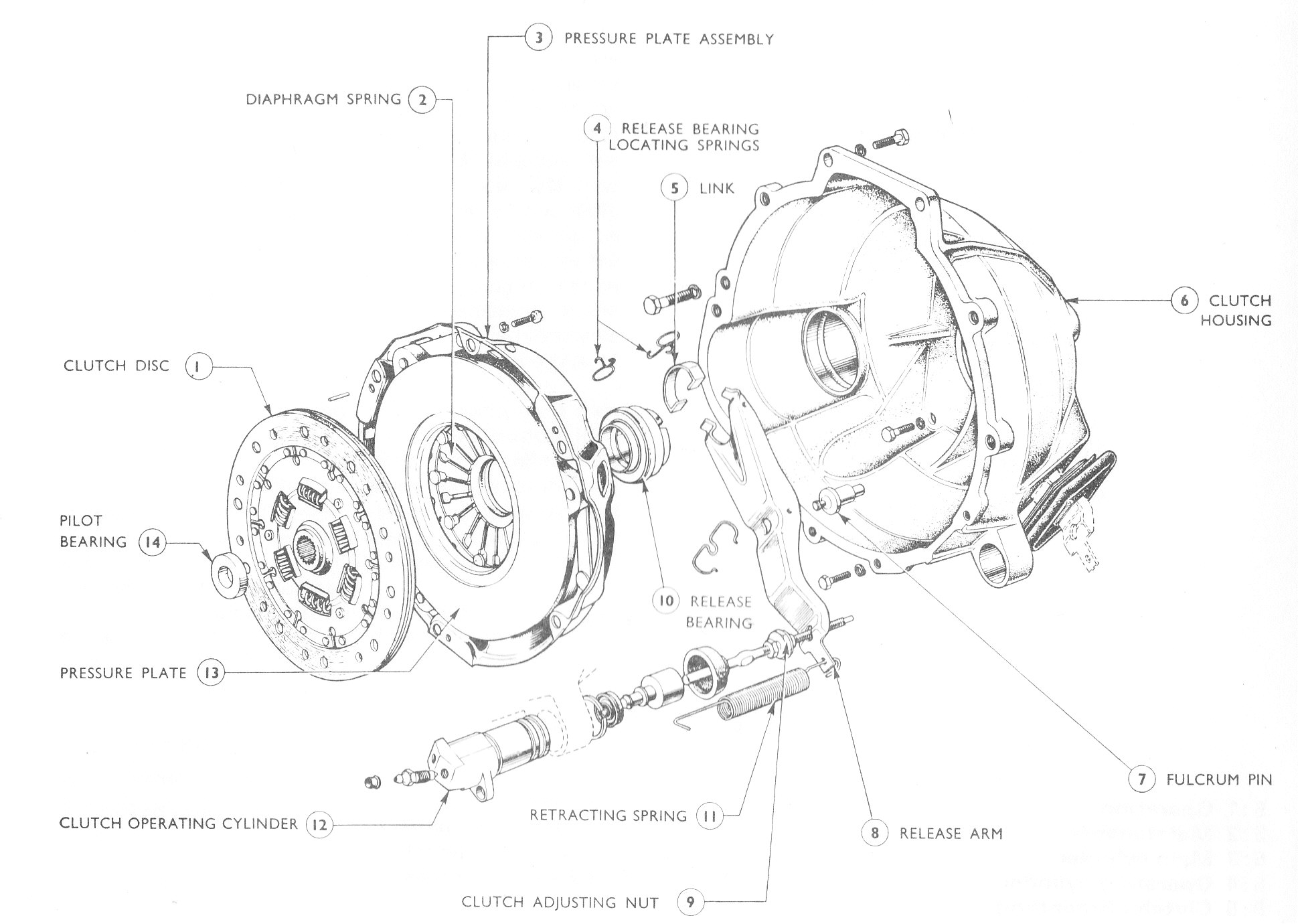
- Automotive. These are usually single pressure plates and are found on cars trucks and tractors.
- Centrifugal. Often found associated with small engines where it is required that the drive is connected once a predetermined engine speed is reached
- Slipping Clutches are a usually a safety feature and are designed to slip at some preset torque so protecting against damage.
- Dog Clutches. These are quite different to any of the above in that they do not rely on friction and it is generally necessary for the two shafts to be stationary when the clutch is either engaged or disengaged.
Plate and Disc Clutches
There are two types of friction clutch which operate on similar principles and which are widely used. These are -
Single Plate Clutch
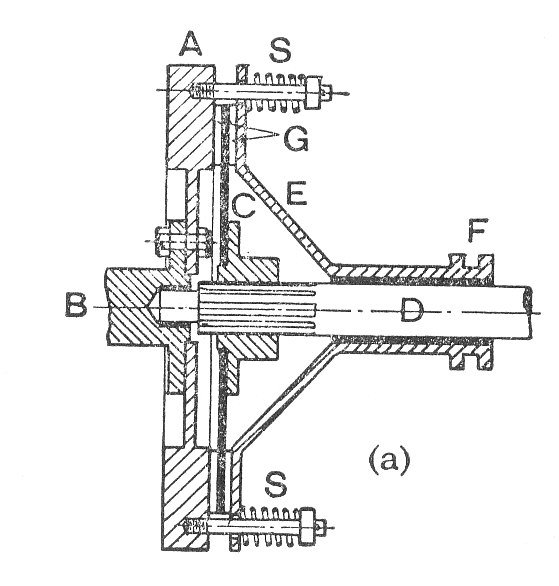
This is shown in the above diagram. The operation is as follows:
- The flywheel A is bolted to to a flange on the drive shaft B.
- The plate C is fixed to a boss which is free to slide axially along the driven shaft D to which it is splined. It therefore rotates with shaft D.
- Two rings G of special friction material are riveted or bonded to A and E or alternatively to plate C.
- The presser plate E is bushed internally so that it revolves freely on the driven shaft D. It is integral with the withdrawl sleeve F.
- A number of springs are arranged around the clutch ( Shown as S) so as to press the two friction surfaces together.
The Clutch operates by moving the withdrawl sleeve to the right. This compresses the Springs S are removes the pressure between the friction surfaces. Hence it is possible to start of stop the driven shaft at will.
Multi Plate Clutch
The diagram shows a multiplate Clutch.
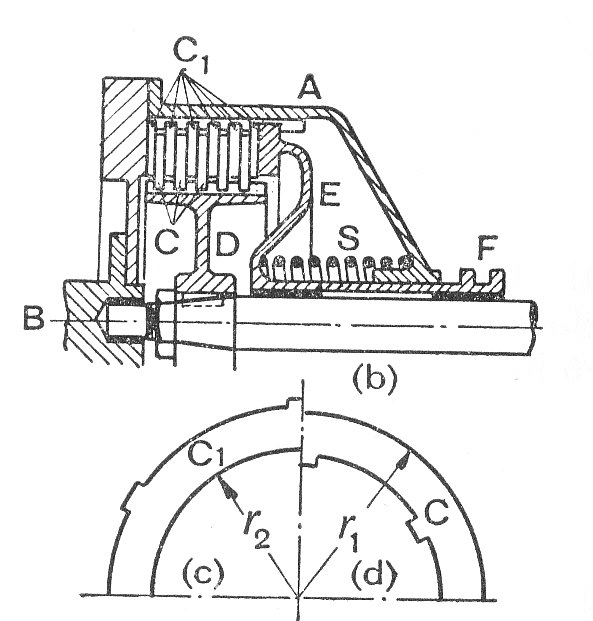
The operation is very similar to the single plate clutch but the area of frictional surfaces is greatly increased. It should be noted that as the discs are free to slide axially under the spring pressure, each pair of contact surfaces is subjected to the same full axial load.
Analysis
Diagram adapted for flat plate.
The frictional force on the circular element shown on the above diagram -
where p is the intensity of normal pressure between the surfaces
By Moments about the axis, the total friction Torque is given by -
The total axial thrust W is given by -
Equations (2) and (3) can be integrated once the variation of p with radius is known. Two particular cases are considered here.
(a) Uniform Pressure
and
Combining equations (4) and (5)
(b) Uniform wear
In this case px = a constant k and equation (3) can be integrated to give -
Similarly
Eliminating k from equation (8) by using equation (7)
Note that assumption of uniform wear is usually preferred since it results in a lower calculated torque for a given value of W.
It is normal for each plate in a clutch to have two working surfaces ( One on each side) and since they are arranged in series the axial load is transmitted equally through each plate. Consequently if the number of plates on one shaft is n then the torque transmitted as calculated from equations (6) or (9) must be multiplied by 2n.
Worked Examples
The solutions to the following examples have been hidden. To see the workings please click on the red buttons.
Example 1
A car engine rated at 12 h.p. gives a maximum torque of 65 lb.ft. The clutch is of the single plate type and both sides of the plate are effective. If the coefficient of friction is 0.3, the mean axial pressure is limited to 12 lb./sq.in. and the external radius of the friction surface is 1.25 times the internal radius, find the dimensions of the clutch plate and the total axial pressure which must be exerted by the springs.
Example 2
A multi-plate friction clutch is required to transmit 100 h.p. at 3,600 r.p.m. The plates are alternatively steel and phosphor bronze and they run in oil. The coefficient of friction of 0.07, the mean axial pressure is 20 lb/sq.in.and the internal radius of the friction surface is 0.8 of the external radius, which is 5 in.
Find the number of plates required and describe their arrangement.
Example 3
A centrifugal clutch has four blocks which slide radially in a spider keyed to the driving shaft and make contact with the internal cylindrical surface of a drum keyed to the driven shaft. When the clutch is at rest each block is pulled against a stop by a spring so as to leave a radial clearance of 0.25 in. between the block and the drum. The pull exerted by the spring is then 100 lb. and the mass centre of of the block is 8 in. from the axis of the clutch.
If the internal diameter of the drum is 20 in., the weight of each block 15 lb. the stiffness of each spring is 200 lb./in. and the coefficient of friction between the block and drum is 0.3 find the maximum horse power that the clutch can transmit at 500 r.p.m.
Example 4
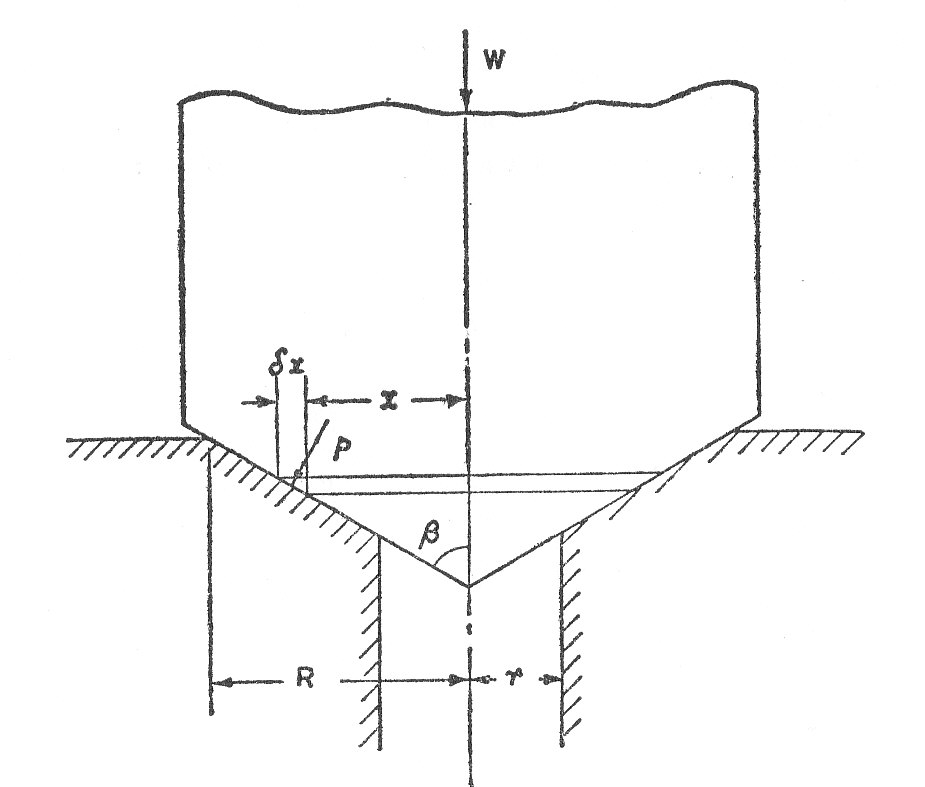
Prove that the torque which can be transmitted by a cone clutch is
where W is the axial load, the semi-cone angle and R and r are the radii.
A cone clutch has radii 0f 5 in. and 6 in. .the cone angle being . If the coefficient of friction is 0.25 and the allowable normal pressure is 20 lb./sq.in. find (a) The necessary axial load and (b) the horse power which can be transmitted at 00 r.p.m. (U.L.)
Example 5
A friction clutch is required to transmit 45 horse-power at 2,000 r.p.m. It is to be a single plate disc type with both sides of the plate effective. The pressure is applied axially by means of springs and is limited to 10 lb./sq.in.
If the outer diameter of the plate is to be 12 in., find the required inner diameter of the clutch ring and the total force exerted by the springs. Assume that the wear on the plates is uniform and that the coefficient of friction is 0.3 (U.L.)
Example 6
A motor drives a machine through a friction clutch which transmits 1260 lb.in. while slip occurs during engagement. For the motor the rotor weighs 140 lb. with a radius of gyration of
in. and the inertia of the machine is equivalent to 50 lb. at the driving shaft with a radius of gyration of 3 in. If the motor is running at 750 r.p.m. and the machine is at rest, find the speed after engaging the clutch and the time taken. Find also the energy absorbed in the clutch during engagement. The torques acting on the motor and machine other than at the clutch are to be neglected.