
Dynamics of Geared Systems
Acceleration is the rate of change of velocity as a function of time and it is vector. Acceleration is the second derivative of position with respect to time or, alternately, the first derivative of the velocity with respect to time.
The kinetic energy of an object is the energy which it possesses due to its motion. It is defined as the work needed to accelerate a body of a given mass from rest to its stated velocity.
The angular motion is one type of motion in which a body acts as a radius and all parts of the moving body rotate in the same angular direction and follow a circular path about a pivot point.
Linear motion is motion along a straight line, and can therefore be described mathematically using only one spatial dimension.
Acceleration of geared systems, and analysing combined angular and linear motions.
You're viewing an older version of this page (#3913). View the current version.
Introduction
When a geared system accelerates or decelerates there is a change in the total inertia of the system. Clearly, the value of this increase or decrease depends upon the speed ratios of the various parts of the system.
In this section we use the moments of inertia of geared shafts to identify the total torque and the Equivalent moment of Inertia for any given shaft in a state of acceleration.
The Acceleration of Geared Systems
- Suppose that two shafts
and
are geared together and the speed ratio
is
- The total moments of inertia on the shafts are
and
It is required to find an expression for the torque on shaft
which will produce an angular acceleration of this shaft of
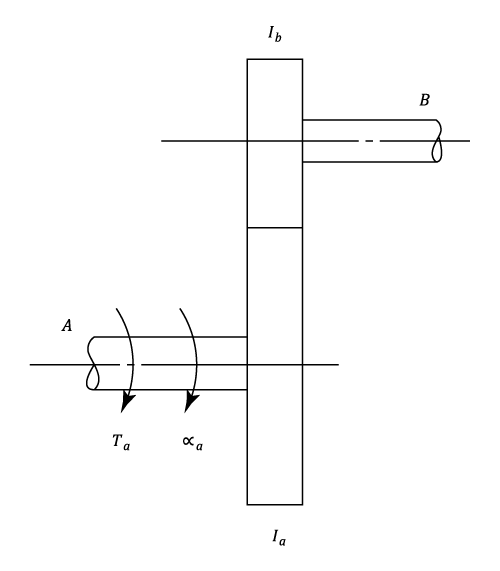
- The torque on shaft
- This will produce an acceleration of shaft
- The torque required on shaft
is
- This would require a torque on shaft
- The Total torque on
is called the Equivalent moment of Inertia referred to shaft
Clearly the argument above could be extended to any number of shafts which have fixed speed ratios with the reference shaft. It is worth noting that the same acceleration of the system shown in the above diagram could be produced by a torque applied to shaft of:
The Total Kinetic Energy of A and B
The Total Kinetic Energy of and
But since ,
Combined Angular and Linear Motion
There are many cases where masses moving with linear motion are connected by a fixed speed ratio to inertias in angular motion. Instead of dealing with the two motions separately, it is possible to reduce the system to one of the following:
An equivalent angular motion
To find the torque required to give an angular acceleration of to the winding drum of moment of inertia
and radius
, which is being used to raise a load
on a cable wrapped round the drum.
This method is used in worked examples 2, 7, and 8.
An equivalent linear motion
The linear acceleration on the level of a car of weight and engine torque
, whose wheels have an inertia of
and radius
, and an engine with an inertia
and a gear ration
, is found from:
The equivalent tractive effort =
= Acceleration Equivalent mass + Losses
Losses
See Example 9.
Example 1 [imperial]
Two gear wheels and
are mounted on parallel shafts so that they may revolve separately or may be meshed together externally.
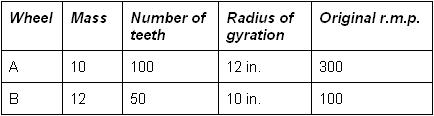
The wheels were originally turning freely in the same direction.
Find:
- a) The speed and direction of rotation of wheel
- b) The loss of energy in ft. lb. due to impact.
- a) Let
r.p.m. be the final speed of
in the opposite direction.
The impulse is equal and opposite on the two wheels at the moment of "meshing".
By moments about their respective axes, it follows that: The change of angular momentum of / The change of angular momentum of
= The radius of
/ The radius of
i.e. . Or
- b) The loss of Kinetic Energy
The loss of K.E.
`
- The speed is
- The loss of Kinetic Energy is
Example 2 [imperial]
A car weighs 1650 lb., road wheels 26.4 in. diameter. The moment of inertia ,, of the rotating parts is
and for each road wheel
.
The clutch is disengaged; the engine is idling at 500 r.p.m., the car is coasting at 18 m.p.h., the bottom gear of to
is engaged and the clutch pedal is suddenly released.
Find the change in speed of the car and the change in kinetic energy.
Initial Engine Speed
Initial Wheel Speed
Let rad./sec. be the final speed of the engine. The final speed of the road wheels will then be
.
Since the speed of the car is that of the wheel circumference, the effective inertia of the wheels and car is:
If the impulsive torque on the engine (i.e. at the clutch) is then that on the wheels is
, neglecting losses.
Hence:
19.5 Gain of angular momentum of engine = Loss of angular momentum of wheels and car.
From equations (#1) (#2) and (#3)
Or,
Giving
This corresponds to a final car speed of:
i.e. A reduction in speed of
The loss of Kinetic Energy is:
- The change in speed is
- The change in kinetic energy is
Example 3 [imperial]
Whilst accelerating, the driving torque at the input shaft of a single-stage reduction gear has a constant value
and the resisting torque at the output shaft
is also constant with a value of
. The respective moments of inertia of the two shafts systems are
and
and the speed of
is
times that of
.
Show that the acceleration of is given by:
and find the gear ratio for which this has a maximum value.
If is equivalent to 150 lb. at 7 in. radius and
is equivalent to 750 lb. at 9 in. radius and if
show that the required value of the ratio is about 5.19 and find the requirement for the output shaft to attain a speed of 240 r.p.m. if is initially at rest.
The torque to accelerate A =
The torque transmitted = (At shaft
)
And the torque transmitted = (At shaft
)
The torque to accelerate =
The output torque =
From which:
To find the maximum value for the gear ratio the above equation is differentiate w.r.t.t. and hence:
Solving the quadratic for :
Thus,
Using equations (#1) and (#2)
The time to reach a speed of 250 r.p.m. from rest
- The gear ratio is
- The requirement is
Example 4 [imperial]
A motor shaft rotates
times as fast as a shaft
geared to
.
If the torque on is constant and
and
are the moments of inertia of
and
respectively, find an expression for
when
has maximum angular acceleration. Evaluate the value of
when
and
.
If a steady driving torque of 45 lb.ft. is applied to and a variable resisting torque is applied to
, find the time to increase the speed of
from 150 r.p.m. to 240 r,p,m, when the resisting torque varies directly with the speed and has a value of 75 lb.ft. at 150 r.p.m.
If the torque on is
then the equivalent torque on
is:
=(The equivalent inertia on
)
Thus, . Therefore,
Differentiating with respect to for a maximum:
Substituting in values,
Since the speed of is
, the equivalent torque on
is:
The equivalent moment of inertia of the system referred to shaft is:
And therefore as the system is accelerating, the equivalent torque on
Substituting in values,
Combining with equation (#1),
Separating the variables and integrating,
To increase the speed of from 150 to 240 r.p.m.
- The time to increase the speed is
Example 5 [imperial]
In a gear unit the input and output shafts are parallel and directly geared to rotate in opposite directions with a speed reduction of 4. Friction losses can be neglected.
If the input to the unit is 30 h.p. at 1400 r.p.m., find the externally applied fixing torque which must be exerted on the unit casing. The direction of the applied torque at the input shaft may be considered positive.
If the inertias of the input and output shafts and connected parts are equivalent to 350 lb. at 8 in. radius and 450 lb. at 12 in. radius respectively, and the resisting torque at output is constant, find the additional constant torque which must be applied at the input to raise its speed from 1400 r.p.m. to 1500 r.p.m. in 1 sec. and also the associated fixing torque on the casing.
The input torque =
The output torque = (Neglecting Losses)
Torque on the casing =
(See "Gear Trains" equation (5))
The equivalent inertia on the input shaft =
The acceleration =
The additional torque at input =
Input torque transmitted, The additional torque at input =
=- The torque needed to accelerate the input shaft=
The torque to the output shaft =
The extra torque on the casing =
- The additional torque
- The extra torque on the casing
Example 6 [imperial]
In the epicyclic train shown in the diagram all the teeth are of 4 d.p. Wheel which is mounted on shaft
is stationary.
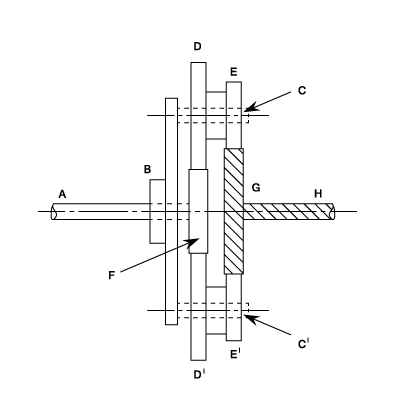
and
are made of one piece of metal and can rotate freely on a pin
which is attached to plate
. A similar pair of pinions
and
are mounted on a pin
.
can rotate freely on shaft
. Wheel
is mounted on the driving shaft
. The polar moment of inertia of the disc
including the two pins
and
is
.
and
together weigh 7 lb with polar radius of gyration about their own centre-line of 3 in.
has a polar moment of inertia of
Find the torque on shaft to accelerate the system so that
has an angular acceleration of
The number of teeth on =
The method of finding the speed and hence the acceleration ratios for an epicyclic gear chain can be found in Gear Trains. As shown there, a table is drawn up as follows:
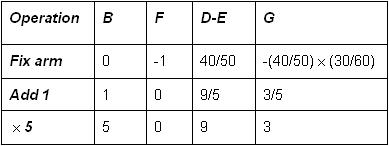
The radius arm of pins and
=
The moment of inertia of the disc and the mass of wheels
about the axis of
.
The equivalent inertia referred to shaft calculated from the speed ratio which have been determined.
Also from the speed ratios:
Acceleration of shaft =
- The torque is
Example 8 [imperial]
The engine of a motor-car runs at 3420 r.p.m. when the road speed is 60 m.p.h. The weight of the car is 2400 lb. The inertia of the rotating parts of the engine corresponds to 24 lb. at a radius of gyration of 0.48 ft. and that of the road wheels is 240 lbs at 0.8 ft.
The efficiency of the engine and transmission is 0.9 and the wind resistance is 200 lb. The road wheel diameter is 2.5 ft.
Estimate the horse-\b{power} developed by the engine when the car travels at 60 m.p.h. with an acceleration of 3 ft./sec.
The speed ratio between the engine and the wheels is:
If is the engine torque, the torque required to accelerate the engine
Torque transmitted to the rear wheels allowing for the efficiency of transmission and the gear ratio:
The equivalent inertia of the wheels and car:
The torque required to overcome wind resistance:
Combining equations (#1), (#2), (#3), (#4) and (#5)
Thus,
- The horse-\b{power} is