
Transmission of Power
A diameter of a circle is any straight line segment that passes through the center of the circle and whose endpoints are on the circle.
Volume is the quantity of three-dimensional space enclosed by some closed boundary.
Power is the rate at which work is done, expressed as the amount of work per unit time and commonly measured in units such as the watt and horsepower.
A nozzle is a device designed to control the direction or characteristics of a fluid flow as it exits an enclosed chamber or pipe via an orifice.
The transmission of Hydraulic Power through pipelines. Includes Nozzles and Jets, the conditions for maximum Power Transmission , Jet reaction and the efficiency of transmission.
You're viewing an older version of this page (#3820). View the current version.
Introduction
The transmission of power through pipes is both common and widespread in its application. Two examples are the large diameter pipes are used in many hydroelectric schemes and the comparatively small bore pipes used to connect the various pumps; motors and rams used on earth moving plant and machine tools.
Power Transmission in a Pipe
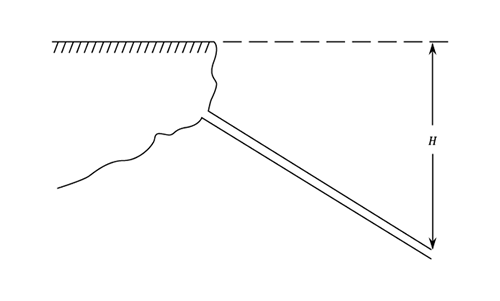
Water Horse Power is given by:
Weight of water / second =
Horse Power of a jet is:
The efficiency of power transmission for the pipe is given by Horse Power at outlet/Horse Power at inlet which is:
Applying Bernoulli's equation to the pipe and ignoring pipe entry losses:
Thus the efficiency of Power Transmission can be written as:
The Conditions for Maximum Power Transmission
i.e. The head lost due to friction is one third of the Total Supply Head.
From equations (#2) and (#3) the Horse Power of the Jet will be:
The weight of water per second, , passing down the pipe increases linearly with
, the velocity of the water along the pipe. However
decreases with velocity and there is therefore an optimum velocity which will give the maximum jet Horse Power for a given pipe and Head.
Equation (#4) can be rewritten using equation (#1). is replaced using the Darcy equation:
For Maximum Power
i.e.
From which it can be seen that i.e. The head lost due to friction is one third of the Total Supply Head.
The efficiency of Power transmission for Maximum Power
This is given by:
The condition for Maximum Power transmitted is rarely used in practice since:
- The efficiency of transmission is low and that means that water is wasted;
- The velocity in the pipeline is high and this can give rise to dangerous Water Hammer effects when valves are closed.
For these reasons it is normal to limit water velocity to a maximum of 6 ft./sec.
Nozzles
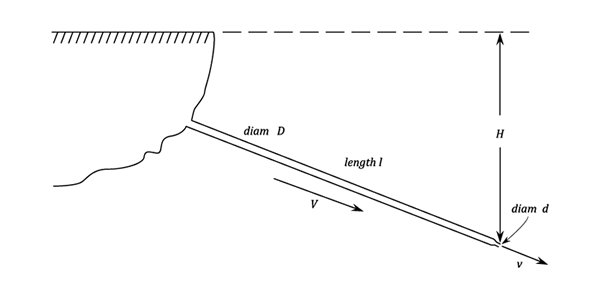
It is assumed that the Head H is the head behind the nozzle and that all pipeline and valve losses have been accounted for elsewhere. There are, of course, losses in the nozzle itself and the actual velocity of discharge will be less than the theoretical value by one to five percent. This is catered for by the use of the coefficient of velocity, , the coefficient of contraction,
and the coefficient of Discharge,
:
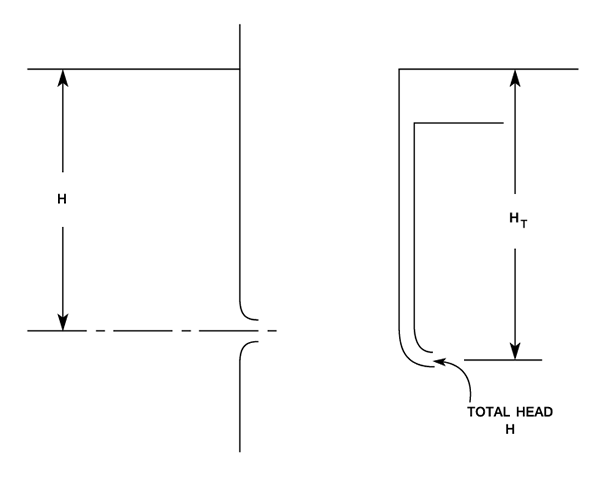
The head Lost in the Nozzle
Let = total head at nozzle (i.e. the sum of the pressure and velocity heads)
where are the Pipe line losses.
Head behind the Nozzle = Head after the nozzle + Head lost in Nozzle: , where
is the head lost.
Substituting from (#3) above:
The Head lost in nozzle will be: Or:
Efficiency of the Nozzle
Efficiency ,
where is the Head behind nozzle.
Thus:
The nozzle diameter for maximum power transmission
In the following calculations the losses in the nozzle are ignored. Two proofs are given. The first uses the previous result for the power transmission through a Pipe Line and the second is from first principles.
Diagram from notes.
- a) It has been shown that the maximum Power transmission through a pipe lie occurs when the head lost due to friction is a third of the total head.
Hence:
Or:
But:
Or:
Thus:
- b) from first principles
Applying Bernoulli's equation across the nozzle and neglecting losses:
And using the continuity equation:
The power output of the nozzle is given by:
The nozzle diameter for the maximum power transmission will occur when
i.e.
Multiply both sides by
Or:
Jet Reaction
The jet reaction is the backward force exerted on the nozzle and the pipe and is equal and opposite to the force exerted by the jet on a fixed plate.
i.e. The jet reaction = the mass of fluid passing through the jet per second the change in velocity.
Therefore the Jet Reaction will be
Nozzle diameter for maximum jet reaction
Equation (#8) shows that:
Thus the jet reaction, can be written as:
The maximum jet reaction will occur when:
And thus:
For this case the Pipe Friction:
Therefore:
where
is the Total Head.
Using equation (#10)
The Efficiency of Power Transmission for Maximum Jet Reaction
The efficiency,
Example 1 [imperial]
A Nozzle discharges 175 galls per min. under a head of 200 ft. The diameter of the nozzle is 1 in. and the diameter of the jet is 0.9 in.
Find:
- The coefficient of velocity for the jet.
- The head lost in the nozzle.
- The horse power available in the jet.
- a) The Coefficient of Contraction,
is given by:
The theoretical discharge = The nozzle area
. From equation (5) velocity (neglecting losses) is
Therefore:
Since 1 gallon of water weighs 10 lb. and 1 cubic foot of water weighs 62.4 lb, then And the coefficient of discharge
From equation (7), the coefficient of velocity:
- b) Using Equation (5)
where
is the head lost in nozzle i.e.
Therefore:
Thus:
- c) The horse power of the jet is dependent upon the weight of water per second and the head of water in the jet
Thus:
Horse power will be:
- a) The coefficient of velocity is
- b) The head lost in nozzle is
- c) The horse power available in the jet is
Example 2 [imperial]
The water available for a Pelton wheel is and the total head from the reservoir level to the nozzles is 900 ft. The turbine has two runners with two jets per runner. All four jets have the same diameter. The pipeline is 10,000 ft. long. The efficiency of power transmission through the pipe line is 91 % and the efficiency of each runner is 90%. The velocity coefficient of each nozzle is 0.975 and the coefficient of friction for the pipe-line is 0.0045.
Determine:
- The horse power developed by the turbine.
- The diameter of the jets.
- The diameter of the pipe-line.
Drawing from notes.
- a) To find the Horse-power of the turbine
The efficiency of the pipe and nozzles is 0.91% and the runners 90%. Hence the efficiency of the whole system is given by:
The total power available is:
Therefore the power output is the total power available the efficiency of the system
i.e.
- b) To find the diameter of the jets
Let the velocity of water from the jets be
i.e. The velocity head of the jets is:
The jet velocity is:
This is the actual velocity through the jet. The theoretical velocity, based on the diameter of the jet will be greater.
i.e. The flow of water is
which is
- c) The Diameter of the Pipe
If is the Total Head behind the nozzle:
The pipe friction is the difference between the Total head and the head behind the nozzle
i.e.
Using the Darcy Equation:
By continuity:
Combining the above two equations to eliminate gives:
\ And thus:
- The horse power developed by the turbine is
- The diameter of the jets is
- The diameter of the pipe-line is
Example 3 [imperial]
During 9 months of each year there is an ample supply of water for a Power station and for 5 hours each day water is pumped to a high level storage basin situated at 300 ft. above the turbines. The basin supplies the turbines for the remaining 3 months of the year through two equal pipe-lines which are arranged in parallel and are 1,000 ft. long. The turbines develop 1500 h.p. for 10 hours per day during these 3 months with an efficiency of 0,86 as reckoned on the conditions at the turbine. Taking each month as 30 days, = 0.005 and assuming that the friction is limited to 15 ft.
Find:
- a) The minimum size of the basin required
- b) The rate of discharge of the pumps.
- c)The diameter of the two pipes.
Let be the diameter of the pipe and
the velocity of flow.
The head of water at the turbines
Therefore the Power supplied th the turbines is given by:
The minimum size of the basin is given by and the number of seconds that the turbines operate over the three month period
i.e. the Minimum Basin size is :
The required Pump output is :
Volume of Basin/Pump operating Time
The head lost due to friction in the pipes is given as 15 ft. So using Darcy's equation:
From which:
As there are two pipes:
Substituting in values:
From which
- The minimum size of the basin required is
- The rate of discharge of the pumps is
- The diameter of the two pipes is
Example 4 [imperial]
In a Power Scheme using a Pelton Wheel, water is to be supplied from a reservoir,which will be 1200 ft. above the turbine, through a pipe-line 5400 ft. long. The Turbine is to produce 7000 b.h.p. at 500 r.p.m. Pipe friction is limited to 10 % of the gross head and the ratio of wheel diameter to jet diameter must not be less than 11:1
Calculate the number and diameter of the jets, the mean diameter of the wheel and the supply-pipe diameter. Assume for the jets to be 0.98, bucket speed 0.45 jet speed and the efficiency of the turbine 87 %,
for the pipe friction is 0.0048.
Let
the velocity of water in the pipe.
the diameter of the supply pipe.
the diameter of the jets.
the jet velocity.
the number of jets..
the diameter of the wheel.
The head lost in the supply pipe is 10 % of the total head so:
Using Darcy's equation:
Applying Bernoulli:
And:
The jet Horse-power is given by:
Substituting in values from above:
i.e.
But:
From equations (#12) and (#13)
Substituting into equation (#11)
Substituting the above into equation (#11)
And:
Using equation (#13)
From the question:
The bucket speed
i.e.
The following conditions were imposed by the question:
must not be >11
must not be >
must not be >0.1625
From equation (#14) and the condition required for
must not be >0.1625
i.e.
From equation (#14)
which is The diameter of the jets.
- The number of jets is
- The diameter of the jets is
- The mean diameter of the wheel is
- The supply-pipe diameter is
Example 5 [imperial]
A twin jet Pelton wheel is supplied by 3 equal pipes in parallel each having a length , diameter
and friction coefficient
connected through a short common pipe to the nozzles. Ignoring losses other than pipe friction, find the nozzle diameters for maximum kinetic energy of the jet.
Calculate the Horse-power developed by the machine if for each pipe ,
and
and given that the efficiency of the machine is
. The permissible loss of head due to pipe friction is 5% of the gross head and
Let
be the water velocity in the pipes.
be the jet velocity.
be the gross head,
Applying Bernoulli and neglecting all losses except pipe friction:
But:
From the above equations:
Where:
The Kinetic Energy of the jets per second is :
From equations (#17) and (#18)
The kinetic energy per second
This will be a maximum when :
i.e. When:
Substituting the above in equation (#16)
From Bernoulli and equation (6)
And:
The frictional head lost is 5% of the total head and thus from the Darcy equation:
Hence:
Substituting into equation (#15)
From equation (9)
The jet horse-power
The machine h.p.= The jet h.p. multiplied with Efficiency
The Horse-power is
Example 6 [imperial]
The output of a multi-cylinder hydraulic motor is required to be 180 h.p. when its efficiency is 73 %. A hydraulic power station developing a pressure of 1200 supplies the motor through four 3 in. pipes, 2 miles long.
Determine the pressure at the motor, the velocity of flow in the pipes and the efficiency of transmission =0.008
Let
be the supply pressure in lb./sq.in.
be the pressure at the motor
be the velocity of water in the pipes
Note: 1 mile is 1769 yards or 5280 ft.
The head lost in a pipe is the difference in pressure between the ends.
(The pressures were converted to ft. of water)
Water h.p.at the motor:
Or:
From Equations (#19) and (#20)
Trial and error gives a value for of 990
From equation (#19)
Transmission efficincy
- The pressure at the motor is
- The velocity of flow in the pipes is
- The efficiency of transmission is