
Compressible Flow
This analysis of water hammer allows for the compressibility of water and the expansion of the pipe
You're viewing an older version of this page (#3776). View the current version.
Introduction
In the other submission on water hammer it was assumed that water is incompressible and whilst this assumption may be adequate in certain situations, it is clearly not true. It would be, for example impossible to control the depth of a submersible vessel unless the density of water increased with depth.
In this submission on Water Hammer allowance is made for the compressibility of water and for the fact that, in general pipes expand due to internal pressure
Pressure rise following Instantaneous Closure
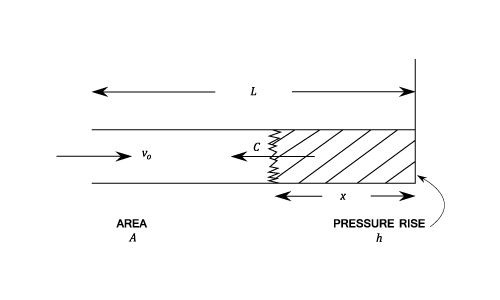
Where is the density and C the velocity of Sound for the fluid (Water)
To see the the Proof please click on the red button
Pressure rise for Instantaneous Partial Reduction of Flow.
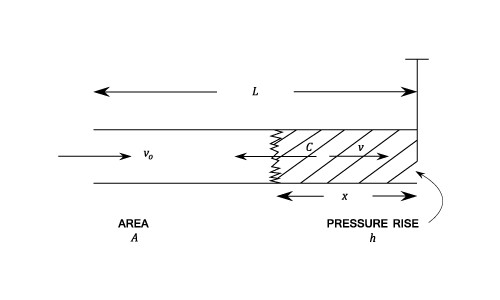
The increase in Pressure head
To see the proof of the above please click on the red button
Instantaneous Partial Closure of Valve
If the reduction in area of the valve is known rather than the reduction of flow or pipe velocity,then the pipe may be treated as a nozzle with a coefficient of discharge of
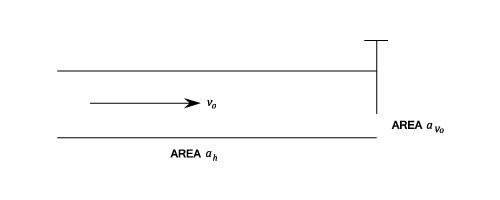
From the Initial Conditions and from the change in Valve Area
For the proof of the above equation please click on the red button
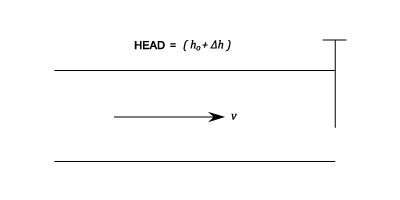
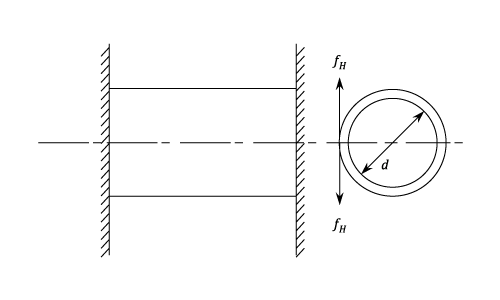
The relationship between pressure rise, speed of sound and bulk modulus allowing for lateral expansion of the the pipe
Notes
- (39)
- Assume a thin cylinder constrained longitudinally and subject to an internal
pressure rise p causing lateral expansion from diameter
And the equivalent Bulk Modulus allowing for Pipe Expansion is given by :-
To see the proof of the above equation please lick on the red button
Pipe with change of section
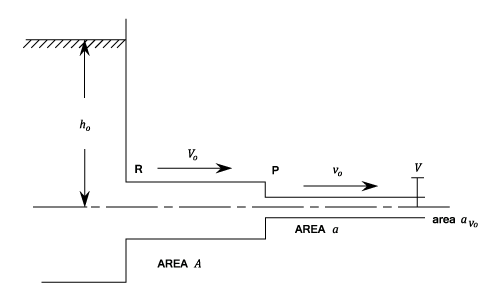
At the initial steady flow conditions it is assumed that friction; velocity head and contraction losses can be neglected, Therefore the pressure throughout both pipes is
Consider a sudden partial closure.
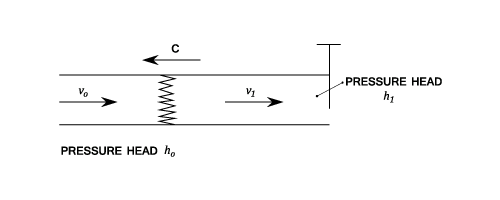
The above diagram shows some instant when the pressure wave is between V & P
from equation (46 )
and from equation ( 16 )
Equations ( 54 ) ( 55 ) and ( 56 ) can be solved for
Now consider an instant in time after the pressure wave has passed through the junction and a reflected wave has set off up the pipe from P to R.
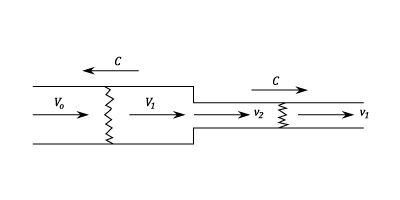
Using equation ( 16 ) for the pressure wave in the large pipe.
similarly for the pressure wave in the small pipe
Note C_* is the velocity of sound in the small pipe
Adding equations ( 59 ) and(60 )
Equate to equation ( 56 )
substitute from ( ) and ( ) for V_0 & V_1
Using the value for v_1 found from equations ( 14 ) ( 27 ) and( ) this equation can be solved for and hence
and
Notes
- If the velocity of sound is the same for both pipes then
- Putting A = infinity i.e.the pipe entering the reservoir
Where is the initial reduction of the pipe velocity due to a partial closure of the valve. i.e. When the pressure wave reaches the reservoir entrance the velocity is reduce still further by an amount equal to the initial velocity reduction at the valve.
Worked Examples
The solution to the first worked example has been hidden. It can be seen by clicking on the red button. The solution to the other examples can only be seen by Members of Codecogs. Membership is free and registering is quick and easy.
Example 1
A pipe carrying water has a valve at the discharge end. The bulk modulus, K, is a) If the initial velocity in a pipeline is
show that an instantaneous closure of the valve will result in a pressure rise at the valve of
b) Given that the initial velocity is 12 ft/sec. and the pressure head in the pipe is 600 ft, find the increase in pressure head which results when the valve is instantaneously closed by 1/5 th.
Example 2
Show that the pressure rise in a pipe-line caused by the sudden displacement of a valve is given by where
is the decrease in velocity of the water,
and
is the velocity of sound transmission in the pipe concerned.
A valve at the outlet end of a pipe-line 4000 ft. long through which water flows at is closed in 5 seconds in such a way that the pressure on the upstream side of the valve increases at a uniform rate. Assuming at
find the increase of pressure caused by the valve closure.
{To see the solution it is necessary to log into Codecogs}
Consider a pound of water at a pressure p which is moving with a velocity v. If K is the bulk modulus then:-
If the velocity v of the water changes by dv and there is a corresponding increase in pressure of dp the, neglecting pipe elasticity, the change in Kinetic Energy must equal the change in Strain Energy.
But the rate of change of Kinetic Energy = the rate of change of Strain Energy
Combing the above two equations:-
From Equation (40)
If the valve is closed gradually the water has a time to decelerate and hence:-
From equations (77) And (78)
Integrating
Integrating again
Substituting into equation (81)
From equations (76) (79) and (84)
Example 3
Develop a formula for the rise of pressure in a pipe through which water is flowing at a constant rate, due to a sudden closing of the valve, allowing both for the expansion of the pipe and the compressibility of the water.
A cast iron pipe of 6 in. bore and walls in. thick, contains water flowing uniformly. Calculate the maximum permissible flow in
if a sudden stoppage is not to stress the pipe to more than
(B.Sc. Part 2)
{To see this solution it is necessary to log into Codecogs}
Let:-
equal the rise in pressure due to the valve closure.
- v be the initial velocity of flow before valve closure.
- T be the thickness of the pipe wall.
- f be the circumferential stress in the pipe under an internal pressure of
- y be the length of pipe needed to hold 1 lb. of water.
Then:-
Substituting for f and y
When the valve is shut the Kinetic Energy of the water is converted into the Strain Energy of the Water and the Strain Energy of the Pipe. i.e.
When the water pressure in the pipe rises by the stress in the pipe, f,
and substituting in the values given in the question:-
Substituting this value for in Equation (98)
From which:-
The maximum flow is given by cross sectional area of the pipe X the velocity of flow
Example 4
Prove that if a valve at the end of a pipe-line conveying water is suddenly but partially closed so as to change the speed in the pipe by the increase in the head
is given by
where a is the speed of sound in the pipe.
A valve at the end of a pipe-line of length is closed in ten equal steps each of
where
The initial head at the valve, which discharges to atmosphere, is
and the initial speed in the pipe is
Determine the head at the valve after 1.25, 2.50 and 3.75 seconds (B.Sc. Part 3)
{To see this solution you will need to log in to Codecogs}
The proof required in the first part of the above question is shown after equation (11)
Let
- v_0 be the normal velocity through the pipe
- A_1 be the are of the valve when fully open.
- A be the area of the valve after partial closure.
- h_0 be the head at the valve wen the valve is in the open position.
- T be the time in which the valve is closed.
be the time for a partial closure.
From equation (16)
But since the time for each partial closure is where:-
the partial closures may be taken to be instantaneous and consequently:-
will be given by equation (11)
- The pressure rise,
This last equation can be rewritten as:-
From equations (104) and (106)
After the first partial closure when t = 1.25 sec.
Substituting in equation (108)
After 2.5 seconds
Equation (108) becomes:-
b{After 3.75 seconds}