
Compressible Flow
This analysis of water hammer allows for the compressibility of water and the expansion of the pipe
You're viewing an older version of this page (#3822). View the current version.
Although it is usual to consider water as incompressible and of a uniform density, this is clearly not true. It would, for example, be impossible to control the depth of a submersible vessel unless the density of water increased with depth.
Here we consider the impact of compressibility for the purpose of computing water hammer and the subsequent pipe expansion.
Pressure rise following Instantaneous Closure
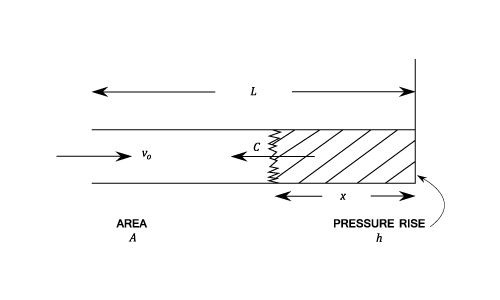
The pressure rise at the valve where
is the density and
the velocity of Sound for the fluid (Water)
Let the initial pipe velocity be
At the instant that the valve is closed a pressure wave, moving at the speed of sound sets off up the pipe bringing the water to rest.
Consider the instant shown above, secs after valve closure. At this moment the length of the column brought to rest is
.
By Newton'\b{s second law}, the pressure force equals the change of momentum per second.
i.e.
Pressure rise at valve where
Notes:
- The pressure at the valve remains at
above normal from the instant the valve is closed until the pressure wave is reflected from the open end of the pipe as a wave of normal pressure and velocity
reaching the valve at time
.
- A wave of reduced pressure,
- The time
- The above proof still applies if the valve is closed in a time of closure
i.e. the valve is closed before the pressure wave returns to the valve.
Pressure rise for Instantaneous Partial Reduction of Flow.
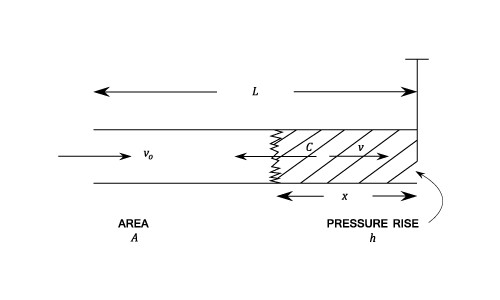
The Pressure rise Where
is the change of velocity.
The increase in Pressure head
The initial velocity is reduced to
by the sudden partial valve closure.
seconds later the pressure wave will have traveled a distance
up the pipe as before
Applying Newton'\b{s second Law}:
Pressure
Which is commonly written as:
Pressure rise Where
is the change of velocity.
And:
The increase in Pressure head
Instantaneous Partial Closure of Valve
If the reduction in area of the valve is known rather than the reduction of flow or pipe velocity,then the pipe may be treated as a nozzle with a coefficient of discharge of
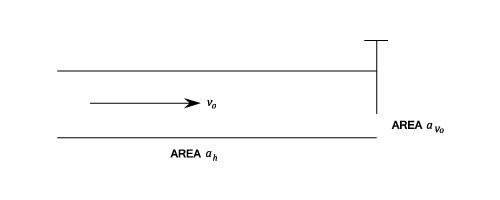
From the Initial Conditions and from the change in Valve Area:
The change of pressure head
The initial flow through the valve

After partial closure:
Thus:
But:
But:
For known initial conditions and change in the valve area this equation can be solved as a quadratic in
Hence:
The relationship between pressure rise, speed of sound and bulk modulus allowing for lateral expansion of the the pipe
Bulk modulus = Increase of Pressure/Volumetric strain
- Assume a thin cylinder constrained longitudinally and subject to an internal
pressure rise causing lateral expansion from diameter
And the equivalent Bulk Modulus allowing for Pipe Expansion is given by :
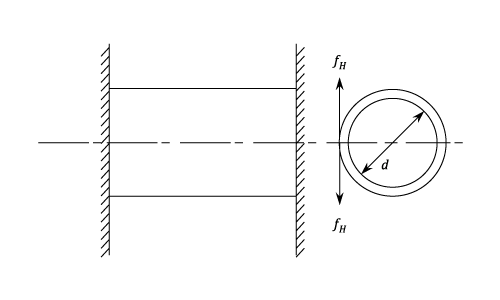
Hoop stress/Hoop strain = Young's Modulus
Hoop strain
also:
or: where
is the thickness of the pipe wall
Consider the situation in the pipe at a time sec.after an instantaneous valve closure. The pressure wave will have reached a point
at a distance
from the valve where
The water in the length
is now at rest and at a pressure
above normal.
During time after closure of the valve a volume
has passed point
and this volume must be accommodated in addition to the initial volume
. This is possible due to the compression of the water and the expansion of the pipe.
Assuming that and substituting from equation 29
Then:
Combining the above equation with
From the above two equations we can :
Eliminate by putting
And the increase in pressure head or:
To eliminate :
By ignoring Pipe Expansion Equations (35 ) (38 ) (41) and (46 ) can be simplified so that:
And The head rise
And:
Thus the equivalent bulk modulus allowing for pipe expansion is given by:
Pipe with change of section
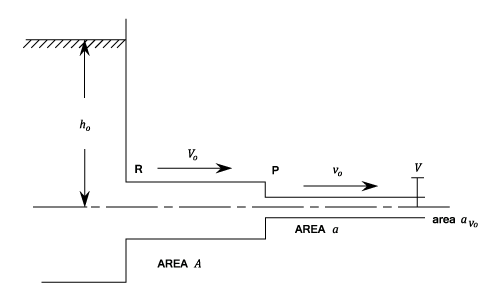
At the initial steady flow conditions it is assumed that friction; velocity head and contraction losses can be neglected. Therefore the pressure throughout both pipes is .
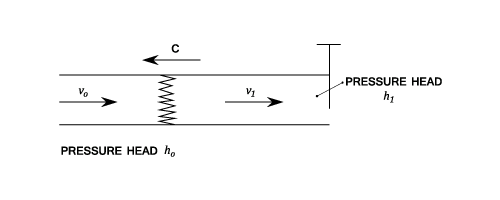
The above diagram shows some instant when the pressure wave is between &
from equation (46)
Flow through valve
and from equation (16)
also:
Equations (54) (55) and (56) can be solved for and hence
and
and hence
.
Now consider an instant in time after the pressure wave has passed through the junction and a reflected wave has set off up the pipe from to
.

By continuity:
Using equation ( 16 ) for the pressure wave in the large pipe:
Similarly for the pressure wave in the small pipe:
Note: is the velocity of sound in the small pipe.
Adding equations ( 59 ) and(60 )
Equate to equation ( 56 )
substitute from ( ) and ( ) for V_0 & V_1
Using the value for found from equations ( 14 ) ( 27 ) and( ) this equation can be solved for
and hence
and
.
Notes:
- If the velocity of sound is the same for both pipes then
- Putting
= infinity i.e.the pipe entering the reservoir
Where is the initial reduction of the pipe velocity due to a partial closure of the valve. i.e. When the pressure wave reaches the reservoir entrance the velocity is reduce still further by an amount equal to the initial velocity reduction at the valve.
The solution to the first worked example has been hidden. It can be seen by clicking on the red button. The solution to the other examples can only be seen by Members of Codecogs. Membership is free and registering is quick and easy.
Example 1 [imperial]
A pipe carrying water has a valve at the discharge end. The bulk modulus,, is
- a) If the initial velocity in a pipeline is
show that an instantaneous closure of the valve will result in a pressure rise at the valve of
- b) Given that the initial velocity is 12 ft/sec. and the pressure head in the pipe is 600 ft, find the increase in pressure head which results when the valve is instantaneously closed by 1/5 th.
a) Using equation (39)
b) When the valve is fully open using equation (42)
And when the valve is closed by 1/5 th
Combining the above two equations and putting
Thus:
Solving the quadratic in
The increase in the pressure head
The increase in the pressure head is
Example 2 [imperial]
Show that the pressure rise in a pipe-line caused by the sudden displacement of a valve is given by where
is the decrease in velocity of the water,
and
is the velocity of sound transmission in the pipe concerned.
A valve at the outlet end of a pipe-line 4000 ft. long through which water flows at is closed in 5 seconds in such a way that the pressure on the upstream side of the valve increases at a uniform rate.
Assuming at find the increase of pressure caused by the valve closure.
Consider a pound of water at a pressure which is moving with a velocity
. If
is the bulk modulus then:
The kinetic energy And the Strain Energy
If the velocity of the water changes by
and there is a corresponding increase in pressure of
the, neglecting pipe elasticity, the change in Kinetic Energy must equal the change in Strain Energy.
i.e.
But the rate of change of Kinetic Energy = the rate of change of Strain Energy
Combing the above two equations:
From Equation (40)
If the valve is closed gradually the water has a time to decelerate and hence:
But is constant
Where:
From equations (77) and (78)
Integrating:
Integrating again:
When ,
And when
,
Substituting into equation (81)
And:
From equations (76) (79) and (84)
But
When
The increase of pressure is