
Bernoullis Theorem
Daniel Bernoulli (1700 - 1782) investigated not only mathematics but also such fields as medicine, biology, physiology, mechanics, physics, astronomy, and oceanography.
Bernoulli'\b{s theorem}, which he derived, is named after him.
The background to Bernoulli's Theorem
You're viewing an older version of this page (#3718). View the current version.
Theorem
Bernoulli's theorem implies, that if the fluid flows horizontally so that no change in gravitational potential energy occurs, then a decrease in fluid pressure is associated with an increase in fluid velocity.
If the fluid is flowing through a horizontal pipe of varying cross-sectional area, for example, the fluid speeds up in constricted areas so that the pressure the fluid exerts is least where the cross section is smallest. This phenomenon is sometimes called the Venturi effect, after the Italian scientist G.B. Venturi (1746 - 1822), who first noted the effects of constricted channels on fluid flow.
Consider the motion of a fluid down a steam tube
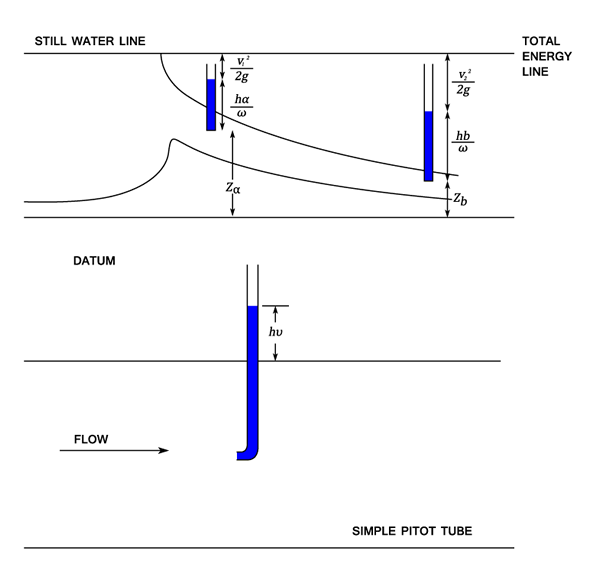
Consider the motion of an isolated volume ,
,
,
. After a time
it is position
',
',
',
',and since the volume
',
',
,
is to both. The net change is equivalent to moving the mass of fluid from
,
,
',
', to
,
,
',
'.
The work done by the pressure on in time
All the work is expended in:
- a) Doing work against the pressure at
i.e.
- b) Raising the weight of
,
,
,
,
- c) Increasing the kinetic energy of
i.e.
Equating (#1) to the work expended:
The equation can be expressed in three ways:
Notice
For more on Bernoulli Equation and for worked examples, please see our new section on http://www.codecogs.com/reference/engineering/fluid_mechanics/pipes/the_flow_through_pipes.php"The Flow through Pipes" . The new page also gives the Darcy equation for the frictional loss in pipes as well as the Chezy formula and Poiseuille Equation for laminar Flow.